 AyurVeDish®
About us
Why AyurVeDish ExistsAyurveda at Our HeartOur Free-From PromiseWhole Food, Plant-Based LivingWhy Grain FreeWhy Oil FreeWhy Dairy FreeWhy Yeast FreeWhy Cane Sugar FreeWhy Soy FreeWhy Thoughtful IngredientsFresh and SeasonalHerbs and SpicesFood from Around the WorldGood Food for EveryoneA Recipe Should Inspire YouEat to LiveSalt, Spice and BalanceAyurveda
Ayurveda Made SimpleThe Five ElementsThe Three DoshasVataPittaKaphaPrakritiYour Dosha CombinationEating for Your ConstitutionChoosing Foods ThoughtfullyThe Six TastesSix Tastes on One PlateFood QualitiesAgni (Fire)Herbs and Spices in the Ayurvedic KitchenEating With the SeasonsAyurveda and the Body ClockFasting: The Ancient PauseBuilding a Plant-Based Ayurvedic MealAyurveda and Modern NutritionFood Combinations and Meal PlanningShop
Speciality All-in-One BlendsGrain Free Rice-Style BlendsSnack & Savoury PremixesGrain Free FloursBakes & DessertsChutneys, Dips & PicklesTadkas & Finishing SpicesDetox & Ayurvedic TeasHot & Cold Drinks





The Six Tastes
The Six Tastes: Shad Rasa, the Language of Flavour
Ask a cook what taste is, and they will probably say “sweet, salty, sour.” Ayurveda goes further. In this tradition, taste is more than flavour. It is a way of understanding food, and a way of enjoying it more fully.
Ayurveda names six tastes, known as Shad Rasa. Each is associated with its own qualities and with the five elements you met earlier. Together they give every cook a simple map for making meals that feel complete.
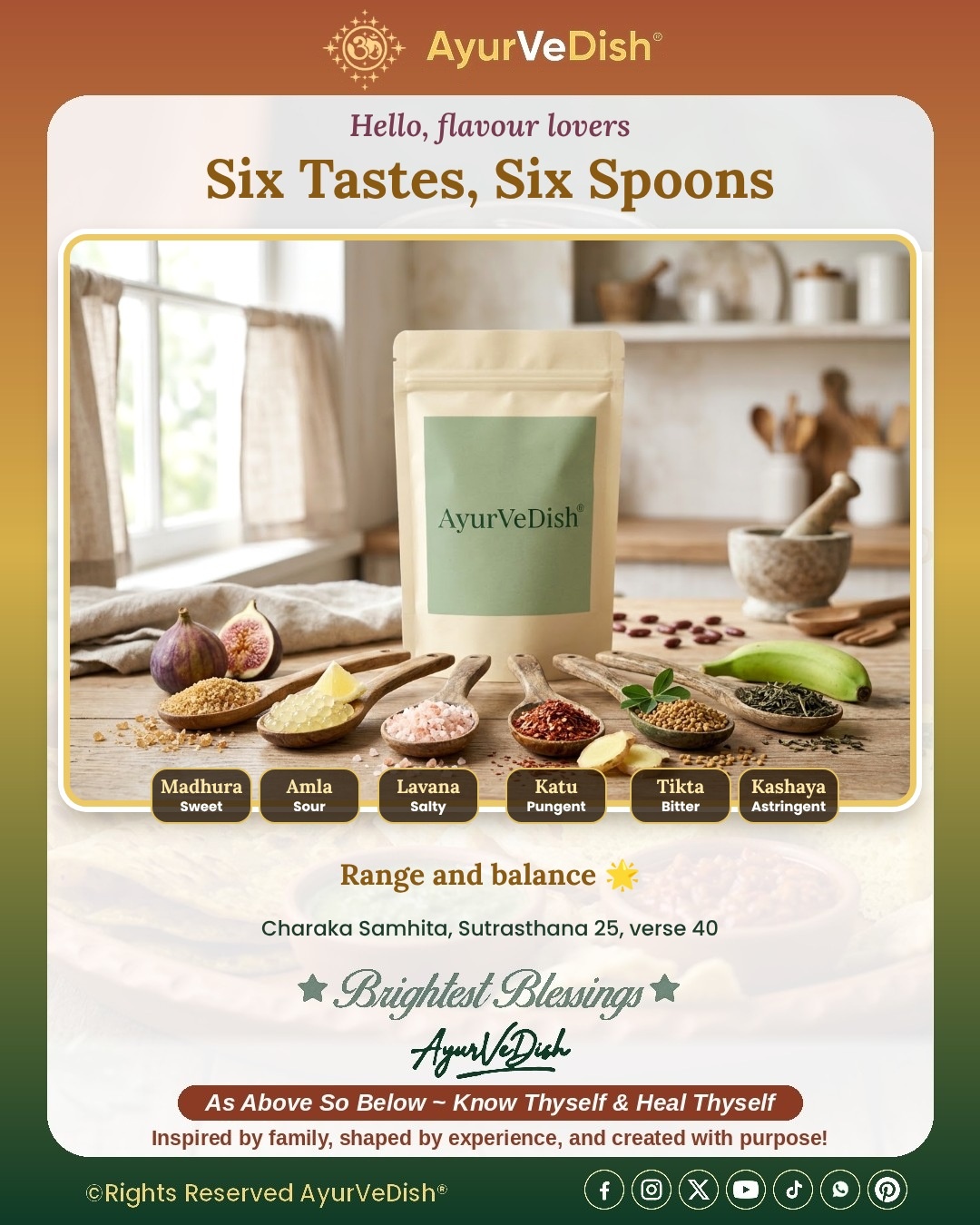
The Six Traditional Tastes
Madhura, sweet. Found in ripe fruit, sweet potatoes and naturally sweet vegetables.
Amla, sour. Found in lemons, limes, tomatoes and other naturally tart foods.
Lavana, salty. Salt and the savoury depth it brings. Best enjoyed in moderation.
Katu, pungent. Found in ginger, black pepper, chilli, mustard and other warming spices.
Tikta, bitter. Found in bitter greens, fenugreek and certain herbs.
Kashaya, astringent. A drying or puckering feel, as with some legumes, green bananas and certain teas.
What the Ancient Texts Say
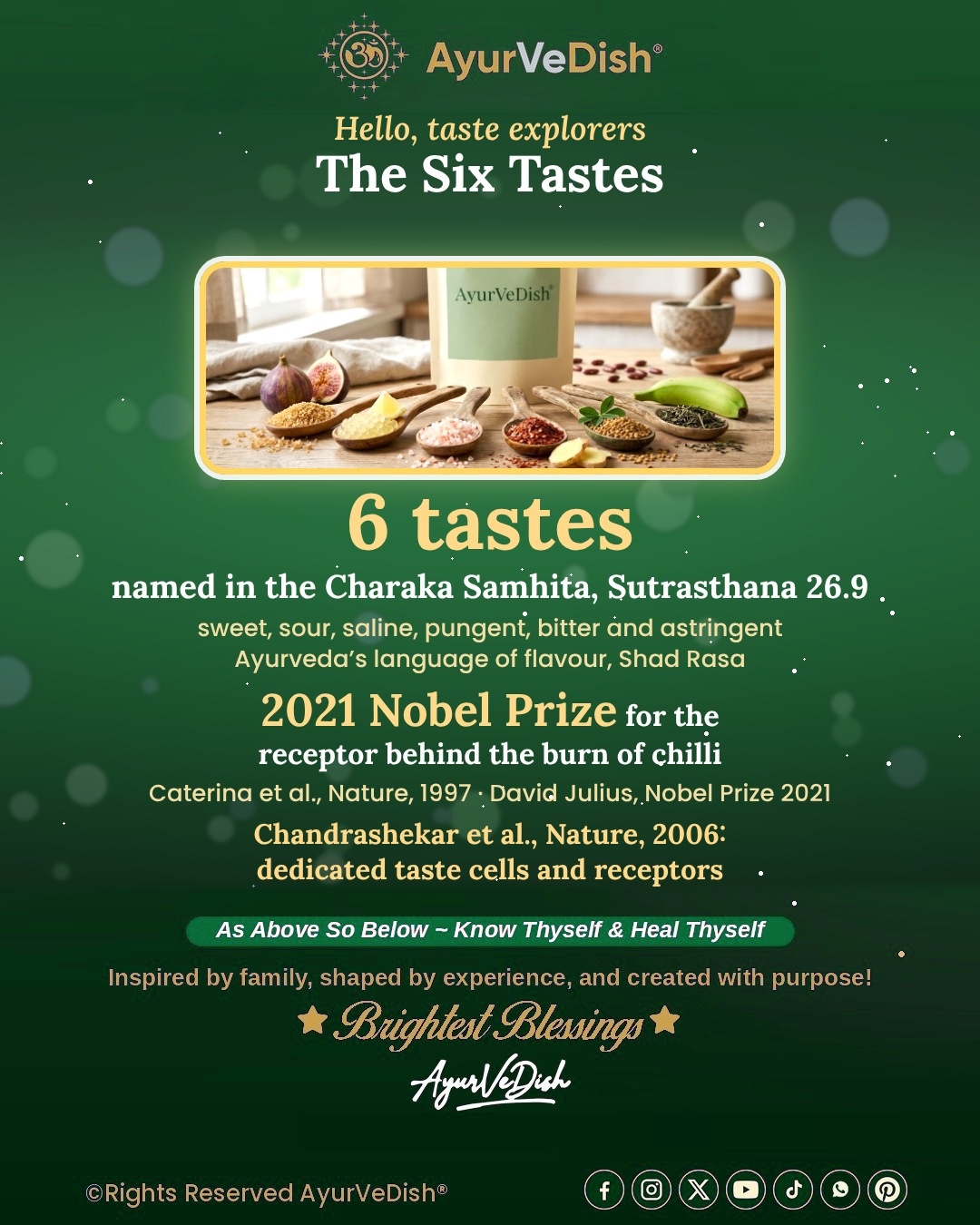
The Charaka Samhita states that there are only six tastes and names each one: sweet, sour, saline, pungent, bitter and astringent (Sutrasthana 26.9). It then makes a remarkable point about variety: regular use of all the tastes gives strength, while living on one taste alone leads to weakness (Sutrasthana 25.40). It adds that the six tastes, used in proper quantity, are beneficial for all human beings (Sutrasthana 26.44).
The ancients did not recommend any one flavour. They recommended range, and balance.
What Researchers Have Found
Modern science agrees that taste is a finely organised sense.
Dedicated detectors (Chandrashekar et al., Nature, 2006): this review describes how the mouth has distinct cell types, each with its own receptors, tuned to detect sweet, sour, bitter, salty and umami.
The secret of chilli (Caterina et al., Nature, 1997): the burn of chilli is not picked up by a taste receptor. Caterina and colleagues identified the capsaicin receptor, a heat-activated channel on pain-sensing nerves. This work led David Julius to share the 2021 Nobel Prize in Physiology or Medicine.
So where Ayurveda names pungent and astringent as tastes in their own right, science describes the burn of chilli as a sensation. It is a difference in how the experience is described, not a contradiction, and a food’s taste alone does not tell you its nutritional value.
Do You Need All Six at Every Meal?
No. Ayurveda encourages awareness of all six tastes, but a meal can combine several naturally, and over a day or a week they tend to turn up on their own.
Our dal and curry blends bring together many of these tastes in one pouch, and one 100g pouch makes about 25 portions at Mild (4g), 14 at Medium (7g) or 10 at Extra Hot (10g), per 200g of vegetables. Our three optional tadka blends, Plain Gujarati Vaghar, Punjabi Masala and South Indian, give you three different ways to start a pot, and our chutneys add a little more of the taste you enjoy.
Discover the six tastes, experiment with ingredients and let flavour make your meals more interesting.
Let Food Be Thy Medicine Before Medicine Becomes Thy Food.
As Above, So Below, Know Thyself and Heal Thyself.
Inspired by family, shaped by experience, and created with purpose!
Brightest Blessings

This page is for information only. For medical advice, please speak to a qualified professional.
Evidence and Sources
- Charaka Samhita, Sutrasthana 26, verses 9 and 44 (Atreyabhadrakapyiya Adhyaya): www.carakasamhitaonline.com/index.php/Atreyabhadrakapyiya_Adhyaya
- Charaka Samhita, Sutrasthana 25, verse 40 (Yajjah Purushiya Adhyaya): www.carakasamhitaonline.com/index.php/Yajjah_Purushiya_Adhyaya
- Chandrashekar J et al., The receptors and cells for mammalian taste. Nature 2006;444(7117):288-294: pubmed.ncbi.nlm.nih.gov/17108952/
- Caterina MJ et al., The capsaicin receptor: a heat-activated ion channel in the pain pathway. Nature 1997;389(6653):816-824: pubmed.ncbi.nlm.nih.gov/9349813/
- The Nobel Prize in Physiology or Medicine 2021, press release: www.nobelprize.org/prizes/medicine/2021/press-release/