 AyurVeDish®
About us
Why AyurVeDish ExistsAyurveda at Our HeartOur Free-From PromiseWhole Food, Plant-Based LivingWhy Grain FreeWhy Oil FreeWhy Dairy FreeWhy Yeast FreeWhy Cane Sugar FreeWhy Soy FreeWhy Thoughtful IngredientsFresh and SeasonalHerbs and SpicesFood from Around the WorldGood Food for EveryoneA Recipe Should Inspire YouEat to LiveSalt, Spice and BalanceAyurveda
Ayurveda Made SimpleThe Five ElementsThe Three DoshasVataPittaKaphaPrakritiYour Dosha CombinationEating for Your ConstitutionChoosing Foods ThoughtfullyThe Six TastesSix Tastes on One PlateFood QualitiesAgni (Fire)Herbs and Spices in the Ayurvedic KitchenEating With the SeasonsAyurveda and the Body ClockFasting: The Ancient PauseBuilding a Plant-Based Ayurvedic MealAyurveda and Modern NutritionFood Combinations and Meal PlanningShop
Speciality All-in-One BlendsGrain Free Rice-Style BlendsSnack & Savoury PremixesGrain Free FloursBakes & DessertsChutneys, Dips & PicklesTadkas & Finishing SpicesDetox & Ayurvedic TeasHot & Cold Drinks





Fresh and Seasonal
Eating With Nature’s Calendar
Namaste, and welcome.
Nature has its own rhythm. As the seasons turn, so do the fruits, vegetables and herbs that fill our markets, gardens and kitchens. At AyurVeDish, we celebrate that variety and the inspiration it brings to everyday cooking.
A Rainbow on the Plate
Spring brings tender greens and fresh herbs. Summer brings berries, tomatoes and courgettes, autumn brings pumpkins, apples and earthy roots, and winter brings hearty greens, pulses and warming soups. Each colour reflects different plant compounds, so a varied plate draws on more of them than a narrow selection ever could.
What the Ancient Texts Say
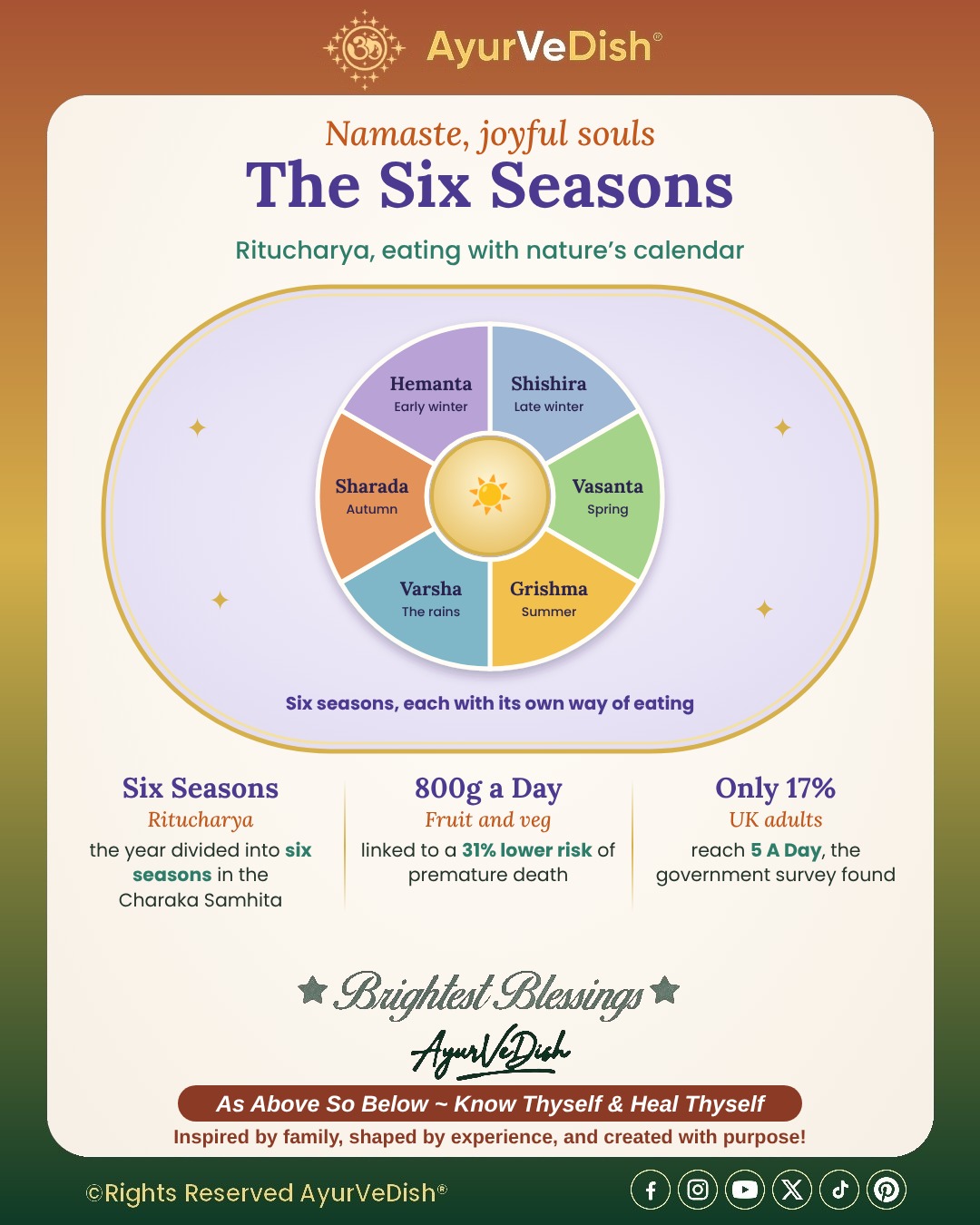
Our ancestors watched the seasons closely. The Charaka Samhita divides the year into six seasons: late winter (shishira), spring (vasanta), summer (grishma), the rains (varsha), autumn (sharada) and early winter (hemanta). It teaches that the body changes with the weather, and that food and daily routine should change with it. This is ritucharya, seasonal living, one of Ayurveda’s oldest ideas. A warming soup on a cold evening and a cool, colourful salad on a hot day are choices we make instinctively, and the old texts put that instinct into words.
Where We Part Ways With Traditional Ayurveda
For the cold months, the Charaka Samhita recommends meat, milk products, cane sugar products, fats and oils, and new rice (Sutra Sthana 6.11 to 13). We honour the principle of eating for the season, but we follow it with plants: warming spices, pulses, roots and seeds, with no meat, no dairy, no cane sugar, no oil and no grains.
Think about when these words were written, around 2,000 years ago. There were no fridges, no freezers and no shops full of fresh food all year round. Harvests could fail, winters were hard, and people lived on whatever the land and their animals could give them. In the cold months fresh food could be scarce, so meat, milk, ghee and stored rice kept people going until spring, and we believe that is why the texts recommended them. Today we can eat warming, seasonal plant food all winter long.
Think about when these words were written, around 2,000 years ago. There were no fridges, no freezers and no shops full of fresh food all year round. Harvests could fail, winters were hard, and people lived on whatever the land and their animals could give them. In the cold months fresh food could be scarce, so meat, milk, ghee and stored rice kept people going until spring, and we believe that is why the texts recommended them. Today we can eat warming, seasonal plant food all winter long.
We love the planet we live on and every creature we share it with. We believe in the bigger order, in which every life matters, and we give 10% of our profit to Act Anukampa Jeevdaya Parivar in Ahmedabad, which cares for animals in shelters and hospitals and serves hot, fresh, sattvic meals to children in the slums.
What Researchers Have Found
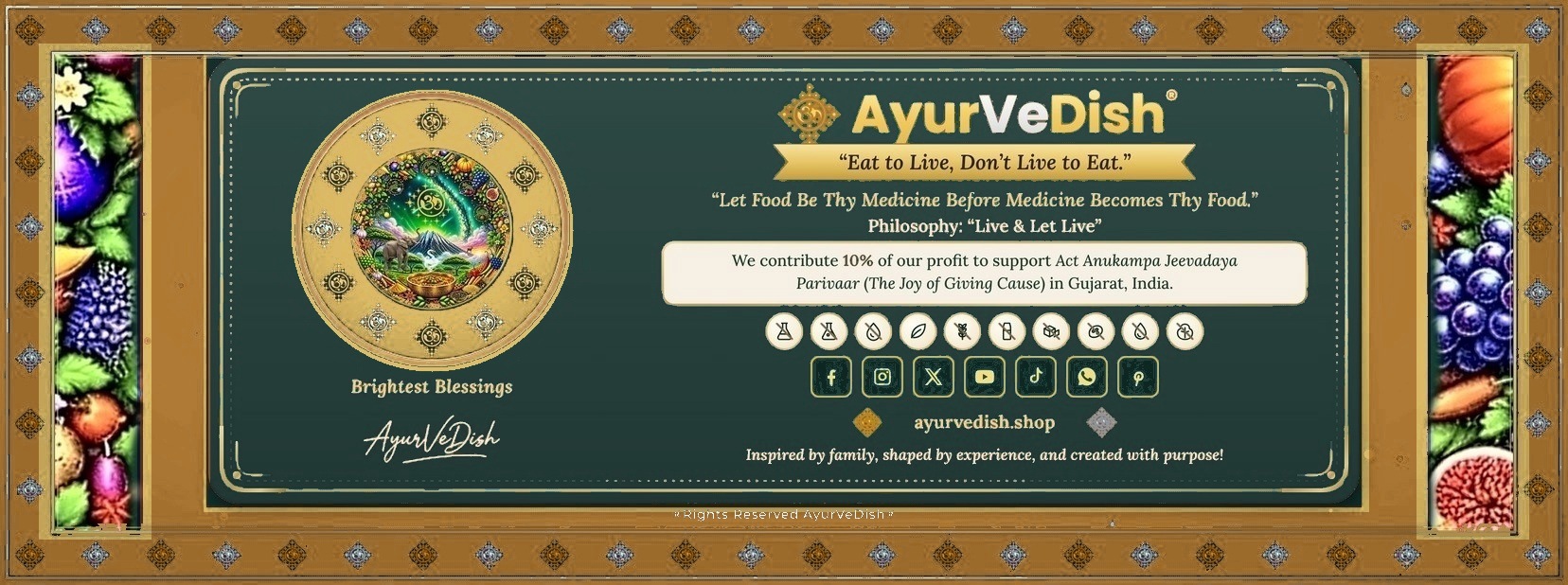
Ten a day. In 2017, Dr Dagfinn Aune and colleagues at Imperial College London pooled 95 studies covering up to 2 million people. Eating about 200g of fruit and vegetables a day was linked to a 16 per cent lower risk of heart disease, an 18 per cent lower risk of stroke and a 15 per cent lower risk of premature death, compared with eating none. At about 800g a day, the figures rose to 24, 33 and 31 per cent. The researchers estimated that around 7.8 million premature deaths worldwide could be prevented each year if people ate 800g a day.
Falling short. The NHS advises at least five 80g portions, 400g, a day, yet the government’s National Diet and Nutrition Survey for 2019 to 2023 found that only 17 per cent of adults, and just 9 per cent of children aged 11 to 18, met it.
Stored, Flown or Frozen
Picked ripe, eaten fresh. Freshness matters more than most of us realise. Vitamin C begins to break down the moment a vegetable is picked. In a review from the University of California, Davis, green peas lost about half their vitamin C within the first day or two after picking, and spinach kept at room temperature lost all of it in less than four days. Even in the fridge, spinach lost three quarters of its vitamin C within three weeks.
Frozen beats tired. The same review found that fresh peas and spinach kept in the fridge fell below the vitamin C levels of their frozen counterparts after ten days. Fresh from the field is best, but frozen vegetables are a far better choice than tired ones that have sat for days.
The hidden cost of flying. Some out-of-season produce, such as asparagus, green beans and berries, is flown in. According to Our World in Data, air freight emits around 50 times as much greenhouse gas as shipping by sea, for every tonne carried the same distance. A kilogram of asparagus flown from Lima to London carries almost 12kg of carbon dioxide equivalent.
These are findings from studies, and results differ from person to person.
Making the Most of Nature’s Abundance
Seasonal cooking need not be complicated or expensive. Roast, steam or simmer vegetables, combine them with beans and lentils, and let herbs and spices give familiar produce a new character. Our curry and dal blends make it easy: one 100g pouch makes about 25 portions at Mild (4g), 14 at Medium (7g) or 10 at Extra Hot (10g), each for 200g of vegetables. Our finishing spices, chutneys and herbal teas bring the flavours of each season to the table.
Food connects us to the land, the seasons, the people who grow it and the living world we share. Follow the seasons. Celebrate variety. Enjoy the natural goodness of plant foods.
Let Food Be Thy Medicine Before Medicine Becomes Thy Food.
As Above, So Below, Know Thyself and Heal Thyself.
Inspired by family, shaped by experience, and created with purpose!
Brightest Blessings

This page is for information only. For medical advice, please speak to a qualified professional.
Evidence and Sources
- Charaka Samhita, Sutra Sthana 6, Tasyashiteeya Adhyaya (the six seasons and the regimen for early winter, verses 11 to 13). carakasamhitaonline.com/index.php/Tasyashiteeya_Adhyaya
- Rickman JC, Barrett DM, Bruhn CM. Nutritional comparison of fresh, frozen and canned fruits and vegetables. Part 1. Vitamins C and B and phenolic compounds. Journal of the Science of Food and Agriculture 2007;87:930-944. ucanr.edu/sites/default/files/2010-06/19187.pdf
- Aune D et al. Fruit and vegetable intake and the risk of cardiovascular disease, total cancer and all-cause mortality: a systematic review and dose-response meta-analysis of prospective studies. International Journal of Epidemiology 2017;46(3):1029-1056. doi.org/10.1093/ije/dyw319
- Imperial College London. Eating more fruits and vegetables may prevent millions of premature deaths. 2017. imperial.ac.uk/news/177778/eating-more-fruits-vegetables-prevent-millions
- Office for Health Improvement and Disparities. National Diet and Nutrition Survey 2019 to 2023 report. gov.uk/government/statistics/national-diet-and-nutrition-survey-2019-to-2023/national-diet-and-nutrition-survey-2019-to-2023-report
- Ritchie H. Very little of global food is transported by air. Our World in Data, 2020. ourworldindata.org/food-transport-by-mode
- NHS. 5 A Day: what counts? nhs.uk/live-well/eat-well/5-a-day/5-a-day-what-counts