 AyurVeDish®
About us
Why AyurVeDish ExistsAyurveda at Our HeartOur Free-From PromiseWhole Food, Plant-Based LivingWhy Grain FreeWhy Oil FreeWhy Dairy FreeWhy Yeast FreeWhy Cane Sugar FreeWhy Soy FreeWhy Thoughtful IngredientsFresh and SeasonalHerbs and SpicesFood from Around the WorldGood Food for EveryoneA Recipe Should Inspire YouEat to LiveSalt, Spice and BalanceAyurveda
Ayurveda Made SimpleThe Five ElementsThe Three DoshasVataPittaKaphaPrakritiYour Dosha CombinationEating for Your ConstitutionChoosing Foods ThoughtfullyThe Six TastesSix Tastes on One PlateFood QualitiesAgni (Fire)Herbs and Spices in the Ayurvedic KitchenEating With the SeasonsAyurveda and the Body ClockFasting: The Ancient PauseBuilding a Plant-Based Ayurvedic MealAyurveda and Modern NutritionFood Combinations and Meal PlanningShop
Speciality All-in-One BlendsGrain Free Rice-Style BlendsSnack & Savoury PremixesGrain Free FloursBakes & DessertsChutneys, Dips & PicklesTadkas & Finishing SpicesDetox & Ayurvedic TeasHot & Cold Drinks





Why Yeast Free
Alive, Hungry and Built to Multiply
Namaste, and welcome.
Some choices begin on a shelf and some begin in a life. This one began in mine. At AyurVeDish, we never use active or baker’s yeast in anything we make, and our flours and premixes are created so that they never need it.
Yeast Is Alive
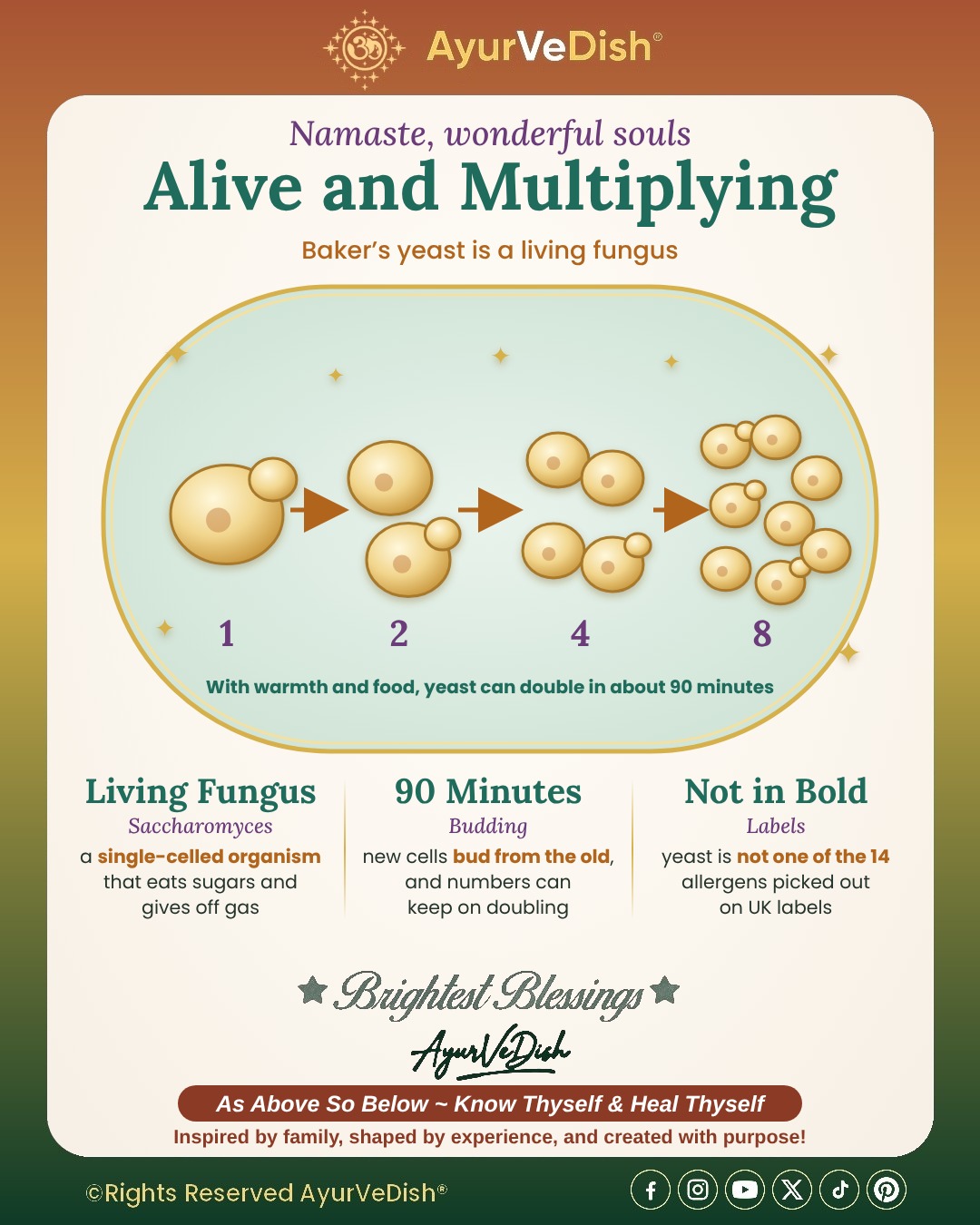
Baker’s yeast is Saccharomyces cerevisiae, a living, single-celled fungus. It is not simply a powder in a sachet. It is an organism, and it behaves like one.
It eats. Each yeast cell feeds on sugars and starches and gives off carbon dioxide gas and alcohol in return. That is fermentation, and the gas it releases is what puffs dough up.
It multiplies. Yeast reproduces by budding: a new cell swells out from the side of its parent, pinches off and begins budding in turn. Given warmth and food in the laboratory, a population of yeast can double in about 90 minutes. That is why a single sachet is enough to raise a whole loaf.
Yeast needs only warmth, moisture and food to keep going, and it is hardy enough to survive the journey through our gut.
My Own Story
For many years I battled with my weight, and I went to my doctor again and again. I was tested for coeliac disease, and I had blood test after blood test. Every result came back normal. So I carried on eating wheat.
What I did not realise was that most wheat products, from bread and rolls to pizza bases and buns, are made with yeast. It was never gluten. All along, it was the yeast I was intolerant to.
In my experience, it takes my body about six weeks to clear yeast once I have eaten it. Because my body was not clearing it, I believe everything I ate was feeding the yeast within me, and I grew larger and larger without understanding why.
I share this because people need to know. If your tests keep coming back normal and you still do not feel right, yeast is worth asking about.
What the Ancient Texts Say
Leaven, or yeast, runs through some of the oldest teachings we have. In the Book of Exodus, the command is to eat unleavened bread for seven days and to put the leaven out of the house: “whosoever eateth leavened bread from the first day until the seventh day, that soul shall be cut off from Israel” (Exodus 12:15). In Leviticus, no grain offering brought to the Lord “shall be made with leaven” (Leviticus 2:11).
The apostle Paul described exactly what yeast does: “A little leaven leaveneth the whole lump” (Galatians 5:9). A pinch of something living spreads through everything it touches.
Jesus returned to it more than once: “Take heed and beware of the leaven of the Pharisees and of the Sadducees” (Matthew 16:6), and “Beware ye of the leaven of the Pharisees, which is hypocrisy” (Luke 12:1). Paul urged people to keep the feast “with the unleavened bread of sincerity and truth” (1 Corinthians 5:8).
The ancients often spoke in symbols. Leaven is one they came back to again and again: something small, living and quietly spreading. We believe their message about it was also, in part, a message about the body.
The Unleavened Tradition
Cooking without yeast is nothing new. In India, everyday breads such as chapati, bhakri and thepla have long been made without any raising agent, and unleavened bread is still eaten at Passover. Our ancestors knew how to make good food without yeast.
What Researchers Have Found
It survives the journey. Dr Thomas Auchtung and colleagues at Baylor College of Medicine found that Saccharomyces, the yeast in beer, bread and processed foods, can survive the passage through the gut and is one of the fungi most commonly detected in human stool.
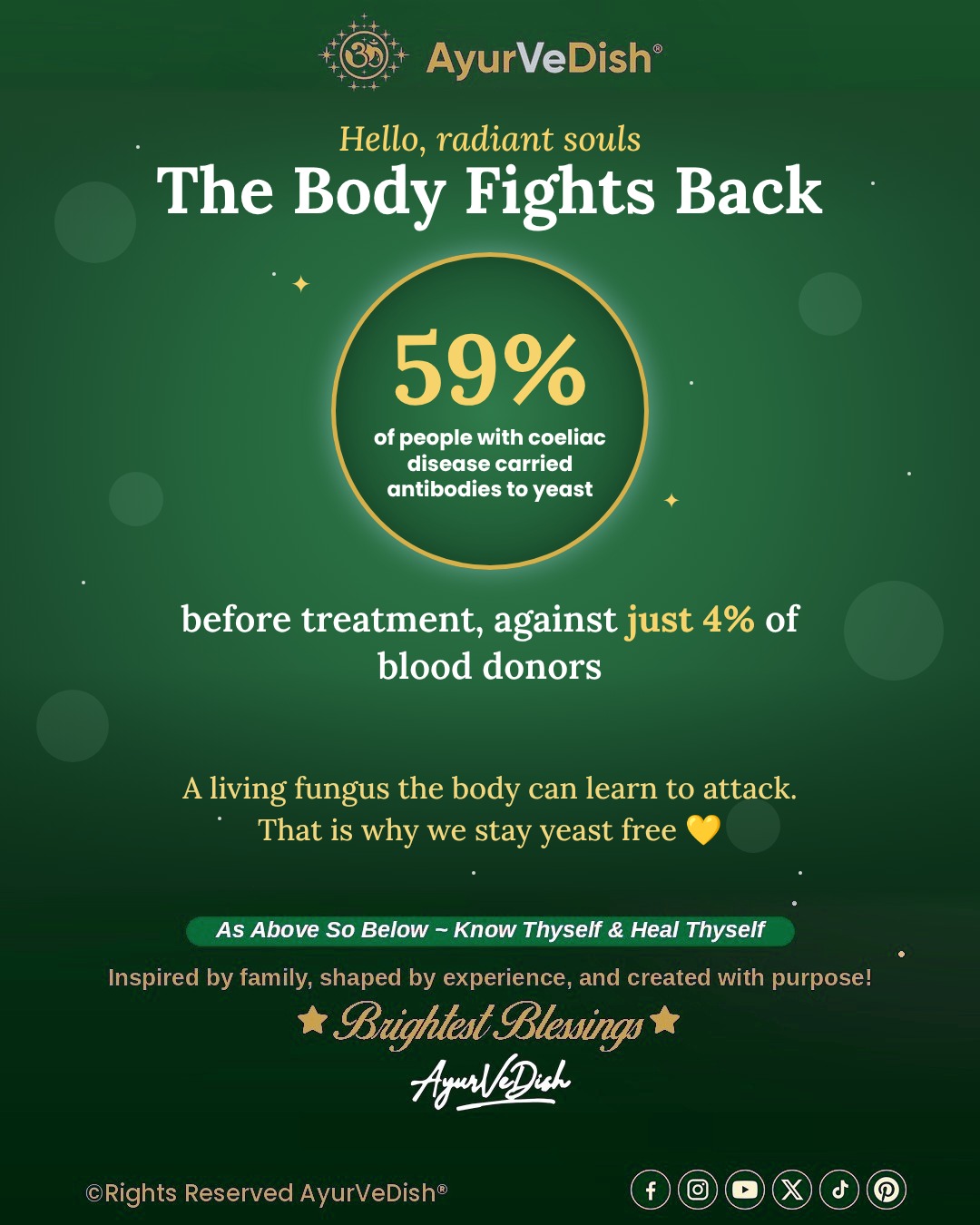
The body fights back. As far back as 1988, researchers reported in the BMJ that people with Crohn’s disease carry antibodies against baker’s yeast. These anti-Saccharomyces cerevisiae antibodies, known as ASCA, are now a recognised marker of the disease. In a study of 105 people with coeliac disease, Dr Alessandro Granito and colleagues in Bologna found ASCA in 59 per cent of them before treatment, against just 4 per cent of blood donors.
Years before diagnosis. In stored blood samples from Israeli soldiers, Dr Eran Israeli and colleagues found yeast antibodies in 10 of 32 people who later developed Crohn’s disease, on average more than three years before they were diagnosed, and in none of 95 people who stayed well.
Yeast, Flare-Ups and Hidden Yeast
Yeast and flare-ups. In a small trial of 19 people with stable Crohn’s disease, disease activity scores were significantly higher while they took baker’s yeast than while they avoided it, and 13 of the 15 with raised yeast antibodies tended to score higher on yeast.
Yeasts and bacteria working together. In 2016, Professor Mahmoud Ghannoum and colleagues found the yeast Candida tropicalis at significantly higher levels in people with Crohn’s disease than in their healthy relatives. It joined with two bacteria to build a biofilm that could trigger inflammation, and its levels rose with the yeast antibody ASCA.
These studies are on people with gut disease, but they show how strongly the body can react to yeast.
Where Yeast Hides
Yeast is not one of the 14 major allergens in UK law, so it is not picked out in bold on ingredient labels. Most bread, rolls, pizza bases, naan, buns, doughnuts and crumpets are made with it. Yeast extract turns up in stock cubes, gravies, soups, crisps and savoury spreads, and beer is brewed with it.
Baking does not make it disappear. The heat of the oven kills the living cells, but their cell walls stay in the bread, and ASCA is an antibody made against part of the yeast cell wall.
Nutritional Yeast: A Different Thing
Where a product calls for a savoury, umami or cheesy flavour, we sometimes use nutritional yeast. This is not baker’s yeast. Nutritional yeast is deactivated during production, so it cannot make anything rise or ferment, and it is used purely as a flavouring. Any product that contains nutritional yeast is not labelled yeast free, so please always check the ingredient list.
Bread Without Baker’s Yeast
Our grain free flours and our grain free bread mix are created to work without active or baker’s yeast. You can enjoy soft, sliceable loaves, pizza bases, flatbreads and cakes, and our grain free cupcakes, muffins, banana bread, pancakes and biscuits, all without it. Judge each product by its own ingredient list, and you will see exactly what is in it.
Let Food Be Thy Medicine Before Medicine Becomes Thy Food.
As Above, So Below, Know Thyself and Heal Thyself.
Inspired by family, shaped by experience, and created with purpose!
Brightest Blessings

This page is for information only. For medical advice, please speak to a qualified professional.
Evidence and Sources
- The Bible (King James Version): Exodus 12:15; Leviticus 2:11; Matthew 16:6; Luke 12:1; 1 Corinthians 5:8; Galatians 5:9. kingjamesbibleonline.org
- Sherman F. Getting started with yeast. Methods in Enzymology 2002;350:3-41 (doubling time about 90 minutes in rich medium), via BioNumbers, Harvard Medical School. bionumbers.hms.harvard.edu/bionumber.aspx?id=108255
- Auchtung TA et al. Investigating colonization of the healthy adult gastrointestinal tract by fungi. mSphere 2018;3(2):e00092-18. doi.org/10.1128/mSphere.00092-18
- American Society for Microbiology. Fungi in the healthy human gut. EurekAlert!, 2018. eurekalert.org/news-releases/779047
- Main J, McKenzie H, Yeaman GR, Kerr MA, Robson D, Pennington CR, Parratt D. Antibody to Saccharomyces cerevisiae (bakers’ yeast) in Crohn’s disease. BMJ 1988;297(6656):1105-1106. doi.org/10.1136/bmj.297.6656.1105
- Granito A, Zauli D, Muratori P et al. Anti-Saccharomyces cerevisiae and perinuclear anti-neutrophil antibodies in coeliac disease before and after gluten free diet. Alimentary Pharmacology and Therapeutics 2005;21(7):881-887. doi.org/10.1111/j.1365-2036.2005.02417.x
- Israeli E et al. Anti-Saccharomyces cerevisiae and antineutrophil cytoplasmic antibodies as predictors of inflammatory bowel disease. Gut 2005;54(9):1232-1236. gut.bmj.com/content/54/9/1232
- Barclay GR, McKenzie H, Pennington J, Parratt D, Pennington CR. The effect of dietary yeast on the activity of stable chronic Crohn’s disease. Scandinavian Journal of Gastroenterology 1992;27(3):196-200. doi.org/10.3109/00365529208999948
- Barta Z et al. Seroreactivity against Saccharomyces cerevisiae in patients with Crohn’s disease and celiac disease. World Journal of Gastroenterology 2003;9(10):2308-2312. wjgnet.com/1007-9327/full/v9/i10/2308.htm
- Hoarau G et al. Bacteriome and mycobiome interactions underscore microbial dysbiosis in familial Crohn’s disease. mBio 2016;7(5):e01250-16. doi.org/10.1128/mBio.01250-16
- ScienceDaily. Fungus identified as key factor in Crohn’s disease. 2016. sciencedaily.com/releases/2016/09/160920151435.htm
- Dr Michael Greger, NutritionFacts.org. Does nutritional yeast trigger Crohn’s disease? nutritionfacts.org/video/flashback-friday-does-nutritional-yeast-trigger-crohns-disease
- GOV.UK. Food labelling: allergen labelling (the 14 major allergens). gov.uk/understanding-food-labelling/allergen-labelling
- Federation of Bakers. How bread is made. fob.uk.com/about-the-bread-industry/how-bread-is-made