 AyurVeDish®
About us
Why AyurVeDish ExistsAyurveda at Our HeartOur Free-From PromiseWhole Food, Plant-Based LivingWhy Grain FreeWhy Oil FreeWhy Dairy FreeWhy Yeast FreeWhy Cane Sugar FreeWhy Soy FreeWhy Thoughtful IngredientsFresh and SeasonalHerbs and SpicesFood from Around the WorldGood Food for EveryoneA Recipe Should Inspire YouEat to LiveSalt, Spice and BalanceAyurveda
Ayurveda Made SimpleThe Five ElementsThe Three DoshasVataPittaKaphaPrakritiYour Dosha CombinationEating for Your ConstitutionChoosing Foods ThoughtfullyThe Six TastesSix Tastes on One PlateFood QualitiesAgni (Fire)Herbs and Spices in the Ayurvedic KitchenEating With the SeasonsAyurveda and the Body ClockFasting: The Ancient PauseBuilding a Plant-Based Ayurvedic MealAyurveda and Modern NutritionFood Combinations and Meal PlanningShop
Speciality All-in-One BlendsGrain Free Rice-Style BlendsSnack & Savoury PremixesGrain Free FloursBakes & DessertsChutneys, Dips & PicklesTadkas & Finishing SpicesDetox & Ayurvedic TeasHot & Cold Drinks





Our Free-From Promise
Flavour Without Boundaries
Namaste, and welcome.
Every AyurVeDish choice starts with one idea: food can be full of flavour and still leave out what does the body harm. Our free-from approach is inspired by Ayurvedic principles and whole food, plant-based living. We have done the research, so you can sit back, enjoy your food and know it is good for you.
One Promise, Many Tables
Each thing we leave out, we leave out for a reason.
Grain free. Grain farming has been part of our lives for only a tiny fraction of human history, and white rice averaged 81.8 parts per billion of inorganic arsenic across Consumer Reports and US government testing, against just 5.6 in buckwheat. Our grain free means seeds only, from a vast array of varieties.
Oil free. Extracted oil is pure fat, about 119 calories a tablespoon, and a single olive oil meal has been shown to impair the lining of the arteries three hours later. Every recipe is designed for air frying and oven baking. Oil is entirely optional.
Cane sugar free. The NHS advises adults to have no more than 30g of free sugars a day, roughly seven sugar cubes, and it says most adults and children in the UK eat too much sugar. We sweeten only with date sugar or coconut sugar.
Something for Everyone
Dairy free and egg free. Cow’s milk is made to grow a calf fast, and much of it comes from pregnant cows, carrying their oestrogen and progesterone. Our cupcakes, muffins and desserts are made without dairy or egg.
Yeast free. There is no active, baker’s yeast in anything we make. Yeast hides in most wheat products, and for some people it is the cause that coeliac tests and blood tests never find.
Soy free. Soya is one of the 14 major allergens that UK law requires to be emphasised on food labels, so we keep it out of the whole range.
Nut free. It is there to help people with nut allergies. We also believe seeds are more nutritious and beneficial in their whole form.
Nothing artificial. No artificial colours, flavours or preservatives. The colour on your plate comes from the herbs, spices and vegetables themselves.
Most of these have their own page in our About Us section, where we share the research and the ancient wisdom behind it.
What the Ancient Texts Say
One of the oldest plant-based stories ever written is in the Book of Daniel, chapter 1, verses 12 to 16. Rather than eat from the king’s table, Daniel asked for ten days of pulse to eat and water to drink. At the end of the ten days, he and his companions looked “fairer and fatter in flesh” than all those who ate the king’s meat, and from then on they were given pulse.
Pulse meant food grown from sown seed, much as our grain free range is built on seeds. The lesson has not changed in thousands of years: leave out what the body does not need, and see the difference for yourself.
What Researchers Have Found
Daniel’s story inspired a modern study. In 2010, Dr Richard Bloomer and colleagues at the University of Memphis published the results of a 21-day Daniel Fast in the journal Lipids in Health and Disease. The 43 adults who completed it ate plant foods only, with no animal products, white flour, processed foods, preservatives, additives, sweeteners, flavourings, caffeine or alcohol, and they ate freely.
After 21 days:
- Total cholesterol fell by 19 per cent.
- LDL cholesterol fell by 23 per cent.
- Systolic blood pressure fell from 114.7 to 105.9 mmHg.
- Diastolic blood pressure fell from 72.2 to 67.0 mmHg.
It was a small study with no control group, and their plan still allowed grains and oil, so ours goes further. Even so, the changes came in just three weeks.
Free From Six of the 14 Major Allergens
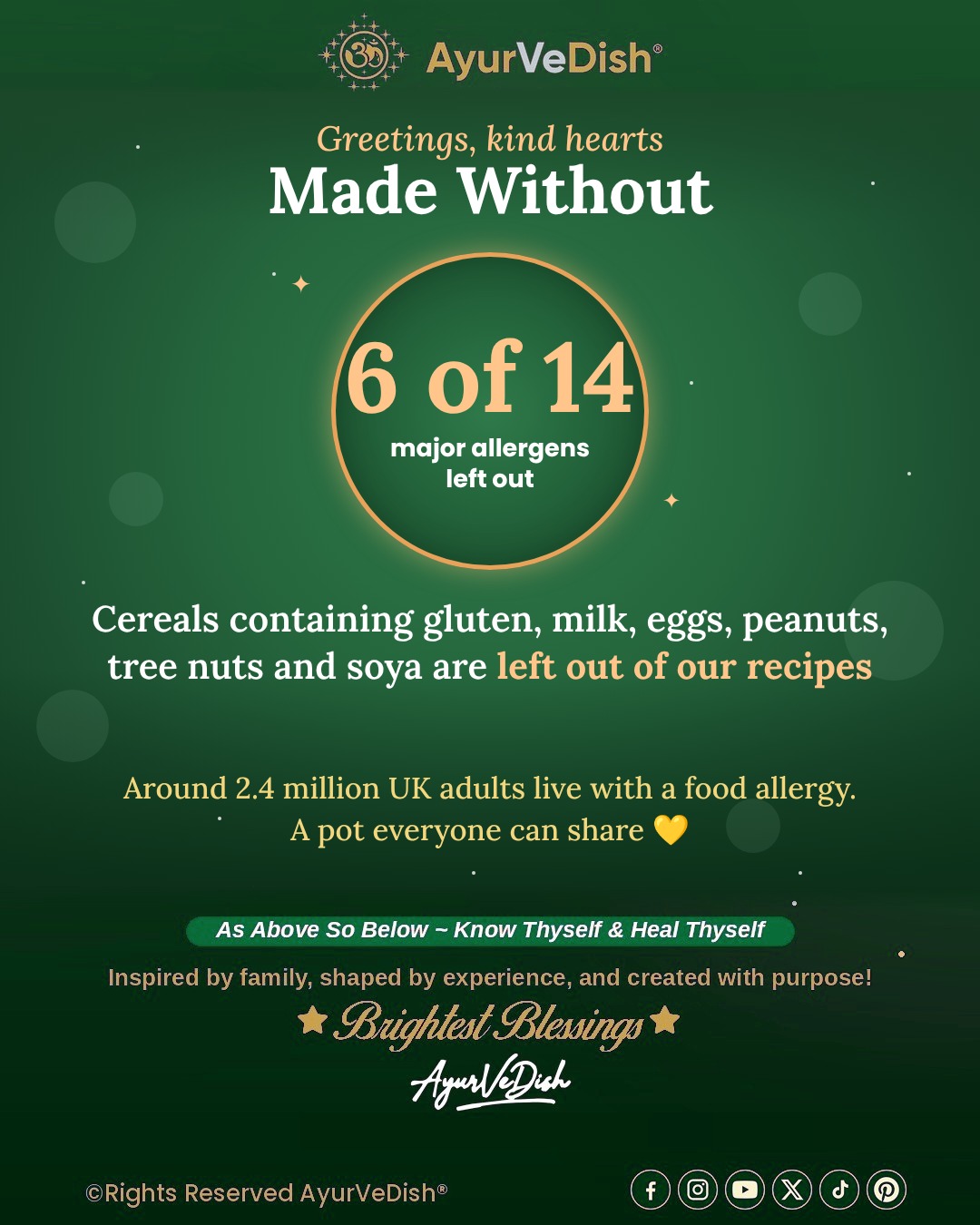
UK law names 14 major allergens that must be emphasised in the ingredients list of prepacked food. Our recipes are made without six of them: cereals containing gluten, milk, eggs, peanuts, tree nuts and soya.
That matters. In 2024 the Food Standards Agency’s Patterns and Prevalence of Adult Food Allergy study estimated that around 6 per cent of UK adults, about 2.4 million people, have a clinically confirmed food allergy, and that peanuts and tree nuts are the foods most likely to cause a reaction.
Colour From Nature, Never a Lab
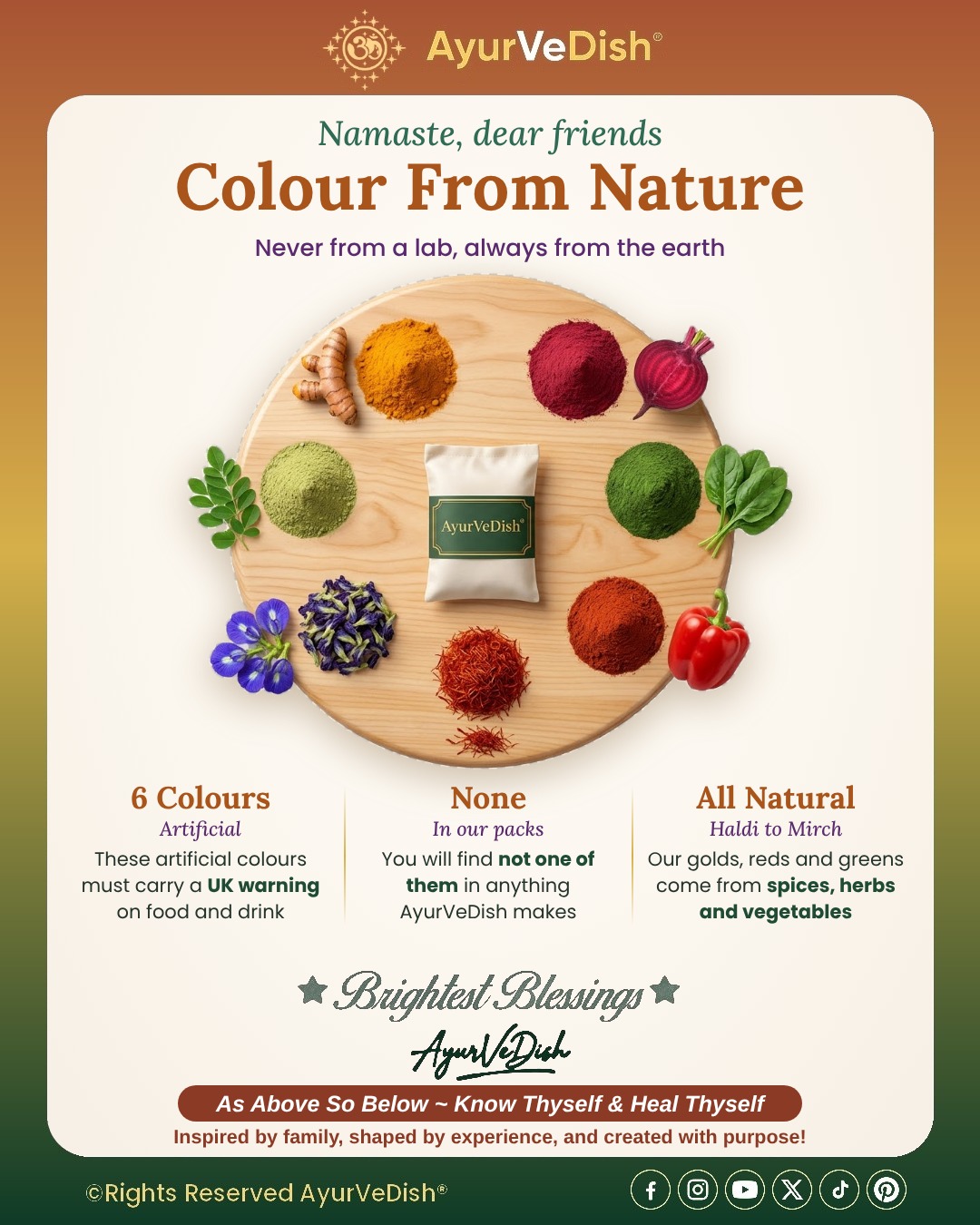
Our nothing artificial promise has science behind it. The Food Standards Agency funded research into food colours and hyperactivity in children, and today food or drink containing tartrazine (E102), quinoline yellow (E104), sunset yellow FCF (E110), carmoisine (E122), ponceau 4R (E124) or allura red (E129) must carry the warning “May have an adverse effect on activity and attention in children.” You will find none of them in AyurVeDish. The golds, reds and greens in our food come from spices, herbs and vegetables, such as turmeric and chilli.
Flavour First, Always
Free-from never means flavour-free. The same promise sits on every pack we make, savoury and sweet, from our blends and grain free flours to our chutneys, teas and drinks.
Everyone’s needs differ. Some of you are looking for new tastes, and others need to avoid certain ingredients. Please always check each product’s own ingredient list and allergen information, and you will see exactly what is in the pack you choose.
Let Food Be Thy Medicine Before Medicine Becomes Thy Food.
As Above, So Below, Know Thyself and Heal Thyself.
Inspired by family, shaped by experience, and created with purpose!
Brightest Blessings
This page is for information only. For medical advice, please speak to a qualified professional.
Evidence and Sources
- The Bible, Book of Daniel, chapter 1, verses 12 to 16 (King James Version). christianity.com/bible/kjv/daniel/1-12-16
- Bloomer RJ, Kabir MM, Canale RE, Trepanowski JF, Marshall KE, Farney TM, Hammond KG. Effect of a 21 day Daniel Fast on metabolic and cardiovascular disease risk factors in men and women. Lipids in Health and Disease 2010;9:94. pmc.ncbi.nlm.nih.gov/articles/PMC2941756
- Food Standards Agency. Allergen labelling for food manufacturers. food.gov.uk/business-guidance/allergen-labelling
- Food Standards Agency. Around 6% of the UK adult population have a food allergy, new report from the Food Standards Agency finds. 2024. food.gov.uk/news-alerts/news/around-6-of-the-uk-adult-population-have-a-food-allergy
- Food Standards Agency, via GOV.UK. Food additives (food colours and hyperactivity). gov.uk/government/publications/food-additives/food-additives
- McCann D et al. Food additives and hyperactive behaviour in 3-year-old and 8/9-year-old children in the community: a randomised, double-blinded, placebo-controlled trial. The Lancet 2007;370(9598):1560-1567. doi.org/10.1016/S0140-6736(07)61306-3
- NHS. Sugar: the facts. www.nhs.uk/live-well/eat-well/food-types/how-does-sugar-in-our-diet-affect-our-health/
- Consumer Reports (November 2014), arsenic in rice and alternative grains. advocacy.consumerreports.org/wp-content/uploads/2019/05/CR_FSASC_Arsenic_Analysis_Nov2014.pdf
- Vogel RA, Corretti MC, Plotnick GD. The postprandial effect of components of the Mediterranean diet on endothelial function. Journal of the American College of Cardiology 2000;36(5):1455-1460. pubmed.ncbi.nlm.nih.gov/11079642
- Maruyama K, Oshima T, Ohyama K. Exposure to exogenous estrogen through intake of commercial milk produced from pregnant cows. Pediatrics International 2010;52(1):33-38. pubmed.ncbi.nlm.nih.gov/19496976