 AyurVeDish®
About us
Why AyurVeDish ExistsAyurveda at Our HeartOur Free-From PromiseWhole Food, Plant-Based LivingWhy Grain FreeWhy Oil FreeWhy Dairy FreeWhy Yeast FreeWhy Cane Sugar FreeWhy Soy FreeWhy Thoughtful IngredientsFresh and SeasonalHerbs and SpicesFood from Around the WorldGood Food for EveryoneA Recipe Should Inspire YouEat to LiveSalt, Spice and BalanceAyurveda
Ayurveda Made SimpleThe Five ElementsThe Three DoshasVataPittaKaphaPrakritiYour Dosha CombinationEating for Your ConstitutionChoosing Foods ThoughtfullyThe Six TastesSix Tastes on One PlateFood QualitiesAgni (Fire)Herbs and Spices in the Ayurvedic KitchenEating With the SeasonsAyurveda and the Body ClockFasting: The Ancient PauseBuilding a Plant-Based Ayurvedic MealAyurveda and Modern NutritionFood Combinations and Meal PlanningShop
Speciality All-in-One BlendsGrain Free Rice-Style BlendsSnack & Savoury PremixesGrain Free FloursBakes & DessertsChutneys, Dips & PicklesTadkas & Finishing SpicesDetox & Ayurvedic TeasHot & Cold Drinks





Why Dairy Free
A Kinder, Creamier Way to Cook
Namaste, and welcome.
Milk, butter, cheese, cream and yoghurt have long been part of kitchens around the world, woven into traditional dishes and cherished recipes. So it is fair to ask: could we create the flavours and comfort we love using the plant kingdom instead? At AyurVeDish, we believe we can.
A World of Plant-Based Possibilities
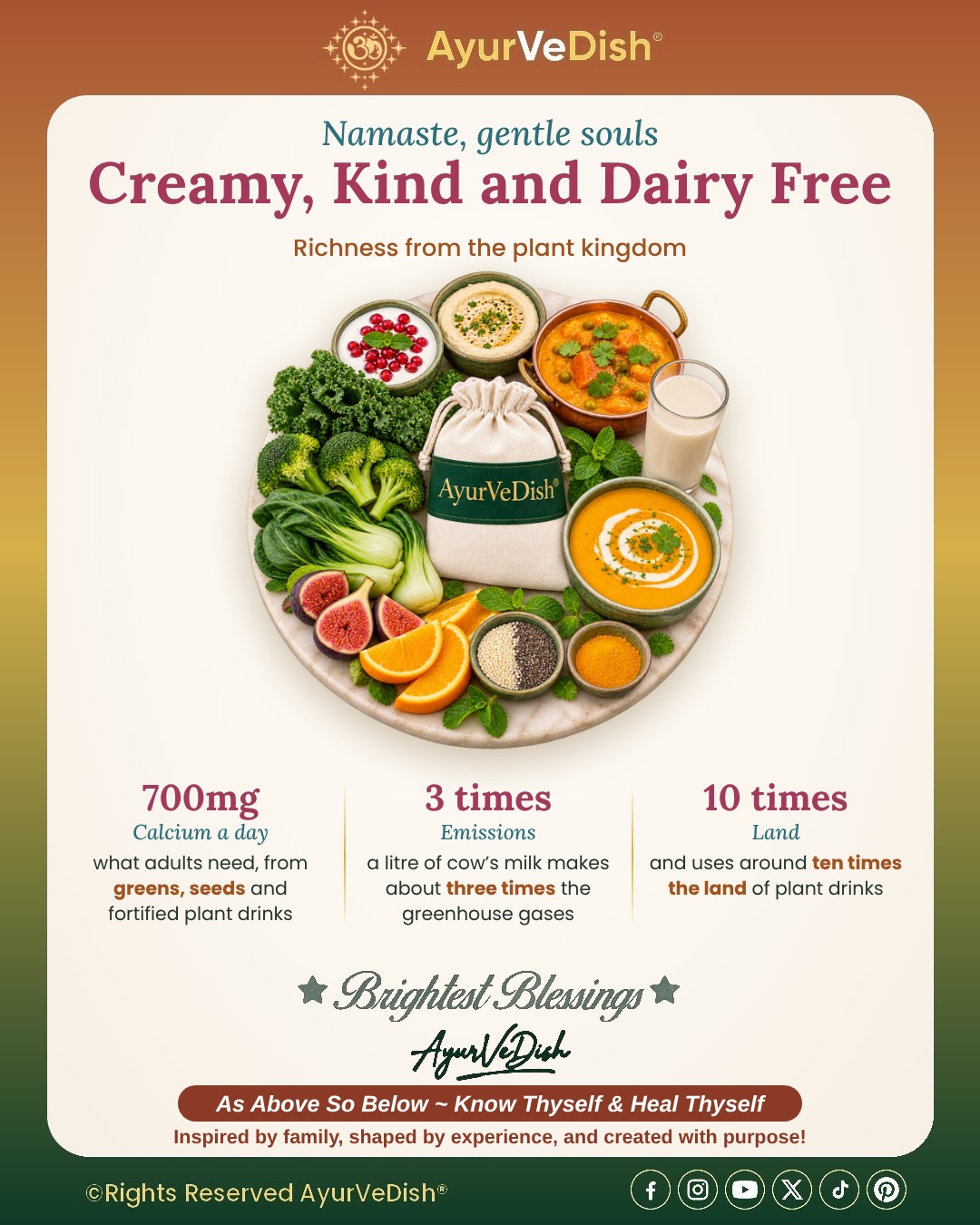
Plants offer an extraordinary variety of flavours and textures. Creamy coconut, beans, lentils, seeds and blended vegetables can all bring richness to recipes. They make smooth sauces, comforting curries, creamy desserts and savoury dips. Our grain free cupcakes, muffins, banana bread, pancakes and biscuits, and our srikand dessert premix, are all made without dairy, egg or cane sugar.
Choosing dairy free need not mean giving up enjoyment. It is an invitation to explore a wider world of ingredients.
What the Ancient Texts Say
The Isha Upanishad opens with one of the best-known verses in Vedic teaching: “īśāvāsyam idaṃ sarvaṃ”. In Sri Aurobindo’s translation: “All this is for habitation by the Lord … By that renounced thou shouldst enjoy; lust not after any man’s possession.”
We read it as a reminder that this world is not ours alone. It is a shared home for all living beings, and we are asked to enjoy it with restraint, taking only what we need.
Compassion in Our Kitchen
Our dairy free choice also comes from the heart. We have a deep and abiding love for animals and all living creatures, great and small, each deserving compassion, respect and the opportunity to live free from unnecessary harm. Kindness can extend beyond our own lives and into the choices we make every day, including the food we prepare, enjoy and share.
Where We Part Ways With Traditional Ayurveda
We hold Ayurveda close, so we want to be open about where we differ. Its classic texts describe cow’s milk as sweet, cold, unctuous and heavy, the very qualities that increase kapha, the dosha of earth and water linked with mucus and congestion. Yet traditional advice still allows kapha types some milk, warmed and spiced, and holds ghee in the highest regard. Ask anyone with a strong kapha constitution who has battled phlegm for days after dairy, and they will tell you that dairy and kapha do not mix.
The milk the ancients knew is not the milk on our shelves. In their day, cows grazed open pasture and fed their own calves. Today, on most British dairy farms, a calf is taken from its mother within the first 24 hours of its birth. She is made pregnant again and again, kept pregnant and lactating for around 300 days a year, and milked by machine two or three times a day, and on farms with milking robots, around the clock. In the United States, cows can still be injected with a synthetic growth hormone, rBST, which has been banned in the European Union since 2000.
Think about when these words were written, around 2,000 years ago. There were no fridges, no freezers and no shops full of fresh food all year round. Harvests could fail, winters were hard, and people lived on whatever the land and their animals could give them. With no fridges, milk was drunk fresh from a cow that grazed freely and fed her own calf, and turning it into ghee was a way to make it last. We believe that is why the texts allowed it. Today’s milk comes from an industry the ancients could never have imagined.
So when people say to us, “But Ayurveda says I can have milk and ghee,” our answer is this: Ayurveda was speaking of a different animal and a different milk. We keep its wisdom, and we apply it to the dairy that exists today. That is why there is no milk, butter, cream, cheese, yoghurt or ghee in anything we make.
We love the planet we live on and every creature we share it with. We believe in the bigger order, in which every life matters, and we give 10% of our profit to Act Anukampa Jeevdaya Parivar in Ahmedabad, which cares for animals in shelters and hospitals and serves hot, fresh, sattvic meals to children in the slums.
Think about when these words were written, around 2,000 years ago. There were no fridges, no freezers and no shops full of fresh food all year round. Harvests could fail, winters were hard, and people lived on whatever the land and their animals could give them. With no fridges, milk was drunk fresh from a cow that grazed freely and fed her own calf, and turning it into ghee was a way to make it last. We believe that is why the texts allowed it. Today’s milk comes from an industry the ancients could never have imagined.
We love the planet we live on and every creature we share it with. We believe in the bigger order, in which every life matters, and we give 10% of our profit to Act Anukampa Jeevdaya Parivar in Ahmedabad, which cares for animals in shelters and hospitals and serves hot, fresh, sattvic meals to children in the slums.
What Researchers Have Found
Made to Grow a Calf, Fast
Cow’s milk is made by nature for one purpose: to turn a newborn calf into a large, strong animal as quickly as possible. It carries about three times the protein of human breast milk. A calf doubles its birth weight in about a month and a half; a human baby takes around six months.
Hormones in every glass. Modern dairy cows are kept pregnant and lactating for around 300 days a year, so much of our milk comes from pregnant cows, whose milk carries markedly elevated levels of oestrogen and progesterone. Dr Ganmaa Davaasambuu, a physician and researcher then working at the Harvard School of Public Health, told the Harvard Gazette that dairy accounts for 60 to 80 per cent of the oestrogens we consume. The Physicians Committee for Responsible Medicine puts it plainly: “Dairy products contain estrogens and insulin-like growth factor-1 (IGF-1), hormones that naturally occur in cow’s milk.”
What it does to us. In a Japanese study, within an hour of a single drink of cow’s milk, men’s blood showed rises in oestrogen and progesterone and falls in testosterone and the hormones that drive it. In children who drank it, oestrogens in their urine rose too. The researchers concluded that the sexual maturation of young children “could be affected by the ordinary intake of cow milk”.
A growth hormone for us too. A review of 23 studies, including eight randomised trials, suggested that drinking milk may raise levels of IGF-1, a powerful growth hormone, in our blood. A major review of 172 studies, asking whether milk promotes prostate cancer through IGF-1, found moderate evidence that higher IGF-1 is linked with a higher risk of prostate cancer. The Physicians Committee has also linked the fat and hormones in dairy with breast cancer.
Calcium, Bones, Skin and the Earth
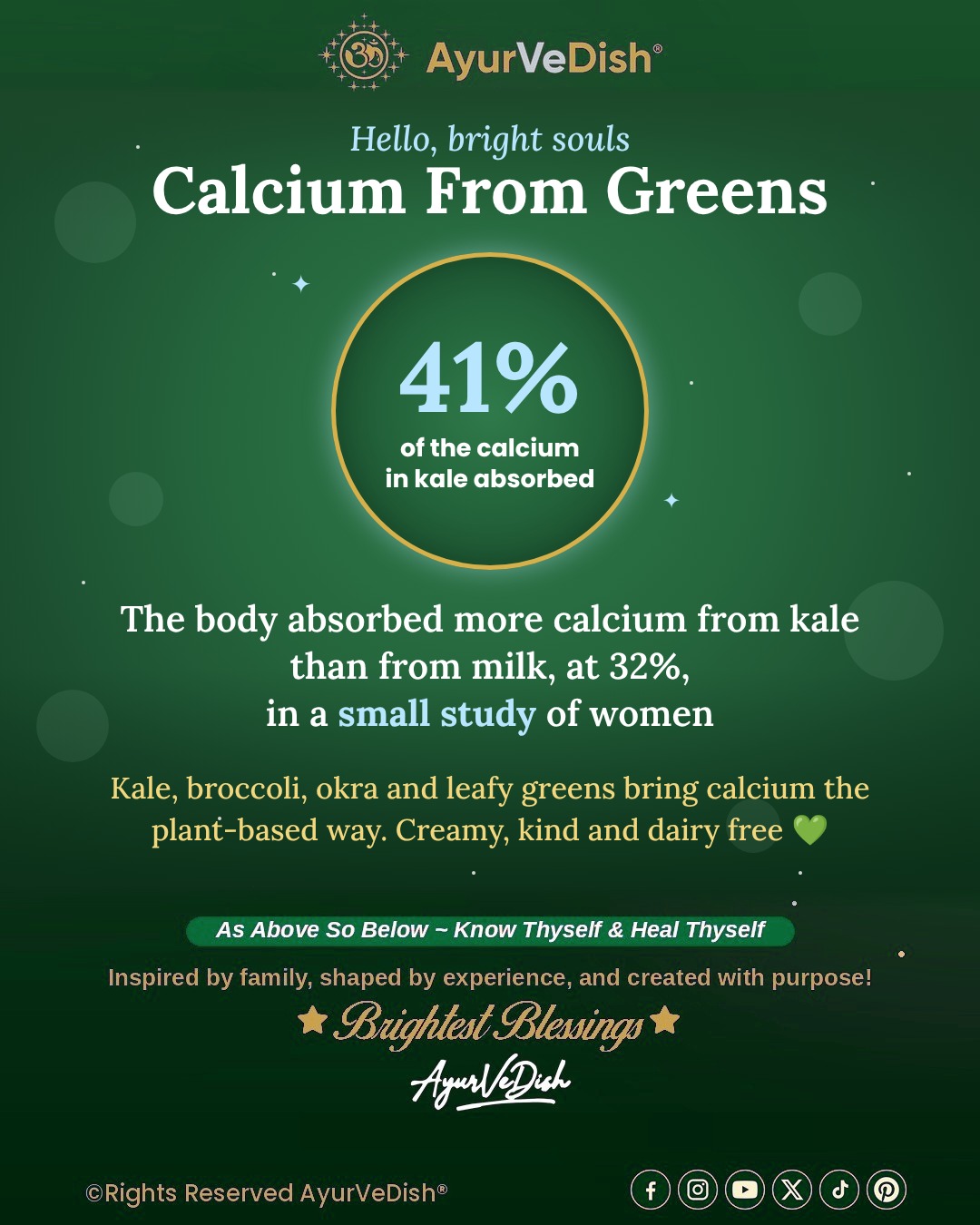
Calcium from kale. In a small study of 11 healthy women by calcium researchers Robert Heaney and Connie Weaver, the body absorbed 40.9 per cent of the calcium in kale, against 32.1 per cent of the calcium in milk. The NHS advises that adults need 700mg of calcium a day, and lists plant sources such as broccoli, cabbage and okra, and plant-based drinks with added calcium.
Milk and bones. In a large Swedish study published in the BMJ in 2014, Professor Karl Michaëlsson and colleagues found that women who drank three or more glasses of milk a day were not protected from fractures. Compared with women who drank less than one glass, they had a 16 per cent higher risk of any fracture, a 60 per cent higher risk of hip fracture and a 93 per cent higher risk of death. A smaller link was seen in men. The authors stressed that this was an observational study and should be interpreted with caution.
Skin. A review of studies covering 78,529 children, adolescents and young adults, published in Nutrients in 2018, found that any dairy intake was linked with 25 per cent higher odds of acne, compared with none.
Lighter on the earth. According to Our World in Data, using figures from Joseph Poore of the University of Oxford and Thomas Nemecek of Agroscope in Switzerland, a litre of cow’s milk produces around three times the greenhouse gas emissions of plant-based drinks and uses around ten times as much land.
Some of these studies were small or observational, but together they show why we choose to leave dairy out.
More Than What We Leave Out
Imagine rich sauces made from blended vegetables, creamy dips made with beans, and desserts inspired by the natural sweetness of plant foods. Dairy free cooking asks us to experiment, learn new techniques and look again at familiar recipes, without limiting the cuisines, traditions or flavours we celebrate.
Food is about more than what we leave out. It is about everything wonderful we can bring to the table.
Why Some People Avoid Dairy
People choose dairy free living for many reasons. Some follow a plant-based lifestyle, some prefer to avoid animal-derived ingredients, and some find that dairy does not agree with them. The NHS describes lactose intolerance as getting symptoms, such as tummy pain, after eating food containing lactose, the sugar in milk. A cow’s milk allergy is different: it is a reaction to the proteins in milk, and it can be serious, so it needs medical advice.
Why We Say No to Dairy
Milk is sold to us as nature’s perfect food. We see it differently. It is the food nature made for a calf, taken from a cow who is kept pregnant for most of her life, and it reaches our glass carrying her hormones with it. As the research on this page shows, those hormones can be measured in our own bodies after a single drink, and the growth hormone IGF-1 is linked with prostate cancer. That is why there is no dairy in anything we make.
Let Food Be Thy Medicine Before Medicine Becomes Thy Food.
As Above, So Below, Know Thyself and Heal Thyself.
Inspired by family, shaped by experience, and created with purpose!
Brightest Blessings

This page is for information only. For medical advice, please speak to a qualified professional.
Evidence and Sources
- Isha Upanishad, verse 1, translated by Sri Aurobindo. motherandsriaurobindo.in/Sri-Aurobindo/books/isha-upanishad
- Isha Upanishad, verse 1, Sanskrit text. shlokam.org/texts/ishavasya-1
- Heaney RP, Weaver CM. Calcium absorption from kale. American Journal of Clinical Nutrition 1990;51(4):656-657. pubmed.ncbi.nlm.nih.gov/2321572
- NHS. Calcium. nhs.uk/conditions/vitamins-and-minerals/calcium
- NHS. Food for strong bones. nhs.uk/live-well/bone-health/food-for-strong-bones
- Michaëlsson K et al. Milk intake and risk of mortality and fractures in women and men: cohort studies. BMJ 2014;349:g6015. bmj.com/content/349/bmj.g6015.full
- Juhl CR et al. Dairy intake and acne vulgaris: a systematic review and meta-analysis of 78,529 children, adolescents, and young adults. Nutrients 2018;10(8):1049. mdpi.com/2072-6643/10/8/1049
- Our World in Data. Dairy vs. plant-based milk: what are the environmental impacts? ourworldindata.org/environmental-impact-milks
- Poore J, Nemecek T. Reducing food’s environmental impacts through producers and consumers. Science 2018;360(6392):987-992. doi.org/10.1126/science.aaq0216
- NHS. Lactose intolerance. nhs.uk/conditions/lactose-intolerance
- NHS. Food allergy. nhs.uk/conditions/food-allergy
- Anaphylaxis UK. Cow’s milk allergy factsheet. anaphylaxis.org.uk/wp-content/uploads/2022/10/Cows-milk-allergy-factsheet-v6.pdf
- NutritionFacts.org (Dr Michael Greger). Dairy and sexual precocity. nutritionfacts.org/video/dairy-sexual-precocity
- Harvard Magazine. Modern milk (Ganmaa Davaasambuu). 2007. harvardmagazine.com/2007/05/modern-milk-html
- Harvard Gazette. Hormones in milk can be dangerous. 2006. news.harvard.edu/gazette/story/2006/12/hormones-in-milk-can-be-dangerous
- Physicians Committee for Responsible Medicine. Dairy consumption linked to prostate, ovarian, breast cancers, finds new narrative review. 7 March 2023. pcrm.org/news/news-releases/dairy-consumption-linked-prostate-ovarian-breast-cancers-finds-new-narrative
- Physicians Committee for Responsible Medicine. Health concerns about dairy. pcrm.org/good-nutrition/nutrition-information/health-concerns-about-dairy
- Maruyama K, Oshima T, Ohyama K. Exposure to exogenous estrogen through intake of commercial milk produced from pregnant cows. Pediatrics International 2010;52(1):33-38. pubmed.ncbi.nlm.nih.gov/19496976
- Qin LQ et al. Milk consumption and circulating insulin-like growth factor-I level: a systematic literature review. International Journal of Food Sciences and Nutrition 2009;60(Suppl 7):330-340. pubmed.ncbi.nlm.nih.gov/19746296
- Harrison S et al. Does milk intake promote prostate cancer initiation or progression via effects on insulin-like growth factors (IGFs)? A systematic review and meta-analysis. Cancer Causes and Control 2017;28(6):497-528. pubmed.ncbi.nlm.nih.gov/28361446
- University of Guelph. Dairy Science and Technology: milk composition. books.lib.uoguelph.ca/dairyscienceandtechnologyebook/chapter/milk-composition
- Lusk G. The Elements of the Science of Nutrition (Bunge: days for the newborn to double its weight). chestofbooks.com/health/nutrition/Science/The-Food-Requirement-During-The-Period-Of-Growth-Part-6.html
- Charaka Samhita, Sutra Sthana 27, Annapanavidhi Adhyaya (the qualities of cow’s milk). carakasamhitaonline.com/index.php?title=Annapanavidhi_Adhyaya
- British Institute of Agricultural Science (BISAS). The issue of dairy cow-calf separation. bisas.org.uk/publications/animal-bytes/the-issue-of-dairy-cow-calf-separation
- Bovine somatotropin (rBST): approved in the United States in 1993; banned in the European Union from 1 January 2000. en.wikipedia.org/wiki/Bovine_somatotropin