 AyurVeDish®
About us
Why AyurVeDish ExistsAyurveda at Our HeartOur Free-From PromiseWhole Food, Plant-Based LivingWhy Grain FreeWhy Oil FreeWhy Dairy FreeWhy Yeast FreeWhy Cane Sugar FreeWhy Soy FreeWhy Thoughtful IngredientsFresh and SeasonalHerbs and SpicesFood from Around the WorldGood Food for EveryoneA Recipe Should Inspire YouEat to LiveSalt, Spice and BalanceAyurveda
Ayurveda Made SimpleThe Five ElementsThe Three DoshasVataPittaKaphaPrakritiYour Dosha CombinationEating for Your ConstitutionChoosing Foods ThoughtfullyThe Six TastesSix Tastes on One PlateFood QualitiesAgni (Fire)Herbs and Spices in the Ayurvedic KitchenEating With the SeasonsAyurveda and the Body ClockFasting: The Ancient PauseBuilding a Plant-Based Ayurvedic MealAyurveda and Modern NutritionFood Combinations and Meal PlanningShop
Speciality All-in-One BlendsGrain Free Rice-Style BlendsSnack & Savoury PremixesGrain Free FloursBakes & DessertsChutneys, Dips & PicklesTadkas & Finishing SpicesDetox & Ayurvedic TeasHot & Cold Drinks





Food from Around the World
One Shared Table
Namaste, and welcome.
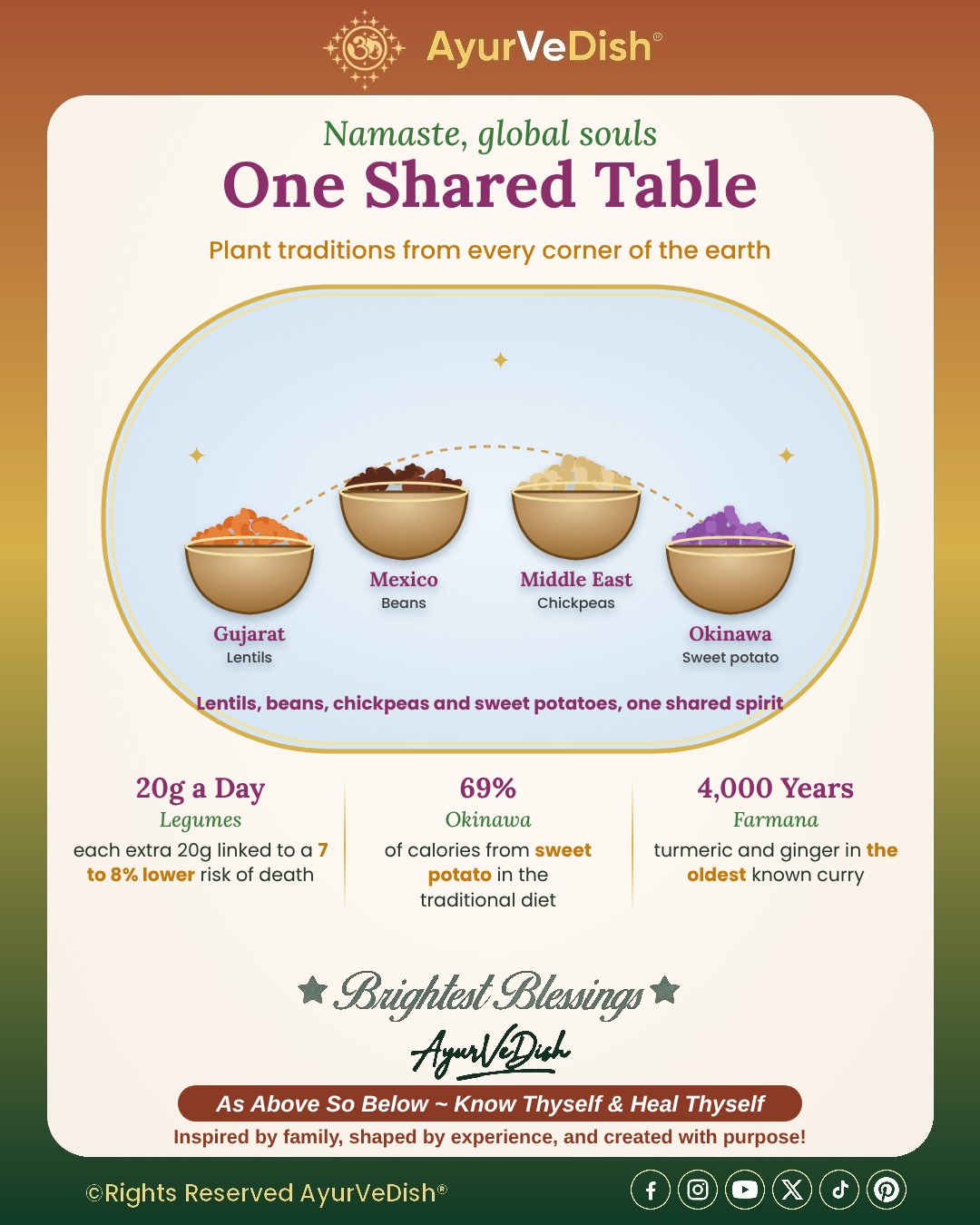
Every culture on earth has found its own way to turn plants into something delicious. A bowl of lentils in Gujarat, beans in Mexico, chickpeas in the Middle East and sweet potatoes in Okinawa look very different on the plate, yet they share a spirit: simple, honest ingredients, cooked with care and flavoured by generations of cooks. At AyurVeDish, we celebrate food beyond the boundaries of any single cuisine.
Common Threads, Different Flavours
Different regions use different herbs, spices and techniques, but their traditional plant-based dishes often share the same foundations: pulses, vegetables, herbs and spices. Cumin and coriander bring depth to lentils in one kitchen. Fresh herbs and citrus brighten a dish in another. Garlic and ginger transform a vegetable dish in a third. Each tradition makes simple plant ingredients exciting without relying on meat, dairy or oil.
What the Ancient Texts Say
Flavour has been travelling the world for thousands of years. At Farmana, an Indus Valley site in India, archaeologists Arunima Kashyap and Steve Weber found traces of turmeric, ginger and aubergine in a cooking pot, from what has been called the world’s oldest known curry, cooked more than 4,000 years ago. Black peppercorns, a spice native to India, were placed in the nostrils of the Egyptian pharaoh Ramesses II, who died around 1213 BCE. And by the first century CE, the Greek sailing guide known as the Periplus of the Erythraean Sea describes ships crossing the ocean to India’s Malabar Coast to load pepper.
Spices crossed deserts and oceans long before any modern shop existed. We believe this is how our ancestors shared what they had learned about food: through trade, travel and the kitchen table.
Cook Without Boundaries
You do not need to travel the world or be an expert cook to explore these traditions. A new combination of herbs and spices, an unfamiliar ingredient or a different way of cooking can introduce a whole new favourite to your table. Our inspiration reaches across Indian regional cooking and cuisines from around the world.

What Researchers Have Found
Beans across the world. In a study of older people in Japan, Sweden, Greece and Australia, legumes were the most important dietary predictor of survival across all the groups studied. Every 20g increase in daily legume intake was linked to a 7 to 8 per cent lower risk of death. Dr Michael Greger of NutritionFacts.org says legumes may be the single most important dietary predictor of a long life.
The Okinawa lesson. Around 1950, the traditional diet of Okinawa in Japan drew about 69 per cent of its calories from sweet potatoes, with fish, meat and dairy each making up about 1 per cent or less. Okinawa went on to have the longest life expectancy in Japan for almost 30 years. As fast food and Western eating spread, that advantage faded: by 2000, Okinawan men had fallen to 26th of Japan’s 47 prefectures.
What Poor Diets Cost the World
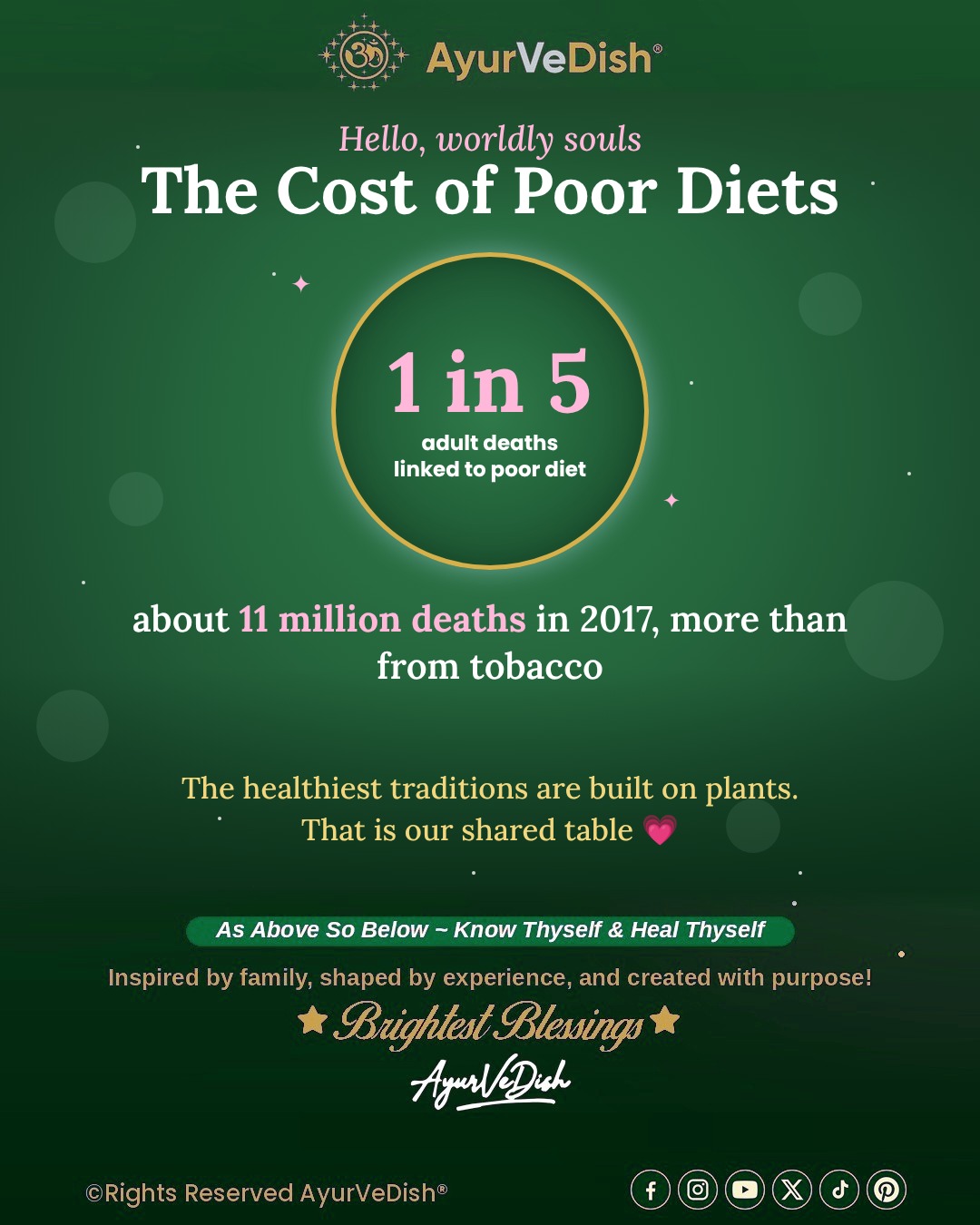
The global toll. In 2019, researchers from the Institute for Health Metrics and Evaluation at the University of Washington reported in The Lancet that poor diets were responsible for 11 million deaths worldwide in 2017, around one in five adult deaths, more than any other risk factor, including tobacco.
Wherever we look, the healthiest traditions are built on plants, and the harm comes when they give way to processed, Western-style food. These are findings from studies, and results differ from person to person.
A Shared Inheritance
Our curry and dal blends bring these flavours home without the guesswork. One 100g pouch makes about 25 portions at Mild (4g), 14 at Medium (7g) or 10 at Extra Hot (10g), each for 200g of vegetables. Alongside them, our grain free falafel, dosa and dhokla premixes, chutneys and finishing spices carry flavours from many kitchens to yours.
Because the world is a shared home, and its food is a shared inheritance.
Let Food Be Thy Medicine Before Medicine Becomes Thy Food.
As Above, So Below, Know Thyself and Heal Thyself.
Inspired by family, shaped by experience, and created with purpose!
Brightest Blessings

This page is for information only. For medical advice, please speak to a qualified professional.
Evidence and Sources
- Kashyap A, Weber S. Harappan plant use revealed by starch grains from Farmana, India. Antiquity 2010;84(326). antiquity.ac.uk/projgall/kashyap326
- Washington State University. Cooking the world’s oldest known curry. 2016. cas.wsu.edu/2016/06/22/cooking-the-worlds-oldest-known-curry
- Darmadi-Blackberry I et al. Legumes: the most important dietary predictor of survival in older people of different ethnicities. Asia Pacific Journal of Clinical Nutrition 2004;13(2):217-220. apjcn.qdu.edu.cn/13_2_8.pdf
- Dr Michael Greger, NutritionFacts.org. Increased lifespan from beans. nutritionfacts.org/video/increased-lifespan-from-beans
- Willcox BJ, Willcox DC et al. Caloric restriction, the traditional Okinawan diet, and healthy aging. Annals of the New York Academy of Sciences 2007;1114:434-455. doi.org/10.1196/annals.1396.037
- GBD 2017 Diet Collaborators. Health effects of dietary risks in 195 countries, 1990-2017: a systematic analysis for the Global Burden of Disease Study 2017. The Lancet 2019;393(10184):1958-1972. doi.org/10.1016/S0140-6736(19)30041-8
- World History Encyclopedia. Pepper (Ramesses II and the Periplus of the Erythraean Sea). worldhistory.org/Pepper
- Gavrilova NS, Gavrilov LA. Comments on dietary restriction, Okinawa diet and longevity. Gerontology 2012;58(3):221-223. doi.org/10.1159/000329894
- The Lancet. Globally, one in five deaths are associated with poor diet. Press release, April 2019. eurekalert.org/news-releases/783880