 AyurVeDish®
About us
Why AyurVeDish ExistsAyurveda at Our HeartOur Free-From PromiseWhole Food, Plant-Based LivingWhy Grain FreeWhy Oil FreeWhy Dairy FreeWhy Yeast FreeWhy Cane Sugar FreeWhy Soy FreeWhy Thoughtful IngredientsFresh and SeasonalHerbs and SpicesFood from Around the WorldGood Food for EveryoneA Recipe Should Inspire YouEat to LiveSalt, Spice and BalanceAyurveda
Ayurveda Made SimpleThe Five ElementsThe Three DoshasVataPittaKaphaPrakritiYour Dosha CombinationEating for Your ConstitutionChoosing Foods ThoughtfullyThe Six TastesSix Tastes on One PlateFood QualitiesAgni (Fire)Herbs and Spices in the Ayurvedic KitchenEating With the SeasonsAyurveda and the Body ClockFasting: The Ancient PauseBuilding a Plant-Based Ayurvedic MealAyurveda and Modern NutritionFood Combinations and Meal PlanningShop
Speciality All-in-One BlendsGrain Free Rice-Style BlendsSnack & Savoury PremixesGrain Free FloursBakes & DessertsChutneys, Dips & PicklesTadkas & Finishing SpicesDetox & Ayurvedic TeasHot & Cold Drinks





Herbs and Spices
Nature’s Colours, Ancient Wisdom and Everyday Flavour
Namaste, and welcome.
For thousands of years, herbs and spices have turned simple ingredients into extraordinary meals. Their colours, fragrances and flavours carry the stories of cultures and generations of cooks who knew that a little of the right ingredient makes all the difference.
Nature’s Colours and Compounds
Plants make a remarkable range of natural compounds, many of which protect them from the stresses of their environment. Turmeric contains curcumin, ginger contains gingerols, black pepper contains piperine, and many aromatic herbs contain polyphenols and essential oils. Each plant has its own composition, and eating a wide variety lets us meet many of these compounds on our plates.
Flavour That Makes Plants Exciting
Cumin and coriander bring warmth and depth to lentils. Ginger and garlic transform a simple vegetable dish. Smoked paprika adds richness to beans, and basil, oregano and thyme give Mediterranean dishes their character. A well-seasoned dish can be deeply satisfying without needing excess salt, added sugar or oil.
What the Ancient Texts Say
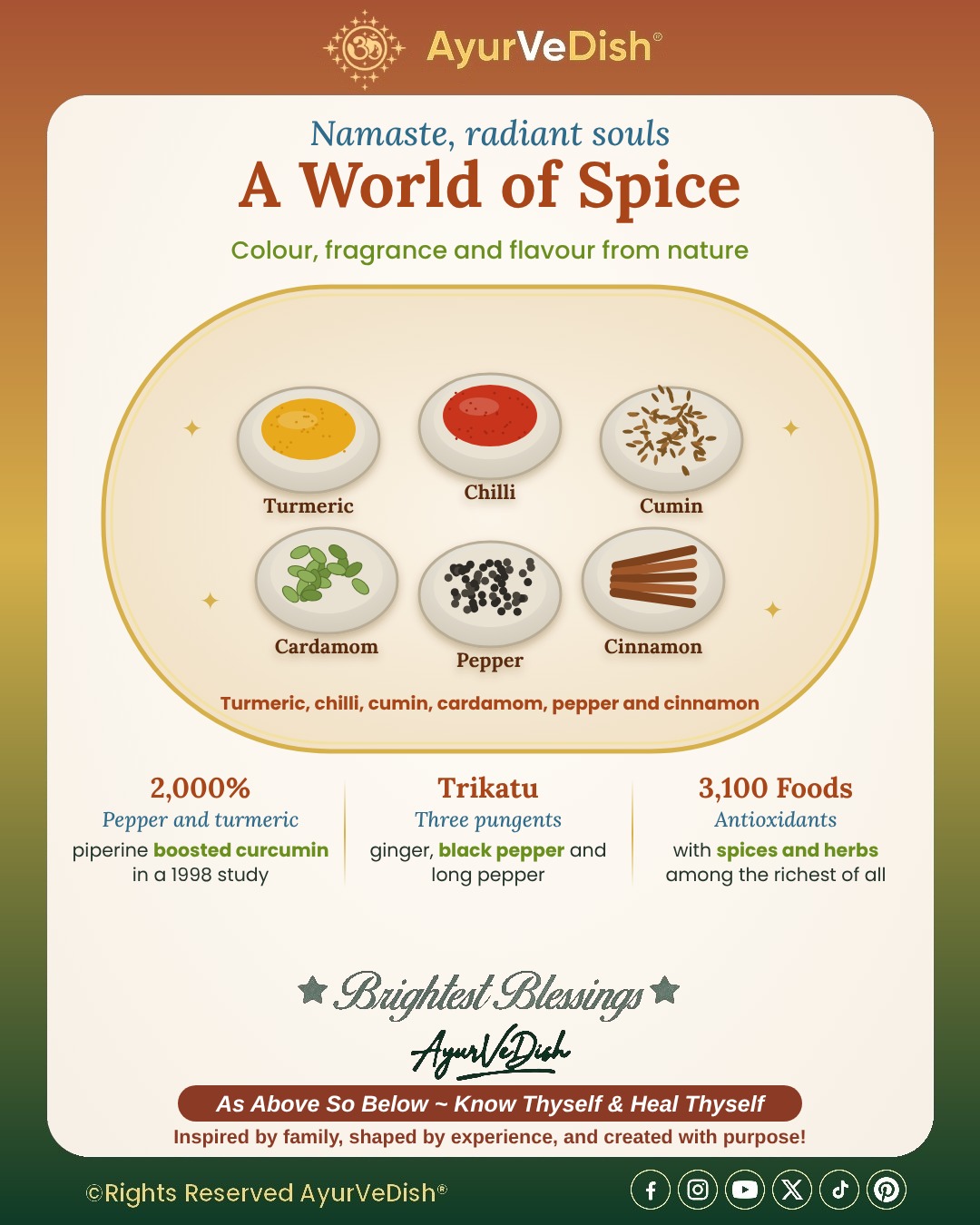
Ayurveda places great importance on digestion, agni, and recognises six tastes: sweet, sour, salty, bitter, pungent and astringent. Herbs and spices are the simplest way to bring them all into a meal, and ginger, cumin, coriander, fennel, turmeric and cardamom have featured in Indian kitchens for centuries.
One classic combination is striking in the light of modern research. Trikatu, “the three pungents”, is a traditional trio of dried ginger, black pepper and long pepper, long said to help the body take in other ingredients. Black pepper’s piperine is exactly what scientists tested with turmeric’s curcumin in 1998. We believe our ancestors learned through generations of cooking what laboratories are only now measuring.
Where We Part Ways With Traditional Ayurveda
Traditional Indian cooking often blooms its spices in hot ghee or oil, a tempering known as tadka. Think about the world it came from, long before fridges and freezers, and ghee could be kept for months in a hot climate, so it was the natural way to carry flavour into food. Today we have no need for it. We dry-toast our spices in a hot pan, or bloom them in a splash of water or stock, and the aromas come alive just the same.

What Researchers Have Found
Packed with antioxidants. Researchers at the University of Oslo measured the antioxidant content of more than 3,100 foods, drinks, spices, herbs and supplements. Spices and herbs came out as some of the richest sources of all, and plant-based foods brought significantly more antioxidants into the diet than non-plant foods.
Turmeric and black pepper. Curcumin is poorly absorbed on its own. In a 1998 study in human volunteers, adding 20mg of piperine from black pepper to 2g of curcumin increased its bioavailability by 2,000 per cent.
Spice, Long Life and Purity
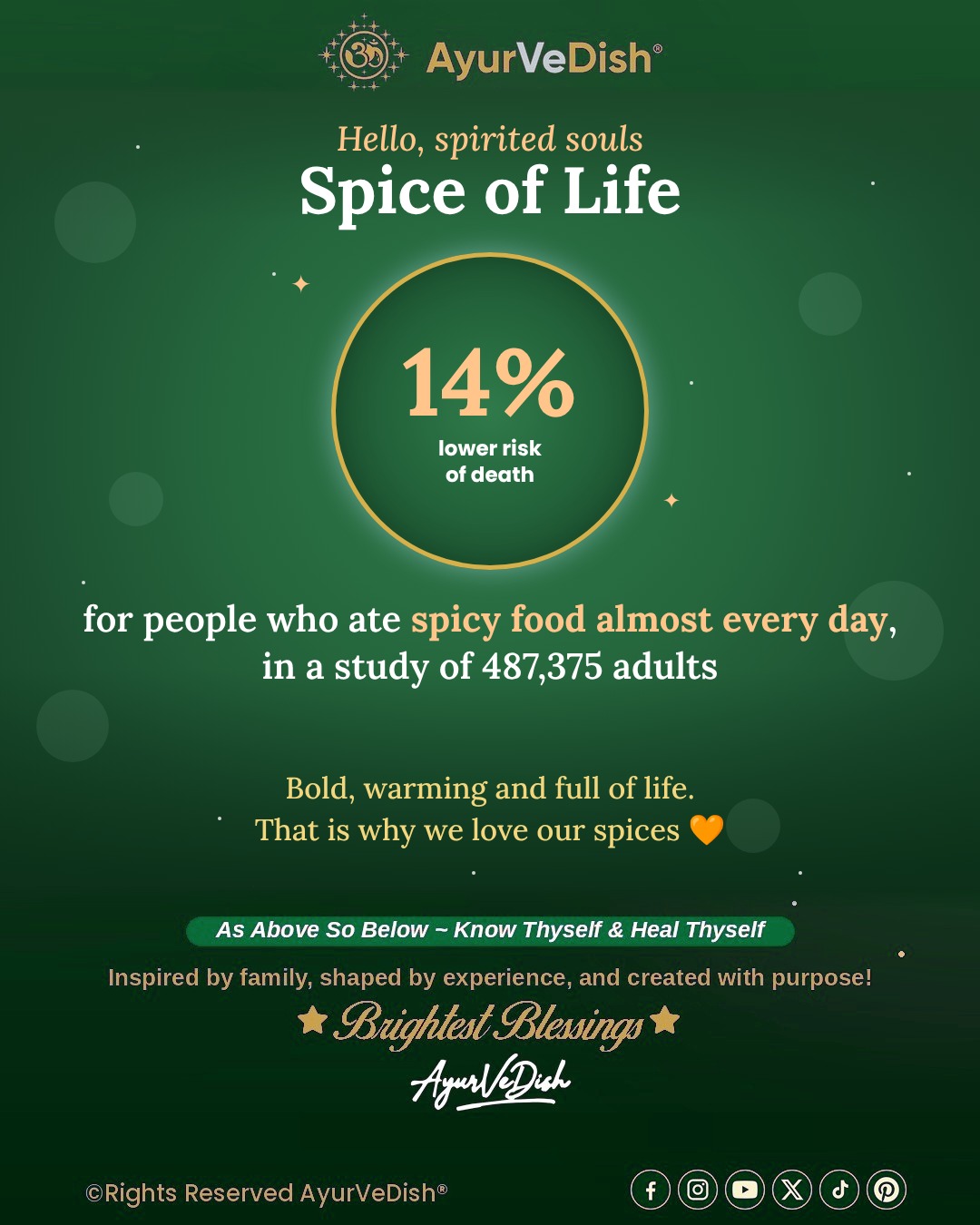
Spice and long life. The China Kadoorie Biobank followed 487,375 adults for a median of 7.2 years. Compared with those who ate spicy food less than once a week, those who ate it once or twice a week had a 10 per cent lower risk of death, and those who ate it six or seven days a week had a 14 per cent lower risk. Those who ate spicy food were also less likely to die from cancer, ischaemic heart disease and respiratory disease.
Colour that should never be there. In 2019, Dr Jenna Forsyth, Professor Stephen Luby and colleagues at Stanford University found that some spice processors in Bangladesh were adding lead chromate, an industrial pigment, to turmeric to give it a brighter yellow. A companion study, the first to directly link lead in turmeric to lead in people’s blood, traced it in pregnant women in rural Bangladesh. As Professor Luby put it, “there is no safe consumption limit for lead.” It is one more reason we choose pure spices and let nature do the colouring.
These are findings from specific studies, and results differ from person to person.
The Beauty of Variety
No single herb or spice holds everything we need. The beauty lies in variety: fresh herbs add fragrance and brightness, dried spices bring concentrated aromas, and colourful vegetables add their own pigments.
Our curry and dal blends are complete, all-in-one blends. Every herb and spice is already in the pouch, in the right balance, so there is no measuring and no extra seasoning to add. Just add your vegetables, pulses or beans and water, then cook. One 100g pouch makes about 25 portions at Mild (4g), 14 at Medium (7g) or 10 at Extra Hot (10g), each for 200g of vegetables. Our finishing spices, chutneys and herbal teas carry the same love of spice into every part of the day.
A little spice. A world of flavour. Nature’s remarkable diversity in every kitchen.
Let Food Be Thy Medicine Before Medicine Becomes Thy Food.
As Above, So Below, Know Thyself and Heal Thyself.
Inspired by family, shaped by experience, and created with purpose!
Brightest Blessings

This page is for information only. For medical advice, please speak to a qualified professional.
Evidence and Sources
- Carlsen MH et al. The total antioxidant content of more than 3100 foods, beverages, spices, herbs and supplements used worldwide. Nutrition Journal 2010;9:3. doi.org/10.1186/1475-2891-9-3
- Shoba G et al. Influence of piperine on the pharmacokinetics of curcumin in animals and human volunteers. Planta Medica 1998;64(4):353-356. pubmed.ncbi.nlm.nih.gov/9619120
- Lv J et al. Consumption of spicy foods and total and cause specific mortality: population based cohort study. BMJ 2015;351:h3942. doi.org/10.1136/bmj.h3942
- ScienceDaily. Regular consumption of spicy foods linked to lower risk of early death. 2015. sciencedaily.com/releases/2015/08/150804202650.htm
- Stanford King Center on Global Development. Stanford researchers find lead in turmeric. 2019. kingcenter.stanford.edu/news/stanford-researchers-find-lead-turmeric
- Forsyth JE et al. Turmeric means “yellow” in Bengali: lead chromate pigments added to turmeric threaten public health across Bangladesh. Environmental Research 2019;179:108722. doi.org/10.1016/j.envres.2019.108722
- Forsyth JE et al. Sources of blood lead exposure in rural Bangladesh. Environmental Science and Technology 2019;53(19):11429-11436. pmc.ncbi.nlm.nih.gov/articles/PMC7705119
- Stanford Report. Lead found in turmeric. 24 September 2019. news.stanford.edu/stories/2019/09/lead-found-turmeric