 AyurVeDish®
About us
Why AyurVeDish ExistsAyurveda at Our HeartOur Free-From PromiseWhole Food, Plant-Based LivingWhy Grain FreeWhy Oil FreeWhy Dairy FreeWhy Yeast FreeWhy Cane Sugar FreeWhy Soy FreeWhy Thoughtful IngredientsFresh and SeasonalHerbs and SpicesFood from Around the WorldGood Food for EveryoneA Recipe Should Inspire YouEat to LiveSalt, Spice and BalanceAyurveda
Ayurveda Made SimpleThe Five ElementsThe Three DoshasVataPittaKaphaPrakritiYour Dosha CombinationEating for Your ConstitutionChoosing Foods ThoughtfullyThe Six TastesSix Tastes on One PlateFood QualitiesAgni (Fire)Herbs and Spices in the Ayurvedic KitchenEating With the SeasonsAyurveda and the Body ClockFasting: The Ancient PauseBuilding a Plant-Based Ayurvedic MealAyurveda and Modern NutritionFood Combinations and Meal PlanningShop
Speciality All-in-One BlendsGrain Free Rice-Style BlendsSnack & Savoury PremixesGrain Free FloursBakes & DessertsChutneys, Dips & PicklesTadkas & Finishing SpicesDetox & Ayurvedic TeasHot & Cold Drinks





Eat to Live
Eat to Live, Don’t Live to Eat
Namaste, and welcome.
“Eat to Live, Don’t Live to Eat.” It sits at the heart of AyurVeDish. It does not mean eating less or counting anything. It means treating food as the foundation of life, choosing the right foods, and eating them with enjoyment and awareness.
Our curry and dal blends make eating to live easy: every herb and spice is already in the pouch. One 100g pouch makes about 25 portions at Mild (4g), 14 at Medium (7g) or 10 at Extra Hot (10g), each for 200g of vegetables. And when you want something sweet, our grain free cupcake, muffin, pancake and banana bread premixes are made without grains, dairy, eggs or cane sugar.
What the Ancient Texts Say
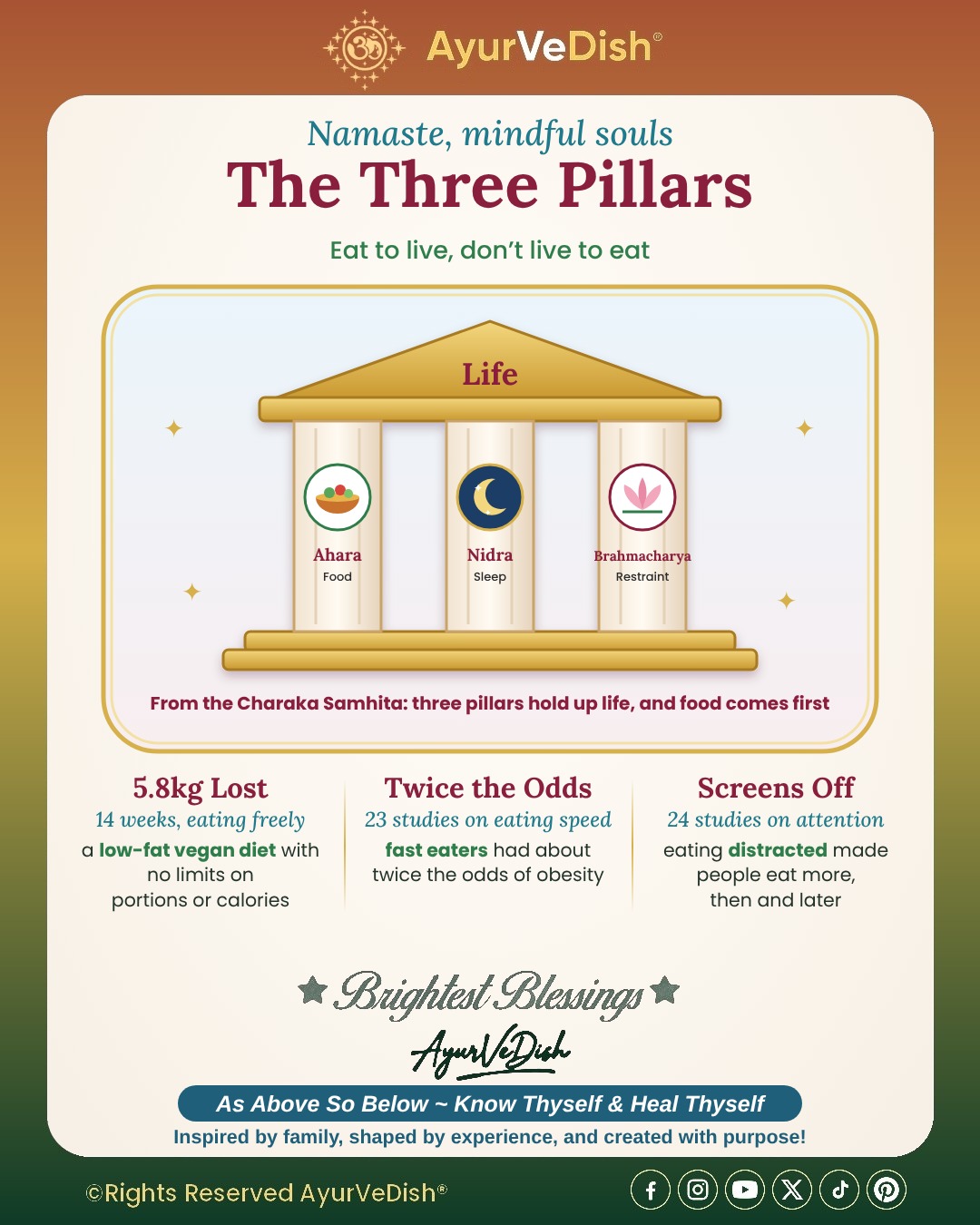
Ayurveda teaches that life rests on three supporting pillars: food (ahara), sleep (nidra) and restraint, the control of the senses (brahmacharya) (Charaka Samhita, Sutra Sthana 11.35). Food comes first. Our ancestors saw eating as the daily act that builds the body and steadies the mind, not as a pastime or a reward.
The same text sets out how to eat. Eat warm, freshly cooked food, in the right quantity, and only once the last meal is digested. Eat in a favourable place. Do not eat too quickly or too slowly. Do not talk or laugh while eating, and eat “with utmost concentration on the food” (Vimana Sthana 1.24 to 25). Fill a third of the stomach with food, a third with liquid, and leave the last third free for vata, pitta and kapha to move (Vimana Sthana 2.3). “Eat to live” is simply their message in plain words.
So sit down. Take a breath. Notice the colours, the smells and the flavours. Eat slowly enough to enjoy each mouthful, and put the screen away. When we pay attention, food becomes a pleasure again, and we hear what our body is telling us.
Where We Part Ways With Traditional Ayurveda
The same verses ask for food that is unctuous (snigdha), and in the classical kitchen that richness came from ghee and oil. Think about the world it was written for, around 2,000 years ago. Most people worked hard with their bodies from dawn to dusk, harvests could fail, and there were no fridges or freezers. Ghee kept well without refrigeration and packed a great deal of energy into a little food, so it made sense. Today most of us move far less, and rich food is on every shelf. We take that richness from whole foods instead, such as sesame, pumpkin and flax seeds and avocado, with no ghee and no oil.
What Researchers Have Found
Eat freely, lose weight. In 2005, Dr Neal Barnard and colleagues at the Physicians Committee for Responsible Medicine put 64 overweight postmenopausal women on either a low-fat vegan diet or a standard low-fat diet for 14 weeks, with no limits on portion size or calories. The vegan group lost an average of 5.8kg, against 3.8kg on the standard diet.
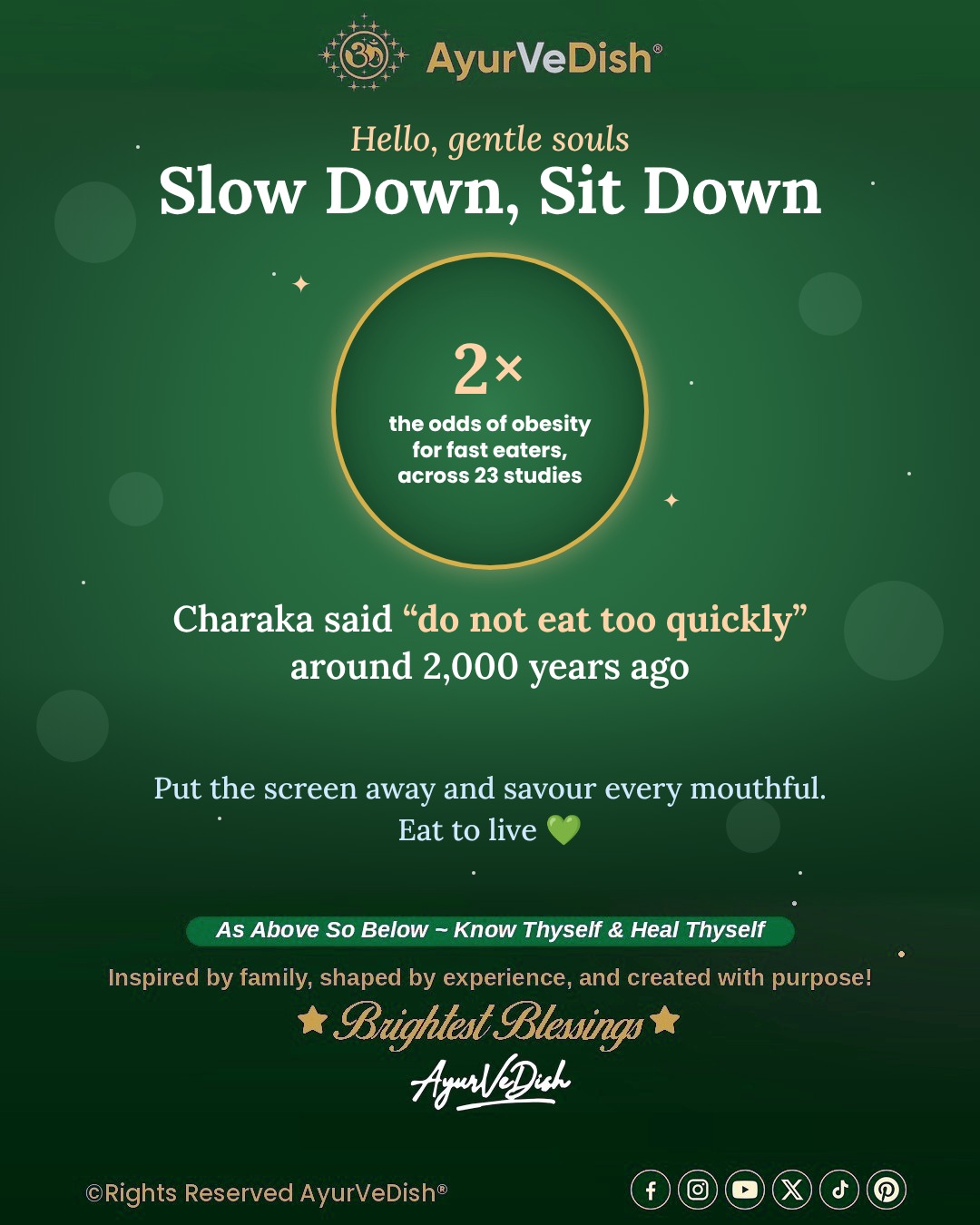
Slow down. A 2015 review of 23 studies, led by Dr Toshiaki Ohkuma, found that people who ate quickly had about twice the odds of obesity of those who did not. Charaka’s “do not eat too quickly” was written about 2,000 years earlier.
Put the screen away. A 2013 review of 24 studies, led by Dr Eric Robinson at the University of Liverpool, found that eating while distracted, by television, a screen or reading, made people eat more at that meal, and even more later on. Remembering a meal well led people to eat less later.
These are findings from studies, and results differ from person to person.
Eat Freely, Eat Well
We do not believe in restriction. We believe in choosing the right foods and then enjoying them until you are satisfied: vegetables, fruits, pulses, seeds, herbs and spices, prepared with care. Dr Joel Fuhrman, whose book is called Eat to Live, sums it up as “Health = Nutrients/Calories”: the more goodness in every mouthful, the less there is to count.
Living to Eat Has a Price
Much of today’s food is designed to be craved, not to nourish: refined, sweetened, salted and engineered so that we keep reaching for more. That is living to eat, and it is the opposite of everything we stand for. We leave out grains, cane sugar, yeast, dairy, nuts, soy, oil and anything artificial, so that what remains is food that feeds the body rather than the craving.
Eat With Joy
To eat is to live. And to live well is to eat with purpose, with gratitude and with joy.
Let Food Be Thy Medicine Before Medicine Becomes Thy Food.
As Above, So Below, Know Thyself and Heal Thyself.
Inspired by family, shaped by experience, and created with purpose!
Brightest Blessings

This page is for information only. For medical advice, please speak to a qualified professional.
Evidence and Sources
- Charaka Samhita, Sutra Sthana 11.35, Tistraishaniya Adhyaya (the three supporting pillars of life). carakasamhitaonline.com/index.php/Tistraishaniya_Adhyaya
- Charaka Samhita, Vimana Sthana 1.24 to 25, Rasa Vimana (the rules of eating). carakasamhitaonline.com/index.php/Rasa_Vimana
- Charaka Samhita, Vimana Sthana 2.3, Trividhakukshiya Vimana (the three parts of the stomach). carakasamhitaonline.com/index.php/Trividhakukshiya_Vimana
- Barnard ND, Scialli AR, Turner-McGrievy G et al. The effects of a low-fat, plant-based dietary intervention on body weight, metabolism, and insulin sensitivity. American Journal of Medicine 2005;118(9):991-997. pubmed.ncbi.nlm.nih.gov/16164885
- Physicians Committee for Responsible Medicine. Vegan diet causes weight loss without exercise, calorie counting, or portion control. 2005. pcrm.org/news/health-nutrition/vegan-diet-causes-weight-loss-without-exercise-calorie-counting-or-portion
- Ohkuma T, Hirakawa Y, Nakamura U et al. Association between eating rate and obesity: a systematic review and meta-analysis. International Journal of Obesity 2015;39:1589-1596. doi.org/10.1038/ijo.2015.96
- Robinson E, Aveyard P, Daley A et al. Eating attentively: a systematic review and meta-analysis of the effect of food intake memory and awareness on eating. American Journal of Clinical Nutrition 2013;97(4):728-742. doi.org/10.3945/ajcn.112.045245
- Fuhrman J. Eat to Live. Little, Brown Spark, revised edition. hachettebookgroup.com/titles/joel-fuhrman-md/eat-to-live/9780316120913