 AyurVeDish®
About us
Why AyurVeDish ExistsAyurveda at Our HeartOur Free-From PromiseWhole Food, Plant-Based LivingWhy Grain FreeWhy Oil FreeWhy Dairy FreeWhy Yeast FreeWhy Cane Sugar FreeWhy Soy FreeWhy Thoughtful IngredientsFresh and SeasonalHerbs and SpicesFood from Around the WorldGood Food for EveryoneA Recipe Should Inspire YouEat to LiveSalt, Spice and BalanceAyurveda
Ayurveda Made SimpleThe Five ElementsThe Three DoshasVataPittaKaphaPrakritiYour Dosha CombinationEating for Your ConstitutionChoosing Foods ThoughtfullyThe Six TastesSix Tastes on One PlateFood QualitiesAgni (Fire)Herbs and Spices in the Ayurvedic KitchenEating With the SeasonsAyurveda and the Body ClockFasting: The Ancient PauseBuilding a Plant-Based Ayurvedic MealAyurveda and Modern NutritionFood Combinations and Meal PlanningShop
Speciality All-in-One BlendsGrain Free Rice-Style BlendsSnack & Savoury PremixesGrain Free FloursBakes & DessertsChutneys, Dips & PicklesTadkas & Finishing SpicesDetox & Ayurvedic TeasHot & Cold Drinks





Why Cane Sugar Free
Sweetness the Natural Way
Namaste, and welcome.
Sweetness is one of life’s simple pleasures. At AyurVeDish, we simply choose to find it in a different place. There is no refined cane sugar in anything we make.
What Refining Does
Sugar cane is a tall, fibrous grass. Refining crushes it, boils its juice and spins out crystals in stages, until what is left is white sugar: about 99.8 per cent sugar, with the fibre, minerals and goodness of the plant stripped away. It brings sweetness and calories, and nothing else.
What the Ancient Texts Say
Ayurveda counts sweet, madhura, as one of the six tastes and welcomes it as part of a balanced meal. The sweetness it points to is the kind found in naturally sweet foods such as fruits, root vegetables and pulses, enjoyed in sensible amounts.
It is also clear about excess. The Charaka Samhita warns that too much sweet taste brings obesity, heaviness, lethargy and too much sleep, the signs of excess kapha (Sutra Sthana 26.43). And among the causes of prameha, the urinary disorders that include what we now call diabetes, it lists “preparations of jaggery”, the sugar cane products of its day (Chikitsa Sthana 6.4).
Where We Part Ways With Traditional Ayurveda
Ayurveda still uses jaggery and sugar, sharkara, in many traditional preparations, and we understand why. But the sugar of Charaka’s day was cane juice boiled down in small batches, not the white crystals that pour from industrial refineries today, and even then Charaka warned of its effects. Today’s sugar is more refined and far more plentiful than anything the ancients knew, so we leave it out altogether.
Think about when these words were written, around 2,000 years ago. There were no fridges, no freezers and no shops full of fresh food all year round. Harvests could fail, winters were hard, and people lived on whatever the land and their animals could give them. Jaggery was boiled down by hand in small batches, a rare, precious store of quick energy for people doing hard physical work from dawn to dusk. We believe that is why the texts used it. Today sugar is cheap, refined and hidden in almost everything we buy.
Think about when these words were written, around 2,000 years ago. There were no fridges, no freezers and no shops full of fresh food all year round. Harvests could fail, winters were hard, and people lived on whatever the land and their animals could give them. Jaggery was boiled down by hand in small batches, a rare, precious store of quick energy for people doing hard physical work from dawn to dusk. We believe that is why the texts used it. Today sugar is cheap, refined and hidden in almost everything we buy.
We love the planet we live on and every creature we share it with. We believe in the bigger order, in which every life matters, and we give 10% of our profit to Act Anukampa Jeevdaya Parivar in Ahmedabad, which cares for animals in shelters and hospitals and serves hot, fresh, sattvic meals to children in the slums.
What Researchers Have Found
A cover-up. In 2016, Dr Cristin Kearns, Dr Laura Schmidt and Professor Stanton Glantz of the University of California, San Francisco uncovered documents showing that in 1965 the Sugar Research Foundation, a sugar industry group, paid Harvard scientists $6,500 for a review of the research on diet and heart disease. Published in the New England Journal of Medicine in 1967, without disclosing the payment, it played down sugar’s role and pointed the finger at fat. For decades, sugar escaped the scrutiny it deserved.
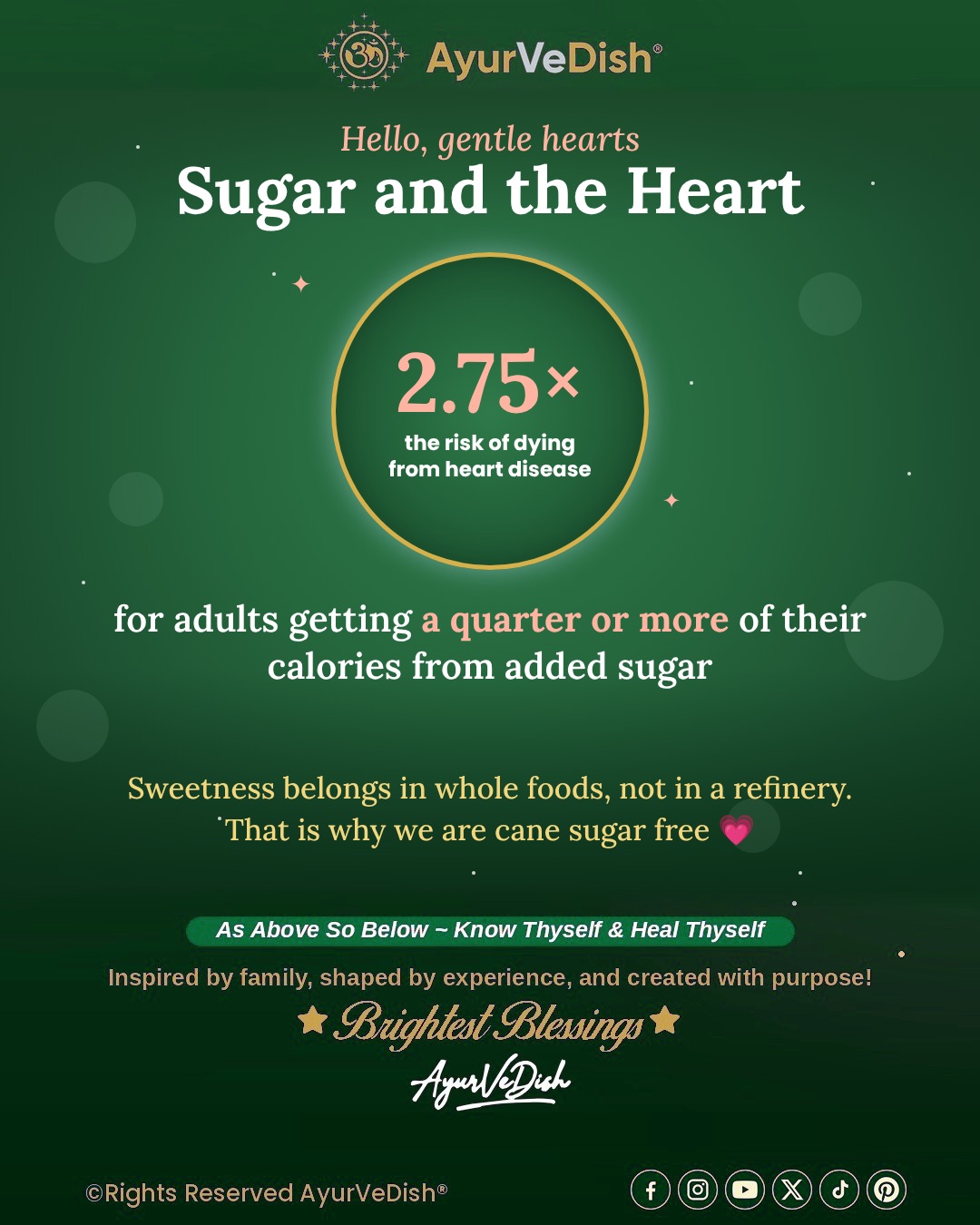
Sugar and the heart. In a study of US adults followed for around 15 years, published in 2014, Dr Quanhe Yang and colleagues at the US Centers for Disease Control and Prevention found that people who got 10 to 24.9 per cent of their calories from added sugar had a 30 per cent higher risk of dying from heart disease than those who got less than 10 per cent. For those who got 25 per cent or more, the risk was 2.75 times as high. Seven in ten adults were getting at least 10 per cent.
Diabetes, Weight and Teeth
Type 2 diabetes. A meta-analysis led by Dr Vasanti Malik of the Harvard School of Public Health, covering 310,819 people, found that those who drank one to two sugar-sweetened drinks a day had a 26 per cent higher risk of type 2 diabetes than those who drank less than one a month.
A better sweetness. Dr Michael Greger of NutritionFacts.org calls dates “one of the healthiest sweeteners”, and reports a trial in which seven dates a day for three weeks significantly reduced DNA-damaging activity in stool samples.
Weight and teeth. The NHS warns that too much sugar can make us gain weight and cause tooth decay, and that sugar is one of the main causes of tooth decay. Being overweight, it adds, raises the risk of heart disease, some cancers and type 2 diabetes.
How Much Is Too Much
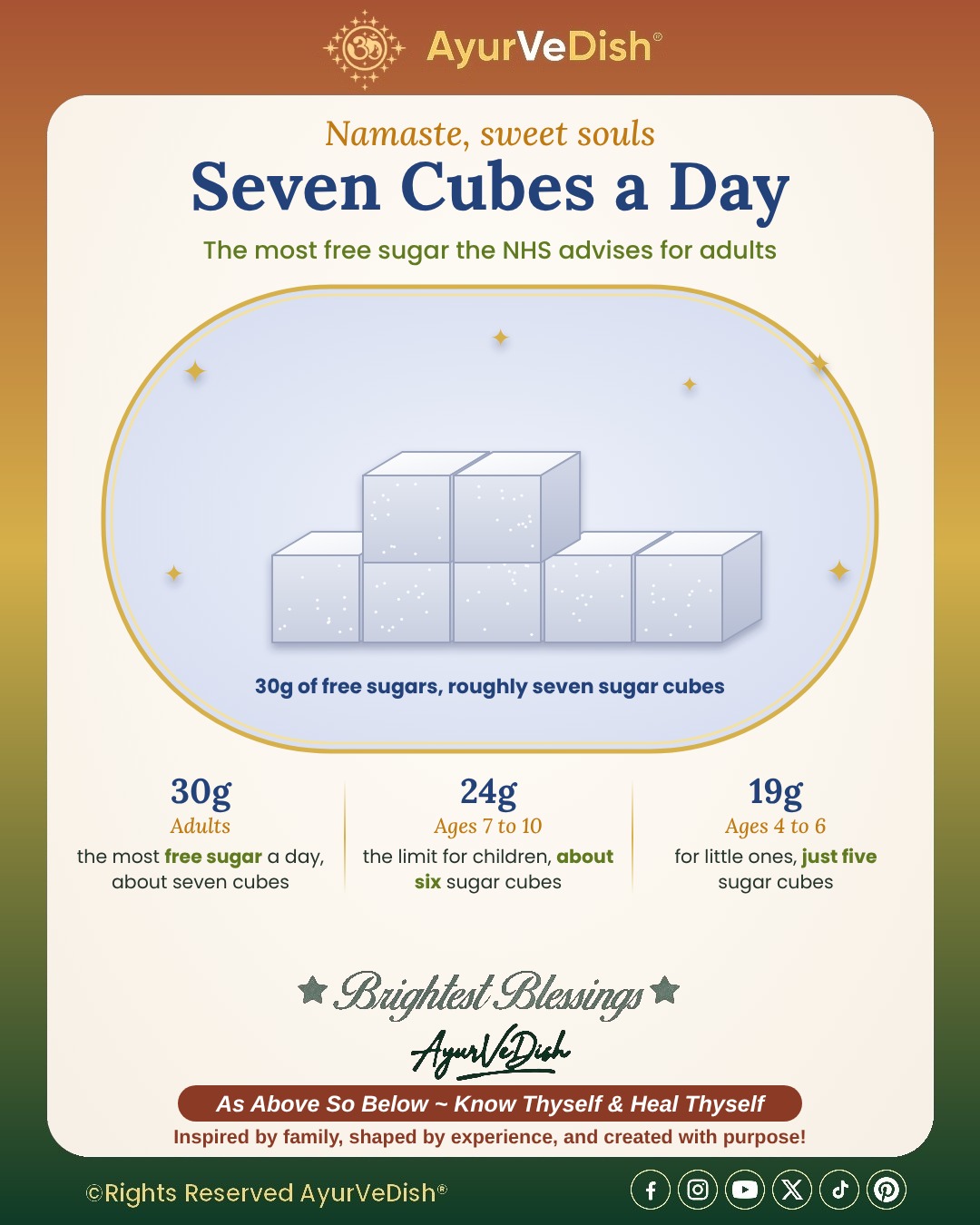
The UK’s Scientific Advisory Committee on Nutrition recommends that free sugars make up no more than 5 per cent of our daily energy. The NHS advises that adults have no more than 30g of free sugars a day, roughly seven sugar cubes. For children aged 7 to 10 the limit is 24g, about six cubes, and for children aged 4 to 6 it is just 19g, about five. Free sugars include any sugar added to food and drink, as well as honey, syrups and fruit juice.
Much of this research looks at added sugars as a whole, but refined cane sugar is the most common of them.
Thoughtful Sweetness
Where a dish calls for sweetness, we use coconut sugar and date sugar, in small amounts. Date sugar is simply dried dates ground into a powder, a whole fruit that keeps its own fibre and a deep, caramel-like flavour. Vegetables add gentle sweetness too, along with colour and texture.
Our Promise
Our grain free cupcakes, muffins, banana bread, pancakes and biscuits, and our srikand dessert premix, are all made without cane sugar, egg or dairy. Your taste buds can enjoy a little sweetness, in its natural form.
Let Food Be Thy Medicine Before Medicine Becomes Thy Food.
As Above, So Below, Know Thyself and Heal Thyself.
Inspired by family, shaped by experience, and created with purpose!
Brightest Blessings

This page is for information only. For medical advice, please speak to a qualified professional.
Evidence and Sources
- Charaka Samhita, Sutra Sthana 26.43 (excess sweet taste). cas.indica.in/madhura-rasa
- Charaka Samhita, Chikitsa Sthana 6.4 (causes of prameha). siva.sh/caraka-samhita/chikitsa-sthana/6/4
- USDA FoodData Central. Sugars, granulated. fdc.nal.usda.gov/food-details/169655/nutrients
- Dr Michael Greger, NutritionFacts.org. Benefit of dates for colon health. nutritionfacts.org/video/flashback-friday-benefit-of-dates-for-colon-health
- Kearns CE, Schmidt LA, Glantz SA. Sugar industry and coronary heart disease research: a historical analysis of internal industry documents. JAMA Internal Medicine 2016;176(11):1680-1685. doi.org/10.1001/jamainternmed.2016.5394
- Scientific American. Sugar industry secretly paid for favorable Harvard research. 2016. scientificamerican.com/article/sugar-industry-secretly-paid-for-favorable-harvard-research
- Yang Q, Zhang Z, Gregg EW, Flanders WD, Merritt R, Hu FB. Added sugar intake and cardiovascular diseases mortality among US adults. JAMA Internal Medicine 2014;174(4):516-524. doi.org/10.1001/jamainternmed.2013.13563
- Malik VS, Popkin BM, Bray GA, Després JP, Willett WC, Hu FB. Sugar-sweetened beverages and risk of metabolic syndrome and type 2 diabetes: a meta-analysis. Diabetes Care 2010;33(11):2477-2483. doi.org/10.2337/dc10-1079
- NHS. How does sugar in our diet affect our health? nhs.uk/live-well/eat-well/food-types/how-does-sugar-in-our-diet-affect-our-health
- Scientific Advisory Committee on Nutrition. Carbohydrates and health. 2015. gov.uk/government/publications/sacn-carbohydrates-and-health-report
- Dixie Crystals. Refined sugar vs raw sugar (how cane sugar is refined). dixiecrystals.com/sugar-101/refined-sugar-vs-raw-sugar
- Eid N et al. Impact of palm date consumption on microbiota growth and large intestinal health: a randomised, controlled, cross-over, human intervention study. British Journal of Nutrition 2015;114(8):1226-1236. doi.org/10.1017/S0007114515002780