 AyurVeDish®
About us
Why AyurVeDish ExistsAyurveda at Our HeartOur Free-From PromiseWhole Food, Plant-Based LivingWhy Grain FreeWhy Oil FreeWhy Dairy FreeWhy Yeast FreeWhy Cane Sugar FreeWhy Soy FreeWhy Thoughtful IngredientsFresh and SeasonalHerbs and SpicesFood from Around the WorldGood Food for EveryoneA Recipe Should Inspire YouEat to LiveSalt, Spice and BalanceAyurveda
Ayurveda Made SimpleThe Five ElementsThe Three DoshasVataPittaKaphaPrakritiYour Dosha CombinationEating for Your ConstitutionChoosing Foods ThoughtfullyThe Six TastesSix Tastes on One PlateFood QualitiesAgni (Fire)Herbs and Spices in the Ayurvedic KitchenEating With the SeasonsAyurveda and the Body ClockFasting: The Ancient PauseBuilding a Plant-Based Ayurvedic MealAyurveda and Modern NutritionFood Combinations and Meal PlanningShop
Speciality All-in-One BlendsGrain Free Rice-Style BlendsSnack & Savoury PremixesGrain Free FloursBakes & DessertsChutneys, Dips & PicklesTadkas & Finishing SpicesDetox & Ayurvedic TeasHot & Cold Drinks




Why Soy Free
Because Not Every Body Agrees With It
Namaste, and welcome.
Soy hides in a surprising number of shop-bought foods. At AyurVeDish we leave it out, for reasons of health, allergy and tradition.
A Plant That Acts Like a Hormone
Soya is rich in isoflavones, plant compounds called phytoestrogens because they can act like the hormone oestrogen in the body. That is not a small thing to put on a plate every day, and it is why food safety bodies keep a close eye on how much of it we eat.
Hidden Everywhere
In the UK, soya is one of the 14 allergens that must be clearly labelled in the ingredients list of pre-packed food. It turns up as soya flour, soya protein, textured vegetable protein and soya lecithin, in breads, ready meals, sauces, meat substitutes and snacks. Much of it is heavily processed: soy protein isolate and concentrate are commonly made using hexane, a petroleum-based solvent, and because processing aids are not ingredients, they do not have to be listed on the label.
And most of the world’s soya is not grown the old way: in 2019, 74 per cent of the world’s soybean area was planted with genetically modified varieties.
What the Ancient Texts Say
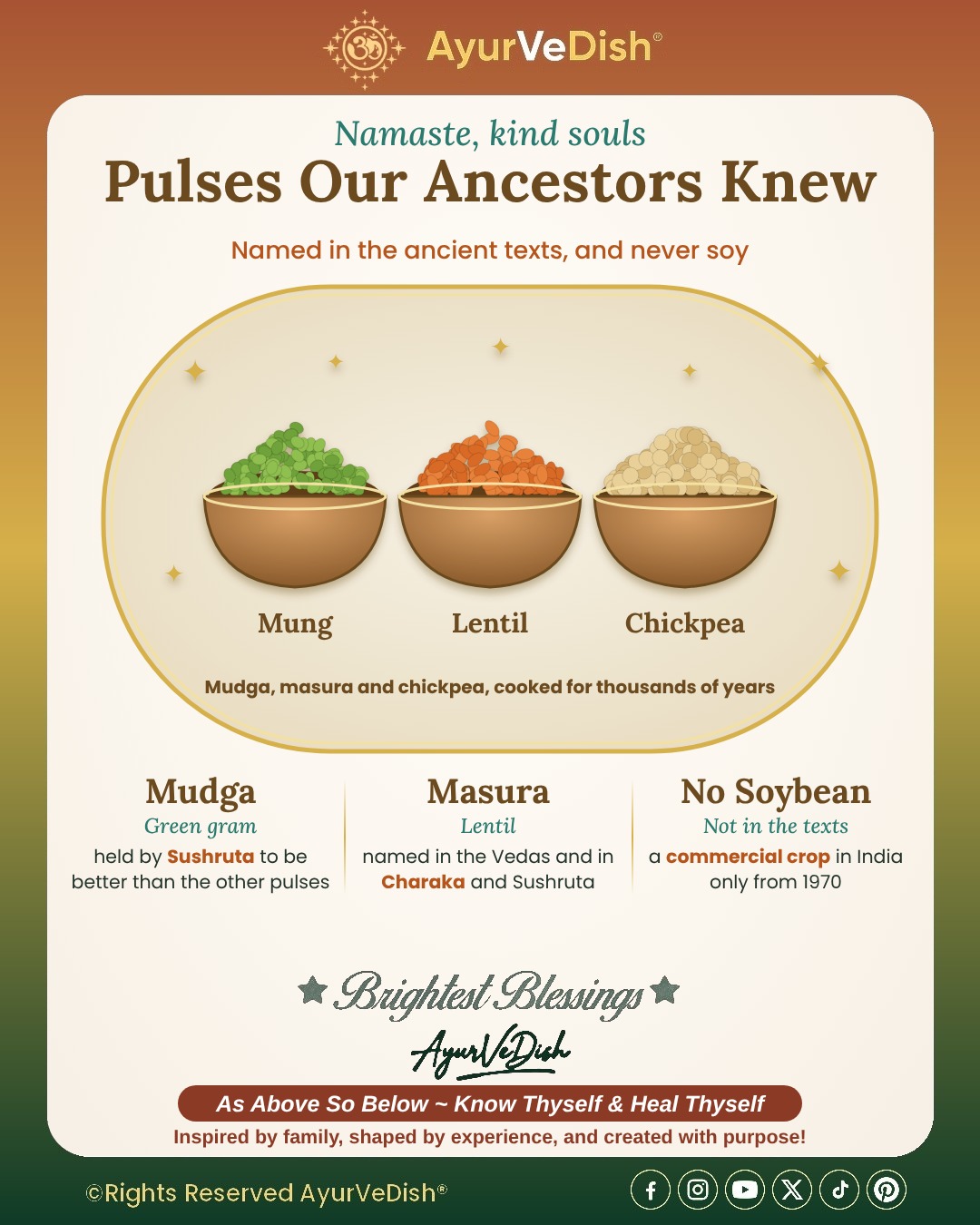
The old Indian texts, from the Vedas to the Charaka and Sushruta Samhitas, name a rich family of pulses: green gram (mudga), black gram (masha), lentil (masura), horse gram (kulattha), pigeon pea (adhaki) and chickpea. Sushruta held green gram to be better than the other pulses.
Soybean is not among them. In his study of Indian pulses through the millennia, the agricultural historian Dr Y. L. Nene traces each of these pulses through the ancient literature, and soybean does not appear. In India, the first commercial soybean crop was grown by farmers only in 1970.
Here Ayurveda and AyurVeDish stand together. We cook with the pulses our ancestors knew and trusted: mung, lentils, chickpeas and horse gram, in dals, soups, stews and savoury snacks.
What Researchers Have Found
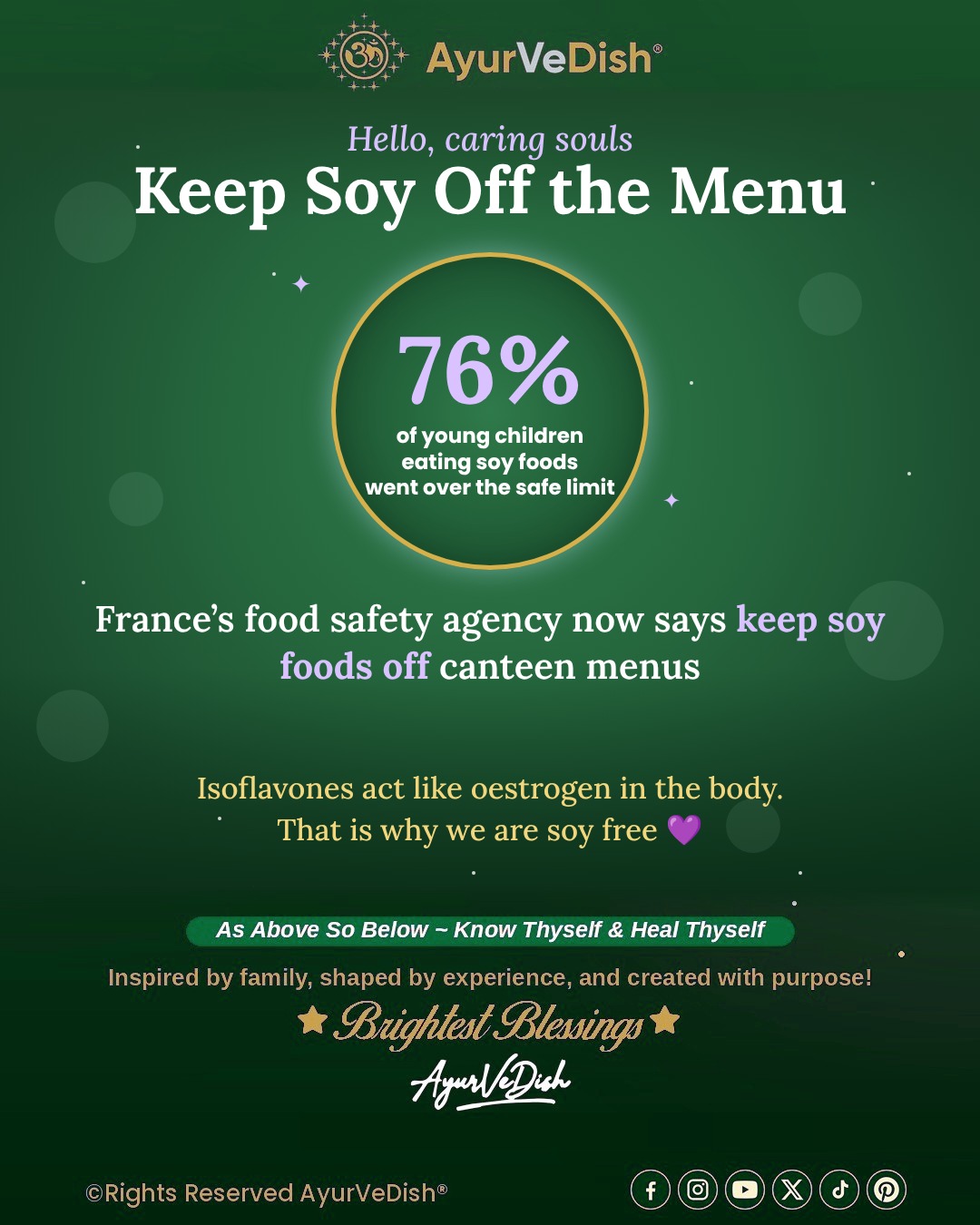
France says keep it off the menu. In March 2025, ANSES, the French Agency for Food, Environmental and Occupational Health and Safety, recommended that soy-based foods should not be served in mass catering, for any age group. It warned that isoflavones have oestrogenic hormonal activity and that too much can harm health, particularly the reproductive system. Among people who eat soy foods, it found that 76 per cent of children aged 3 to 5, 53 per cent of girls aged 11 to 17, and 47 per cent of men and of women aged 18 to 50 went over its health-based limit.
Babies. The UK’s Committee on Toxicity found “some uncertainty about the safety of soya-based infant formula”, noting that animal studies indicate “a possible concern”, and advised that it be used only in exceptional circumstances. The NHS says soya formula is suitable from 6 months only under medical supervision, and explains that, because of their low body weight, babies take in much higher amounts of phytoestrogens than older children or adults.
Soya and the Thyroid
The thyroid. In a trial led by Professor Thozhukat Sathyapalan at the University of Hull, 60 people with a mildly underactive thyroid took soy protein with 2mg of phytoestrogens for eight weeks and 16mg for another eight, in turn. On the higher dose, six women progressed to full hypothyroidism, a rate 3.6 times higher.
A 2021 meta-analysis of 41 studies found no change in men’s reproductive hormone levels, but responses differ, and some people simply find that soy does not agree with them. I am one of them.
More Than What We Leave Out
Our grain free falafel, dal vada and pakoda premixes are built on pulses and seeds, never soy, and our soy free choice widens the table for anyone seeking alternatives. One less ingredient list to worry about.
Let Food Be Thy Medicine Before Medicine Becomes Thy Food.
As Above, So Below, Know Thyself and Heal Thyself.
Inspired by family, shaped by experience, and created with purpose!
Brightest Blessings
This page is for information only. For medical advice, please speak to a qualified professional.
Evidence and Sources
- Nene YL. Indian pulses through the millennia. Asian Agri-History 2006;10(3):179-202. asianagrihistory.org/pdf/articles/Indian_pulses.pdf
- Singh BB. Success of soybean in India: the early challenges and pioneer promoters. Asian Agri-History. asianagrihistory.org/pdf/articles/successofsoyabean.pdf
- GOV.UK. Food labelling: allergen labelling. gov.uk/understanding-food-labelling/allergen-labelling
- The Cornucopia Institute. Dirty little secret in the natural foods industry: toxic chemical use. 12 February 2015. cornucopia.org/?p=3375
- ANSES. Avoid isoflavones on menus in mass catering. 24 March 2025. anses.fr/en/content/avoid-isoflavones-menus-mass-catering
- Committee on Toxicity. COT statement on the potential risks from high levels of soya phytoestrogens in the infant diet: lay summary. cot.food.gov.uk/sites/default/files/cot/cotlsumphytos.pdf
- NHS. Types of formula. nhs.uk/baby/breastfeeding-and-bottle-feeding/bottle-feeding/types-of-formula
- Sathyapalan T et al. The effect of soy phytoestrogen supplementation on thyroid status and cardiovascular risk markers in patients with subclinical hypothyroidism: a randomized, double-blind, crossover study. Journal of Clinical Endocrinology and Metabolism 2011;96(5):1442-1449. pubmed.ncbi.nlm.nih.gov/21325465
- ISAAA. Brief 55-2019: executive summary. isaaa.org/resources/publications/briefs/55/executivesummary
- Reed KE et al. Neither soy nor isoflavone intake affects male reproductive hormones: an expanded and updated meta-analysis of clinical studies. Reproductive Toxicology 2021;100:60-67. pubmed.ncbi.nlm.nih.gov/33383165