 AyurVeDish®
About us
Why AyurVeDish ExistsAyurveda at Our HeartOur Free-From PromiseWhole Food, Plant-Based LivingWhy Grain FreeWhy Oil FreeWhy Dairy FreeWhy Yeast FreeWhy Cane Sugar FreeWhy Soy FreeWhy Thoughtful IngredientsFresh and SeasonalHerbs and SpicesFood from Around the WorldGood Food for EveryoneA Recipe Should Inspire YouEat to LiveSalt, Spice and BalanceAyurveda
Ayurveda Made SimpleThe Five ElementsThe Three DoshasVataPittaKaphaPrakritiYour Dosha CombinationEating for Your ConstitutionChoosing Foods ThoughtfullyThe Six TastesSix Tastes on One PlateFood QualitiesAgni (Fire)Herbs and Spices in the Ayurvedic KitchenEating With the SeasonsAyurveda and the Body ClockFasting: The Ancient PauseBuilding a Plant-Based Ayurvedic MealAyurveda and Modern NutritionFood Combinations and Meal PlanningShop
Speciality All-in-One BlendsGrain Free Rice-Style BlendsSnack & Savoury PremixesGrain Free FloursBakes & DessertsChutneys, Dips & PicklesTadkas & Finishing SpicesDetox & Ayurvedic TeasHot & Cold Drinks





Kapha
Kapha: Earth and Water, the Dosha of Steadiness
Think of a mountain beside a lake. It is still, strong and steady, and it holds everything together. That is the picture the ancients used for Kapha, the dosha of stability, structure and nourishment.
Kapha is made of earth and water. Earth gives it form and steadiness. Water gives it softness and cohesion. It is the dosha that holds us together, in body and in mind.
The Qualities of Kapha
Kapha is described through heaviness, coolness, softness and steadiness. In everyday life these show as a calm nature, strong stamina, a loyal heart and a slow, steady appetite. In balance, the traditions describe patience, kindness and endurance. Every home is richer for someone with those gifts.
What the Ancient Texts Say
The Charaka Samhita (Sutrasthana 1.61) describes Kapha as heavy, cold, soft, unctuous, sweet and steady, and the Ashtanga Hridaya (Sutrasthana 1.12) agrees, adding smooth and dense. The Sushruta Samhita (Sutrasthana 15) names five forms of Kapha, whose work includes lubricating the joints, building strength and giving firmness to the limbs. The ancients saw Kapha as the dosha that builds and protects.

Kapha and Food
The idea is simple. A heavy, cool dosha is balanced by lighter, livelier food. The Charaka Samhita (Sutrasthana 1.66) lists pungent, bitter and astringent tastes as those that pacify Kapha, and sweet, sour and salty tastes as those that increase it.
In a plant-based kitchen that points to variety, lighter meals, plenty of vegetables and lively flavours. Beans, lentils, chickpeas, leafy greens and a wide range of vegetables make good foundations, and ginger, black pepper, cumin and other aromatic spices bring warmth and depth.
How We Cook for Kapha
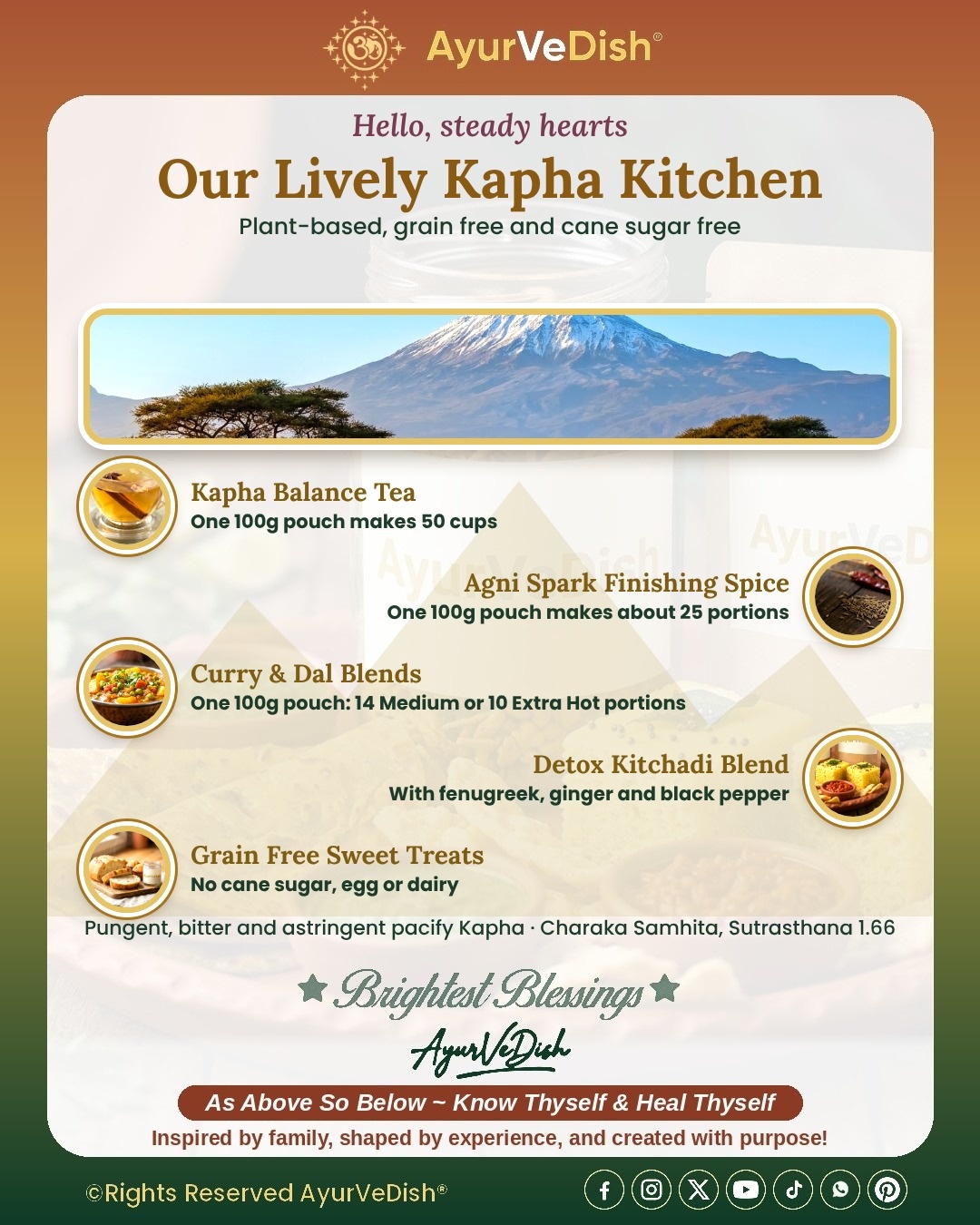
Our Kapha Balance herbal tea is caffeine free: dry ginger (sunth) 25%, cinnamon (dalchini) 16%, tulsi 16%, green cardamom (elaichi) 10%, black pepper (kali mirch) 8%, fennel (saunf) 6%, turmeric (haldi) 6%, amla 4%, clove (laung) 3%, carom (ajwain) 3% and vanilla 3%. One level teaspoon (2g) in 200ml of freshly boiled water, steeped for 5 to 7 minutes, makes a cup, so one 100g pouch makes 50 cups. The vanilla and cardamom add gentle sweetness, so no sweetener is needed.
Our Agni Spark is a warming sprinkle-on finishing spice of cumin (jeera), dry ginger (sunth), black pepper (kali mirch), long pepper (pippali), carom (ajwain) and more. There is no cooking: sprinkle it over dals, soups and vegetables at the table. One 100g pouch makes about 25 portions of 4g.
For lively, warming meals, our all-in-one curry and dal blends bring pungent spice to any pulse or vegetable. One 100g pouch gives about 25 portions at Mild (4g), 14 at Medium (7g) and 10 at Extra Hot (10g) per 200g of vegetables. A tadka is always optional.
For a light one-pot meal, our Detox Kitchadi Blend adds fenugreek (methi), dry ginger (sunth) and black pepper to our grain free kitchadi base. One 100g pack makes about 25 pots at Mild (4g), 14 at Medium (7g) and 10 at Extra Hot (10g).
For something sweet, our grain free cupcake, banana bread, muffin and pancake premixes and our srikand dessert are made without cane sugar, egg or dairy.
Eating for Kapha: A Practical Guide
Kapha is heavy, cold, soft, oily, stable and slow, so it settles with food that is warm, light, dry and briskly spiced, in portions that leave some room. Here is that idea as a grain free, oil free basket and a full day of meals.
| Food group | Leans towards settling | Use more lightly |
|---|---|---|
| Vegetables | Young radish and mooli, onions, leeks, spring onions, garlic, watercress, rocket, cabbage, cauliflower, broccoli, Brussels sprouts, kale, aubergine, bitter gourd (karela), pointed gourd (parwal), fresh methi, amaranth leaves (chaulai), green beans and chicory | Sweet potato, squash, pumpkin and potatoes, cucumber, okra, avocado, mushrooms (Charaka calls them cold, sweet and heavy), and mustard greens (sarson), which he says unsettle all three doshas |
| Fruit | Lemons, which Charaka says ease kapha and vata, pomegranate, amla, apples and pears (best cooked), cranberries, quince and berries | Bananas, mango, melon and watermelon, grapes, dates, figs and other dried sweet fruit, fresh coconut and tamarind |
| Pulses | Mung and moong dal, red lentils (masoor), chickpeas and kala chana, split peas, horse gram (kulthi), black-eyed beans and moth beans | Split urad dal, which Charaka calls heavy, large portions of chickpea or red lentil tofu, and dals finished with coconut cream |
| Herbs and spices | Fresh and dry ginger, black pepper, mustard seed, fenugreek seed, ajwain, cumin, turmeric, cloves, cinnamon, pure hing and holy basil (tulsi), with long pepper as an occasional pinch | Salt of every kind, date paste, date sugar and coconut sugar, and long pepper taken daily, which Charaka warns against |
| Seeds and grain free staples | Buckwheat flour and groats, amaranth (including puffed rajgira), besan chilla cooked on a dry tawa, quinoa in modest portions, and small amounts of dry-roasted pumpkin and sunflower seeds | Sesame seeds (Charaka says they raise kapha), cassava and sabudana, coconut milk, coconut cream and coconut yoghurt, chia puddings, and large handfuls of seeds |
| Drinks | Hot water sipped through the day, fresh ginger tea, tulsi tea, cinnamon and clove tea, and hot water with lemon and ginger | Iced and chilled drinks, sweet sharbats and juices, coconut milk drinks, and large glasses of water taken with a meal |
Tastes, qualities and temperature
Charaka gives pungent, bitter and astringent as the tastes that settle kapha, and all three are drying; bitter is the lightest of the six tastes, and pungent is the one he credits with kindling digestion and opening the body’s channels. Sweet, sour and salty increase kapha, and sweet is the heaviest and coldest of all, which is why ripe fruit and starchy roots sit in the lighter column. Mung is the welcome exception: the Ashtanga Hridaya names it among sweet foods that do not raise kapha, and Charaka calls it light, dry and the best of pulses. Choose food that is warm to hot, freshly cooked and on the dry side: dry-cooked shaak, brothy soups rather than creamy ones, toasted spices and crisp-edged vegetables from a dry tray. Quantity is part of the picture too, since the texts tie kapha to a slow digestive fire, ask that we eat only once the last meal has been digested, and advise taking heavy foods only to a third or a half of fullness. Sweet potato, squash and potatoes have no classical taste assignment, so their place in the lighter column is modern practice.
Cooking methods
- Dry-roasting: cabbage, sprouts, cauliflower and broccoli on a hot tray, and whole spices in a dry pan.
- Water-sauté with the least liquid that stops sticking, letting the pan run dry at the end for colour.
- Steaming greens, then finishing them with a dry tempering of mustard seed, cumin and pure hing.
- Baking or air-frying besan pakora-style bites and buckwheat flatbreads in place of frying.
- Brothy simmering: rasam-style and clear vegetable soups rather than thick, creamy gravies.
- Cooking on a dry tawa: buckwheat roti and besan or moong chilla.
A day of eating
- Breakfast, light or late: begin with hot water, lemon and fresh ginger, then a buckwheat and besan chilla with grated mooli and spring onion, or warm stewed apple with cinnamon and clove.
- Lunch, the main meal: Gujarati sambharo of cabbage and carrot dry-cooked with mustard seed, turmeric and pure hing, masoor dal with ginger and black pepper, and buckwheat roti from a dry tawa.
- Dinner, early and light: a horse gram rasam-style broth with black pepper and curry leaves, or a UK-style leek, watercress and red lentil soup with plenty of black pepper.
- Snack: often none is needed; if hunger is real, a crisp apple, slices of young mooli with lemon and a pinch of black salt, or dry-roasted chickpeas with ajwain.
- Drinks: hot water through the day, ginger or tulsi tea mid-morning, cinnamon and clove tea in the afternoon, and only small sips with meals.
Through the UK year
Classically, kapha builds up through the cold of late winter, flares in spring when the strengthening sun melts it and dulls digestion, and settles in summer. For spring, Charaka tells us what to avoid (heavy, sour, oily and sweet food, and sleeping by day) and recommends regular exercise; the pungent, bitter and astringent emphasis follows from that rather than being written out. As our adaptation for the UK, we read the cold, damp months of January and February as the build-up, and March to May, as the days lengthen and warm, as the time kapha is most likely to feel heavy. That is when we move towards the settling column: lighter dals, spring greens, watercress, radishes and purple sprouting broccoli with ginger and pepper, and fewer sweet roots and dense puddings.
Build a list with our Ready-Made Lists on the Shopping List Builder.
What suits you will always depend on you as a person, your digestion, the season and how the food is prepared.
My Own Experience
My own constitution is predominantly Kapha. Yet when my teacher first gave me the questionnaire during my course, Kapha was the weakest dosha showing in me, and Vata and Pitta led. It was a lesson in how far out of balance we can drift without noticing. When I brought Kapha-focused meals together with a whole-food, plant-based way of eating, I found the combination did more for my wellbeing than either one alone. That experience shaped AyurVeDish, and it is why we love sharing it.
What Researchers Have Found
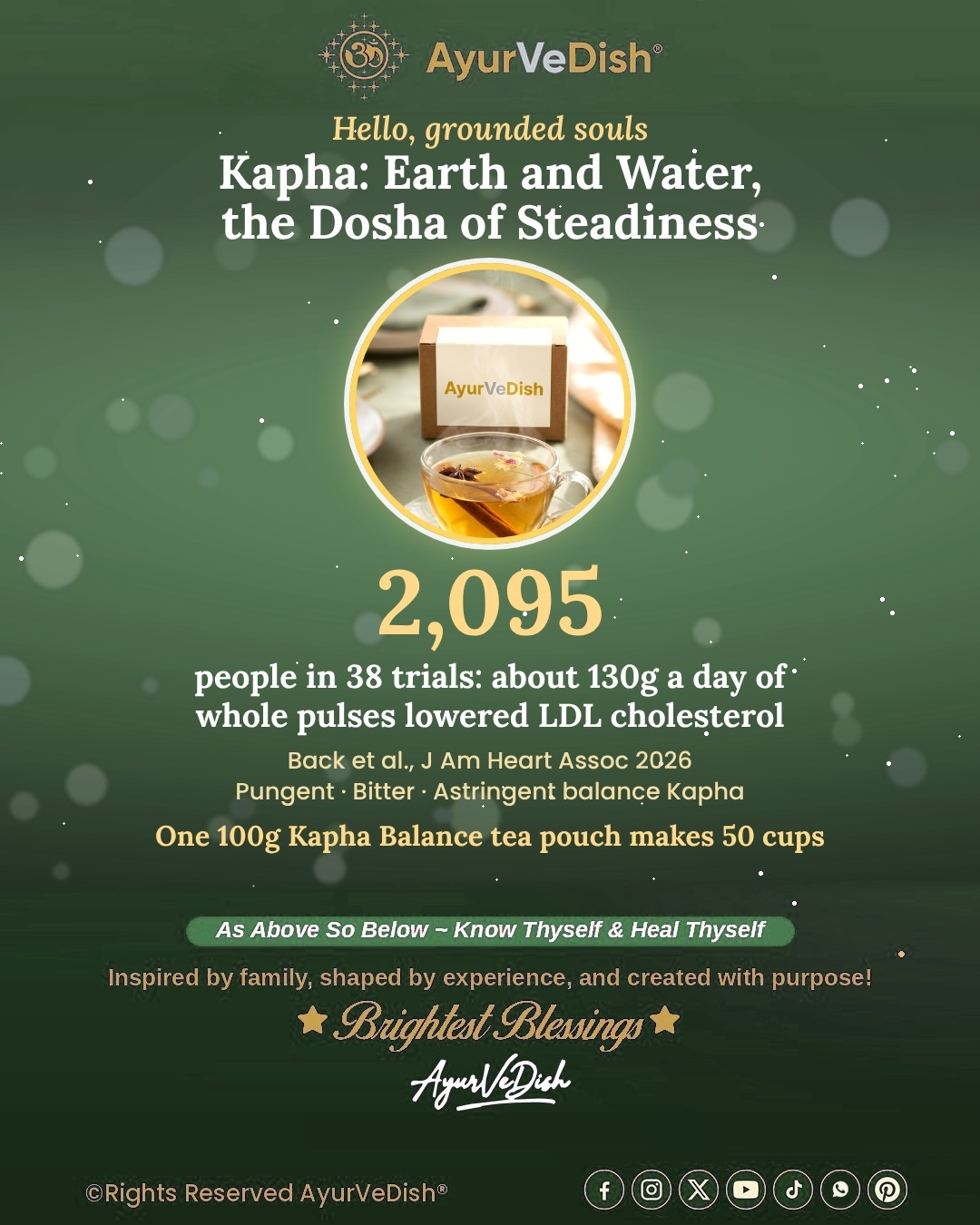
Lentil, bean and pea dishes have good modern support. In 2026, in the Journal of the American Heart Association, Back and colleagues combined 38 randomised trials with 2,095 people. About 130g a day of whole pulses (roughly half to two-thirds of a cup) lowered LDL cholesterol by 0.14 mmol/L, non-HDL cholesterol by 0.22 mmol/L, and apolipoprotein B (apoB, a marker of cholesterol-carrying particles) by 0.08 g/L. For beans, the benefit grew with the amount eaten, up to a cup a day.
In 2018, in Frontiers in Microbiology, Chauhan and colleagues studied the gut bacteria of healthy people in rural western India, grouped by their Ayurvedic constitution as Vata, Pitta or Kapha. Several bacteria were found in different amounts in each group, and some were specific to men or women. In other words, the old constitution types appear to line up with measurable differences between people.
Begin Where You Are
You do not need to decide whether you are Kapha. Simply notice. Do you feel brighter after light, lively food? Do heavy meals leave you feeling slow? That noticing is the beginning of the practice, so follow what feels right with curiosity.
Let Food Be Thy Medicine Before Medicine Becomes Thy Food.
As Above, So Below, Know Thyself and Heal Thyself.
Inspired by family, shaped by experience, and created with purpose!
Brightest Blessings

This page is for information only. For medical advice, please speak to a qualified professional.
Evidence and Sources
- Charaka Samhita, Sutrasthana 1, Deerghanjiviteeya Adhyaya, verse 61. carakasamhitaonline.com/index.php/Deerghanjiviteeya_Adhyaya
- Charaka Samhita, Sutrasthana 1, verse 66. siva.sh/caraka-samhita/sutra-sthana/1/66-70
- Ashtanga Hridaya, Sutrasthana 1, verse 12. satyori.com/source-texts/ashtanga-hridayam/sutrasthana/1/12/
- Sushruta Samhita, Sutrasthana 15. wisdomlib.org/hinduism/book/sushruta-samhita-volume-1-sutrasthana/d/doc122907.html
- Back S et al. Whole dietary pulses and lipid targets. Journal of the American Heart Association 2026. pubmed.ncbi.nlm.nih.gov/42132198/
- Chauhan NS et al. Gut microbiome and Prakriti in healthy adults of rural western India. Frontiers in Microbiology 2018. frontiersin.org/journals/microbiology/articles/10.3389/fmicb.2018.00118/full
- Charaka Samhita, Sutrasthana 1 (Deerghanjiviteeya Adhyaya), verses 61 to 65: the qualities of kapha. siva.sh
- Charaka Samhita, Vimanasthana 1 (Rasa Vimana), verses 6 to 10: the tastes that increase and settle each dosha. siva.sh
- Charaka Samhita, Sutrasthana 26 (Atreyabhadrakapyiya Adhyaya), verses 56 to 60: lightness of the tastes, vipaka, and the unctuous and dry tastes. siva.sh
- Charak Samhita Online (Charak Samhita Research, Training and Development Centre, Jamnagar). Charaka Samhita, Sutrasthana 26, Atreyabhadrakapyiya Adhyaya (verses 43, 49 and 53: actions of the tastes, rock salt and amalaka as non-heating, salt as the most heating taste). carakasamhitaonline.com
- ayurveda-origin. Ashtanga Hridaya, Sutrasthana 10, Rasabhediyam (mung among sweet foods that do not raise kapha; amalaka and pomegranate as sour fruits that do not aggravate pitta). ayurveda-origin.pages.dev
- Charaka Samhita, Sutrasthana 27 (Annapanavidhi Adhyaya), verses 21 to 25: mung, urad and black-eyed beans. siva.sh
- Charaka Samhita, Sutrasthana 27 (Annapanavidhi Adhyaya), verses 26 to 30: horse gram, moth beans, chickpeas, lentils, peas and sesame. siva.sh
- Charaka Samhita, Sutrasthana 27 (Annapanavidhi Adhyaya), verses 96 to 100: pointed gourd, aubergine, bitter gourd and other bitter vegetables. siva.sh
- Charaka Samhita, Sutrasthana 27 (Annapanavidhi Adhyaya), verses 121 to 125: mustard greens, mushrooms and grapes. siva.sh
- Charaka Samhita, Sutrasthana 27 (Annapanavidhi Adhyaya), verses 166 to 170: ginger, lemon, radish, holy basil and ajwain. siva.sh
- Charak Samhita Online. Charaka Samhita, Vimanasthana 1, Rasa Vimana (verse 16 on long pepper; verses 24 to 25 on the rules of eating). carakasamhitaonline.com
- Charak Samhita Online. Charaka Samhita, Sutrasthana 5, Matrashiteeya Adhyaya (verses 6 to 7: heavy foods to a third or half of fullness). carakasamhitaonline.com
- Satyori. Ashtanga Hridayam, Sutrasthana 1, verse 8: the doshas across life, day, night and digestion, and the four digestive fires. satyori.com
- Charaka Samhita, Sutrasthana 6 (Tasyashiteeya Adhyaya), verses 21 to 25: late winter and spring regimen. siva.sh
- Ashtanga Hridaya, Sutrasthana 12 (Doshabhediya Adhyaya), verses 21 to 25: the seasonal build-up, flare and settling of each dosha. siva.sh