 AyurVeDish®
About us
Why AyurVeDish ExistsAyurveda at Our HeartOur Free-From PromiseWhole Food, Plant-Based LivingWhy Grain FreeWhy Oil FreeWhy Dairy FreeWhy Yeast FreeWhy Cane Sugar FreeWhy Soy FreeWhy Thoughtful IngredientsFresh and SeasonalHerbs and SpicesFood from Around the WorldGood Food for EveryoneA Recipe Should Inspire YouEat to LiveSalt, Spice and BalanceAyurveda
Ayurveda Made SimpleThe Five ElementsThe Three DoshasVataPittaKaphaPrakritiYour Dosha CombinationEating for Your ConstitutionChoosing Foods ThoughtfullyThe Six TastesSix Tastes on One PlateFood QualitiesAgni (Fire)Herbs and Spices in the Ayurvedic KitchenEating With the SeasonsAyurveda and the Body ClockFasting: The Ancient PauseBuilding a Plant-Based Ayurvedic MealAyurveda and Modern NutritionFood Combinations and Meal PlanningShop
Speciality All-in-One BlendsGrain Free Rice-Style BlendsSnack & Savoury PremixesGrain Free FloursBakes & DessertsChutneys, Dips & PicklesTadkas & Finishing SpicesDetox & Ayurvedic TeasHot & Cold Drinks






My Daily Ritual Abroad
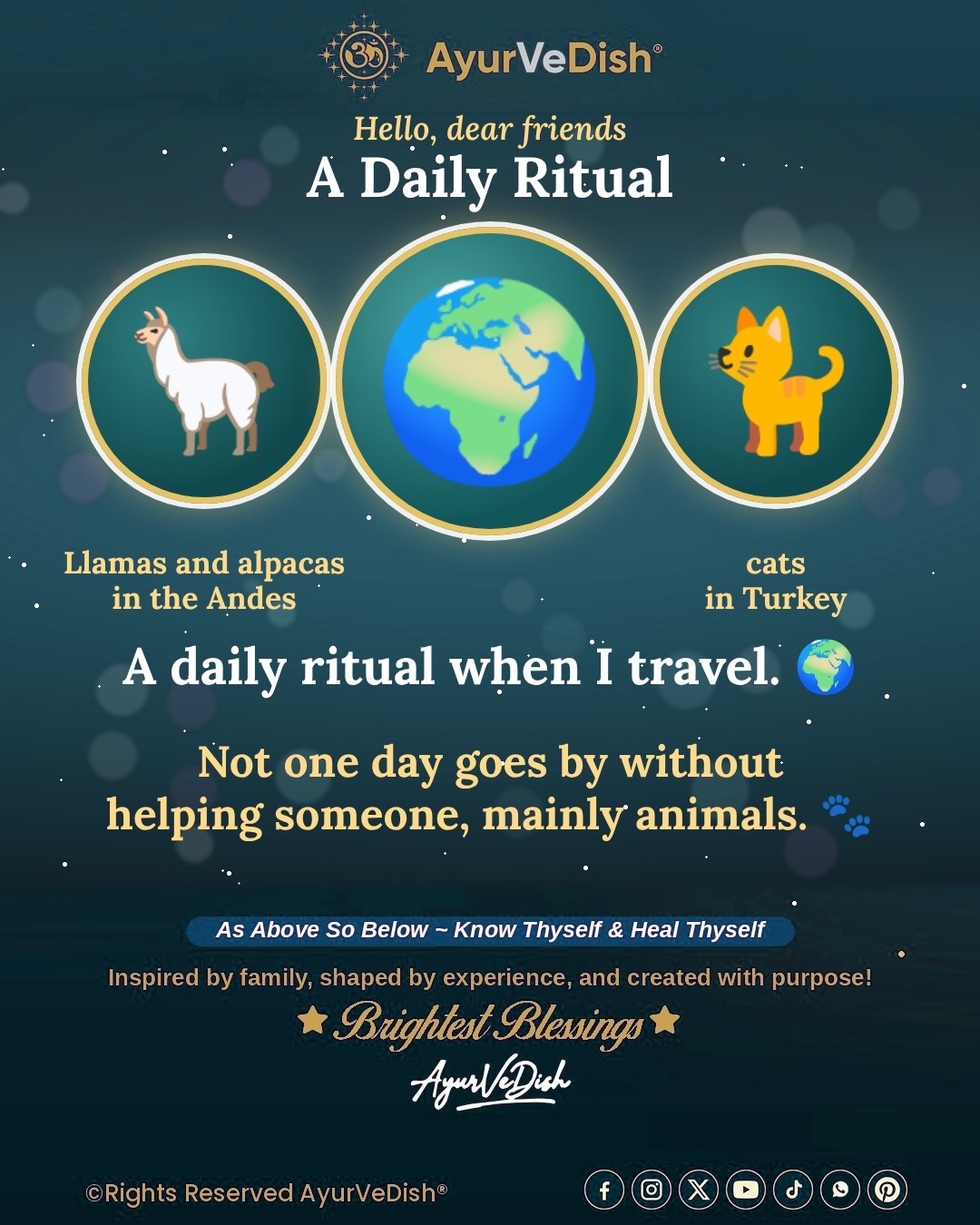
When I travel, helping people and animals, mainly animals, is my daily ritual. I cannot let a day go by without helping someone or something. In Peru I went up into the mountains to feed alpacas and help people in the villages. In South, North and Central India I did the same. Europe has few street animals. In Turkey there are hardly any dogs, but a great many cats, so I feed the cats.
Every Life Deserves Compassion
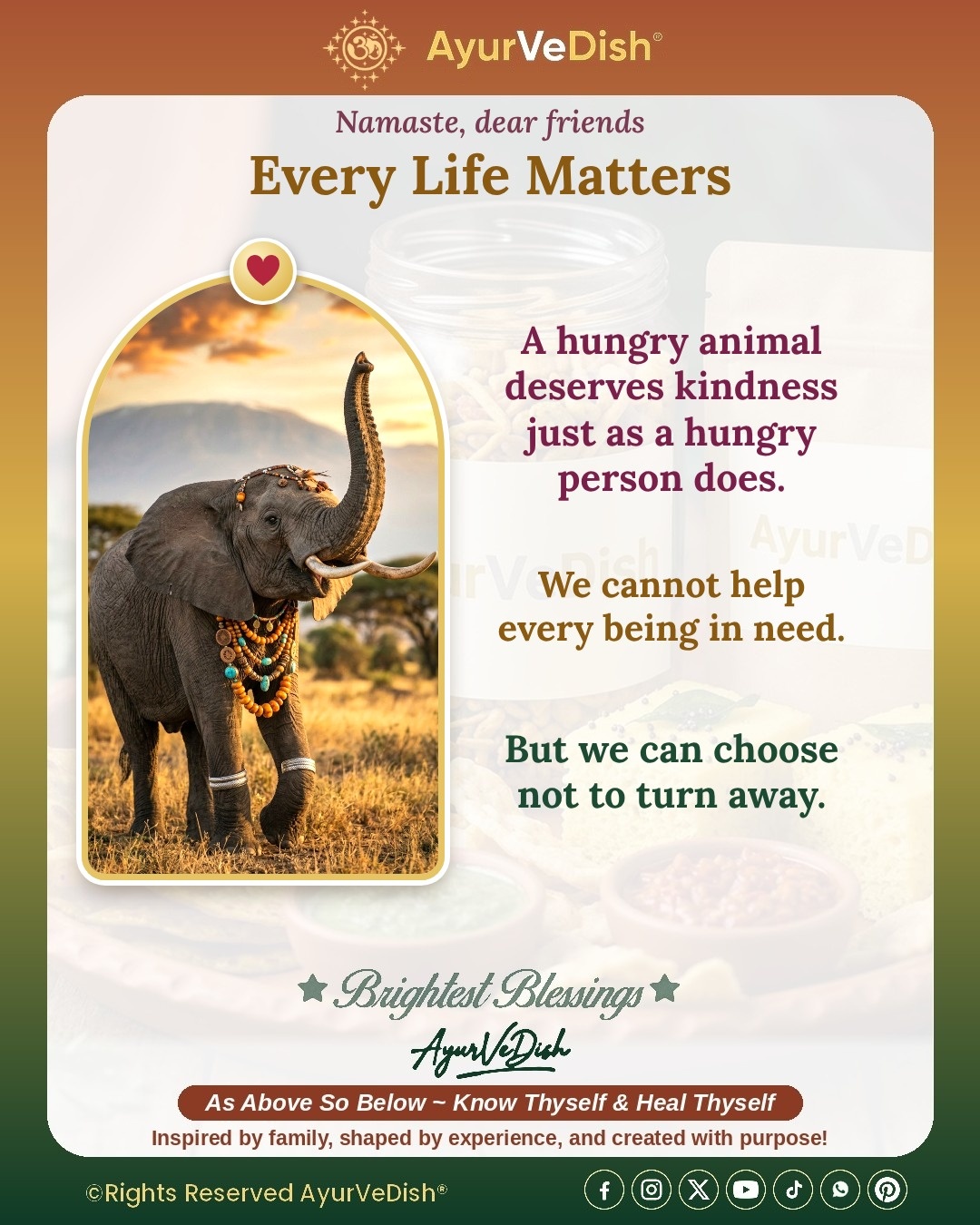
A hungry animal deserves kindness just as a hungry person does. Street animals face hard days, and many have no one looking out for them. One act of kindness may not change the world, but it can change the life in front of us.
We cannot help every being in need, but we can choose not to turn away when we have the chance. Kindness is measured not only by grand gestures, but by small things done consistently, often when nobody is watching.
Closer to Home
At home I regularly send money to the RSPCA. The causes I give to are clean water in Africa and dog and cat rescue.
Safe water is something many of us never think about. WHO and UNICEF reported in August 2025 that 2.1 billion people, one in four, still lack safely managed drinking water. In parts of sub-Saharan Africa and Central and Southern Asia, many people spend more than 30 minutes a day collecting it.
What the Ancient Texts Say
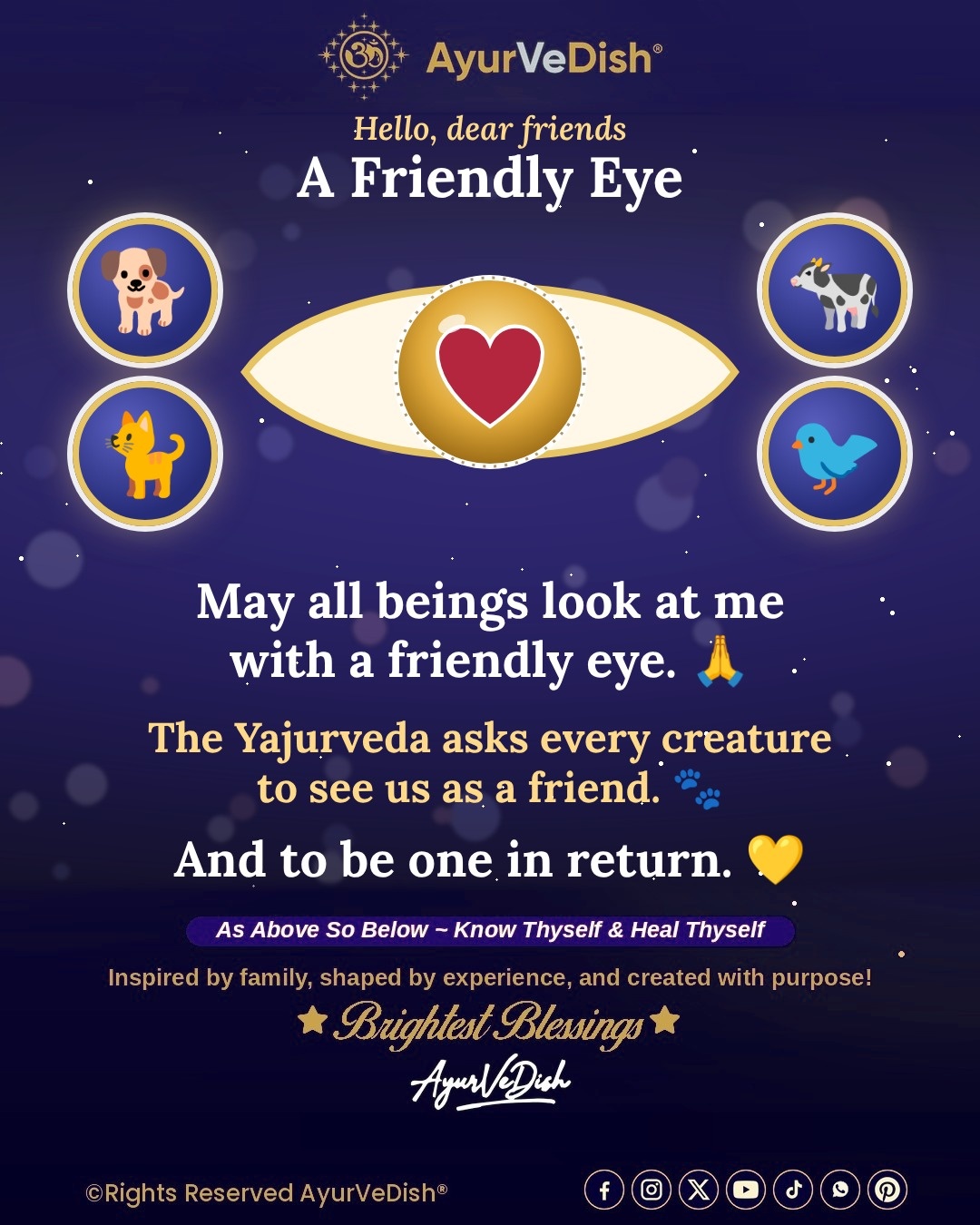
The Mahabharata teaches that non-harm, ahimsa, is the highest dharma, the best austerity and the greatest gift. The Yajurveda (36.18) holds a prayer: “May all beings look at me with a friendly eye.” It asks every creature to see us as a friend, and quietly asks us to be one in return.
The Isha Upanishad (verse 2) says that one who wishes to live a hundred years on this earth should live doing karma, that is, action. Compassion was never meant to stay a feeling. It was meant to become a deed. The ancients put it into prayer and principle, and trusted us to live it.
What Researchers Have Found
In a 2015 study in Science, Miho Nagasawa and colleagues in Japan measured oxytocin, the bonding hormone, in 30 dogs and their owners. The more a dog gazed lovingly at its owner, the more oxytocin rose in the owner, and the dog’s rose too. The dogs were family pets, not strays, so the study shows what a bond can do.
A 2018 review in the Journal of Experimental Social Psychology by Oliver Curry and colleagues combined 27 studies from 24 articles, with 4,045 people. It found that acts of kindness gave a small-to-medium boost to the well-being of the person doing them, across ages and in both men and women. A small act can matter to the one who receives it and the one who gives.
Cats join the story too. In a 2025 study in Applied Animal Behaviour Science, Chang and colleagues followed 30 pet cats and found that in securely bonded cats, oxytocin in the saliva rose after time with their owner. We have our own fur babies at home, so this one made us smile. 🐾💛
Moments That Matter
Together, the people, animals and acts of service in this page are the heart of our promise. Compassion is best understood through the lives we touch and the actions we take.
Food can nourish us, but compassion can bring us together.
As Above, So Below, Know Thyself and Heal Thyself.
Inspired by family, shaped by experience, and created with purpose!
Brightest Blessings

This page is for information only. For medical advice, please speak to a qualified professional.
Evidence and Sources
- Mahabharata and Yajurveda 36.18 on ahimsa and the friendly eye, Hindupedia
- Isha Upanishad, verse 2, Wisdomlib
- Nagasawa M et al. (2015) Oxytocin-gaze positive loop and the coevolution of human-dog bonds, Science, reported by Gizmodo
- Curry OS et al. (2018) Happy to help? Journal of Experimental Social Psychology, Bournemouth University
- 1 in 4 people globally still lack access to safe drinking water, WHO and UNICEF, 26 August 2025, UNICEF USA
- RSPCA
- Chang H, Zhang J, Huang H, Aviles-Rosa EO, Huang H, Guo Y, Xiao Z, Liu Q, Deng B, Zhang L. The effects of owner–cat interaction on oxytocin secretion in pet cats with different attachment styles. Applied Animal Behaviour Science 2025;283:106524