 AyurVeDish®
About us
Why AyurVeDish ExistsAyurveda at Our HeartOur Free-From PromiseWhole Food, Plant-Based LivingWhy Grain FreeWhy Oil FreeWhy Dairy FreeWhy Yeast FreeWhy Cane Sugar FreeWhy Soy FreeWhy Thoughtful IngredientsFresh and SeasonalHerbs and SpicesFood from Around the WorldGood Food for EveryoneA Recipe Should Inspire YouEat to LiveSalt, Spice and BalanceAyurveda
Ayurveda Made SimpleThe Five ElementsThe Three DoshasVataPittaKaphaPrakritiYour Dosha CombinationEating for Your ConstitutionChoosing Foods ThoughtfullyThe Six TastesSix Tastes on One PlateFood QualitiesAgni (Fire)Herbs and Spices in the Ayurvedic KitchenEating With the SeasonsAyurveda and the Body ClockFasting: The Ancient PauseBuilding a Plant-Based Ayurvedic MealAyurveda and Modern NutritionFood Combinations and Meal PlanningShop
Speciality All-in-One BlendsGrain Free Rice-Style BlendsSnack & Savoury PremixesGrain Free FloursBakes & DessertsChutneys, Dips & PicklesTadkas & Finishing SpicesDetox & Ayurvedic TeasHot & Cold Drinks





Food Combinations and Meal Planning
Ancient Guidance, Gently Applied
Which foods go well together? People have asked this for thousands of years. Ayurveda has a full tradition on it, and modern nutrition has some pleasing things to add. The ancients wrapped a lot of everyday kitchen sense into their rules about combining food. The kindest way to enjoy them is as inspiration.
What the Ancient Texts Say
The Charaka Samhita calls food that works against the body viruddha ahara, meaning “incompatible food”. Sutrasthana 26.85 describes it as food that stirs up the doshas without clearing them from the body. The text then lists many ways food can be incompatible. They include place, time and quantity, digestion, preparation, cooking and the order in which foods are eaten.
The same text gives the other half of the picture. Sutrasthana 26.106 says the effects are lessened or absent when a person is used to the combination, takes only a little, has strong digestion, is young or is physically fit. Even the ancient authors did not intend these as rigid rules, so we read them as traditional guidance.
Building a Varied Plant-Based Meal
A practical starting point is variety.
1. Vegetables: enjoy a colourful selection of seasonal vegetables, cooked in the way you like.
2. Plant proteins: include lentils, beans, chickpeas and peas.
3. Herbs and spices: add flavour and aroma with seasonings that complement your ingredients and suit your taste.
4. Variety through the week: explore different ingredients, textures and cooking methods.
Ayurveda describes six tastes: sweet, sour, salty, pungent, bitter and astringent. Use them as inspiration for interesting combinations, though you do not need all six in every meal.
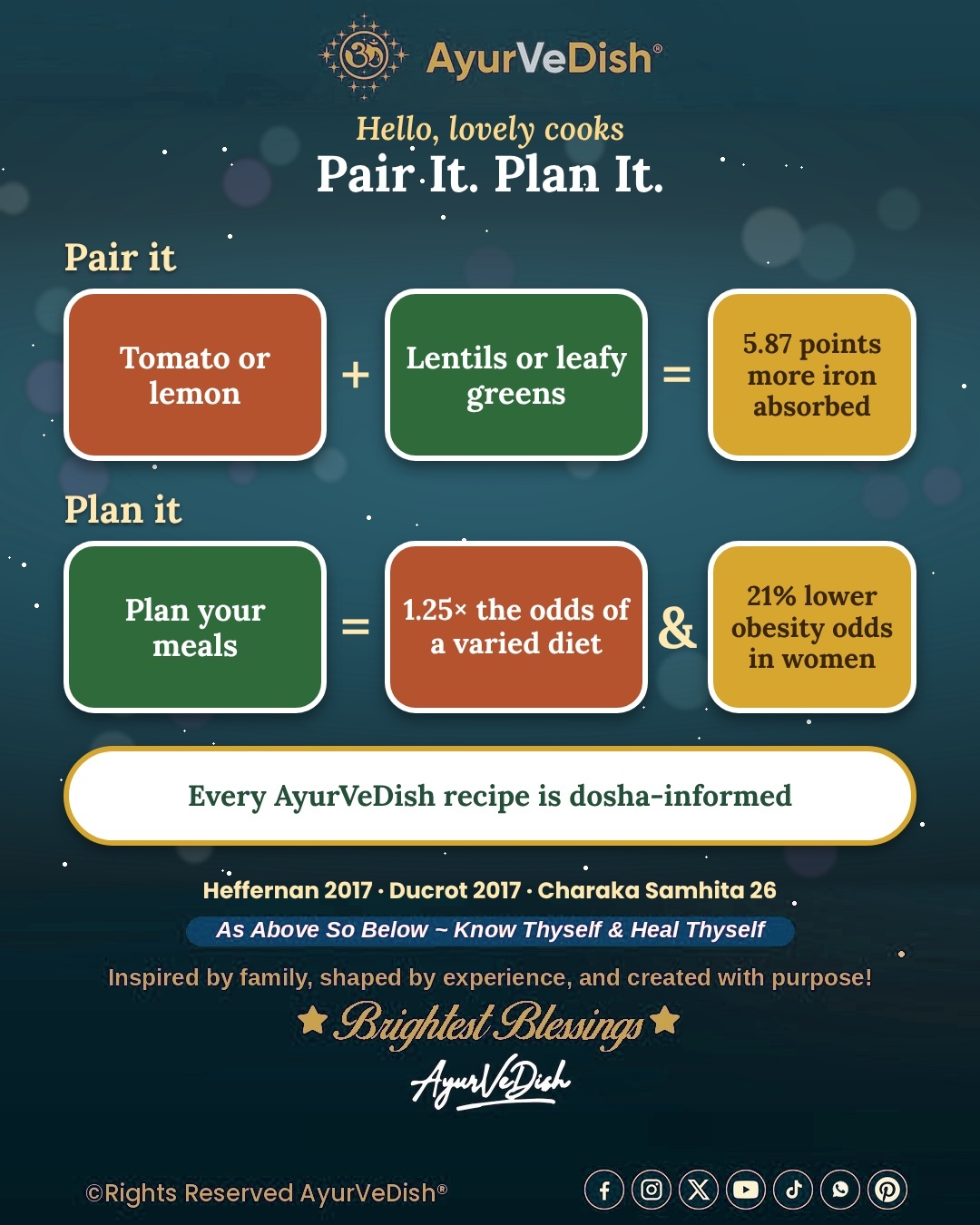
Every AyurVeDish Recipe Is Dosha-Informed
Ayurveda describes individual constitution through Vata, Pitta and Kapha, and traditional guidance may suggest considering your constitution, the season and the qualities of foods. At AyurVeDish, you do not have to work this out on your own. Every one of our recipes and fact sheets is written to inform you. Each one shows how to make the dish friendly to your dosha, and how that food presents to Vata, Pitta and Kapha. You can see at a glance how the same meal sits with your own constitution and how to adjust it, all in one place, so you can cook and choose with confidence.
Incompatible Food in Charaka, Read for a Plant-Based Kitchen
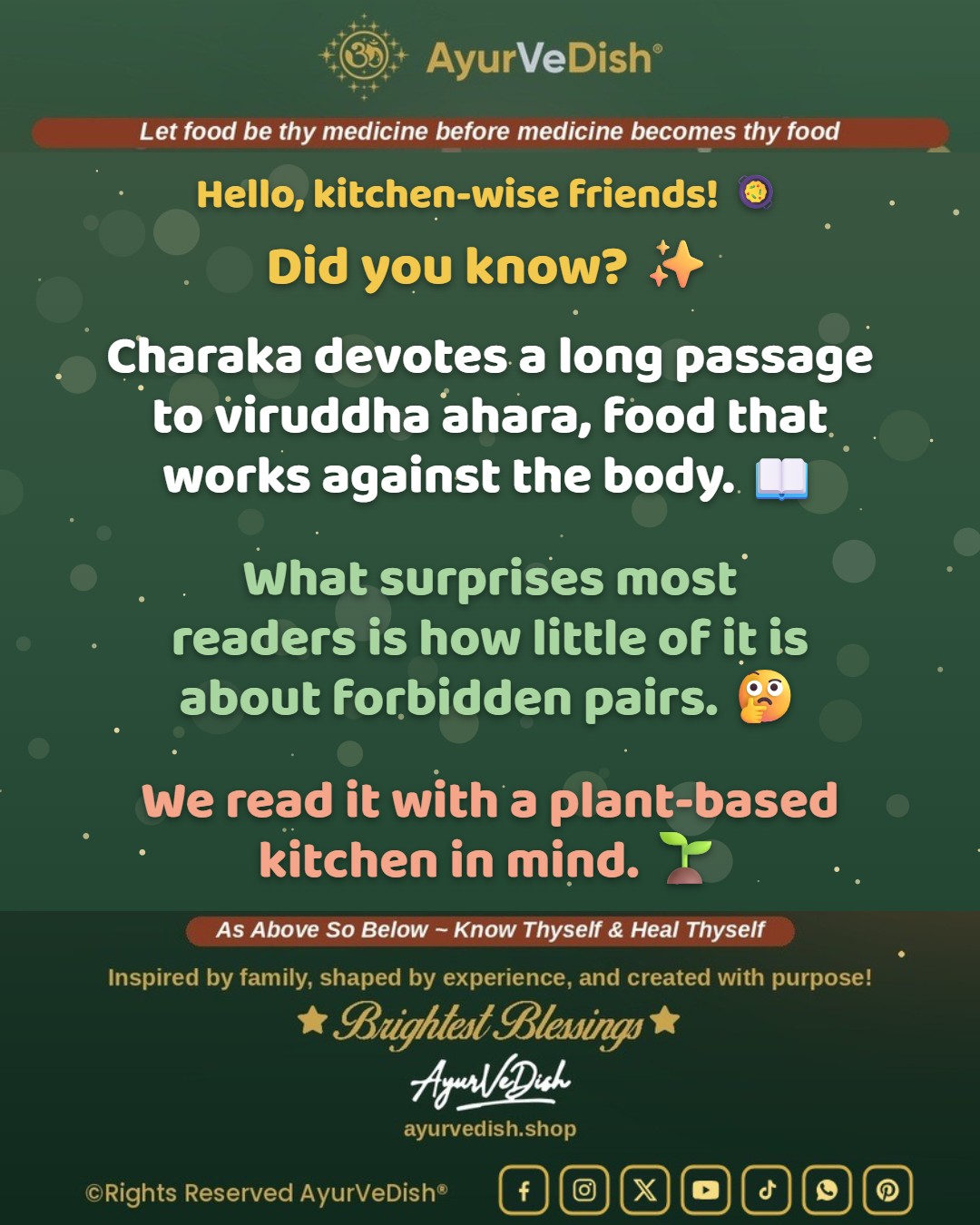
Charaka devotes a long passage to viruddha ahara, food that works against the body. What surprises most readers is how little of it is about forbidden pairs. He sets out eighteen ways a meal can go wrong, and most of them concern place, season, quantity, habit, cooking and the state of the person eating. The famous pairs are only one heading among many.
Honesty matters here. Nearly every named pair in the passage involves dairy, fish, meat or honey, none of which belong in our kitchen, so those examples simply do not apply to us. We do not stretch them to cover plant foods that look similar; coconut milk, for instance, is not the milk Charaka was writing about, and we make no classical claim about it either way.
| Heading | What Charaka means | In our grain free, oil free kitchen |
|---|---|---|
| Place | Dry, sharp food in an arid land, or cold, oily food in a marshy one | Read your own climate: a damp British winter asks for warm, light, well-spiced food |
| Season | Cold, dry food in winter; pungent, hot food in summer | No raw salads as the main meal in January; ease off chilli and salt in a July heatwave |
| Digestive fire | Food that ignores the strength of a person’s digestion | A heavy chickpea dish suits a strong appetite, not a sluggish one |
| Quantity | His example is two foods mixed in equal measure (honey and ghee), outside our range | The principle stands: portion and proportion change a food’s effect |
| Habit | Sweet, cold food given suddenly to someone used to pungent, hot food | Change a diet in steps, not overnight |
| Processing and cooking | Preparation that spoils a good food; food cooked with poor fuel, undercooked, overcooked or burnt | Cook pulses fully, never char spices, and do not reheat a dish until it catches |
| Potency | Strongly heating and strongly cooling substances taken together | Avoid pairing iced drinks with a fiery, pungent dish |
| Order | Eating with no appetite, eating when ravenous, or eating before the bowels have moved | Wait for real hunger, and do not let it run so long that you overeat |
| Condition | Vata-raising food after hard physical work; kapha-raising food for someone idle or oversleeping | A light, dry supper does not suit someone back from a long shift on their feet |
| Liking and quality | Food that is unpleasant to the eater; produce unripe, overripe or spoiled | Cook what you enjoy, and buy produce at its proper ripeness |
| Manner of eating | Eating without a calm, settled place to do it | Sit down, away from the screen, for the main meal |
The few plant-only examples
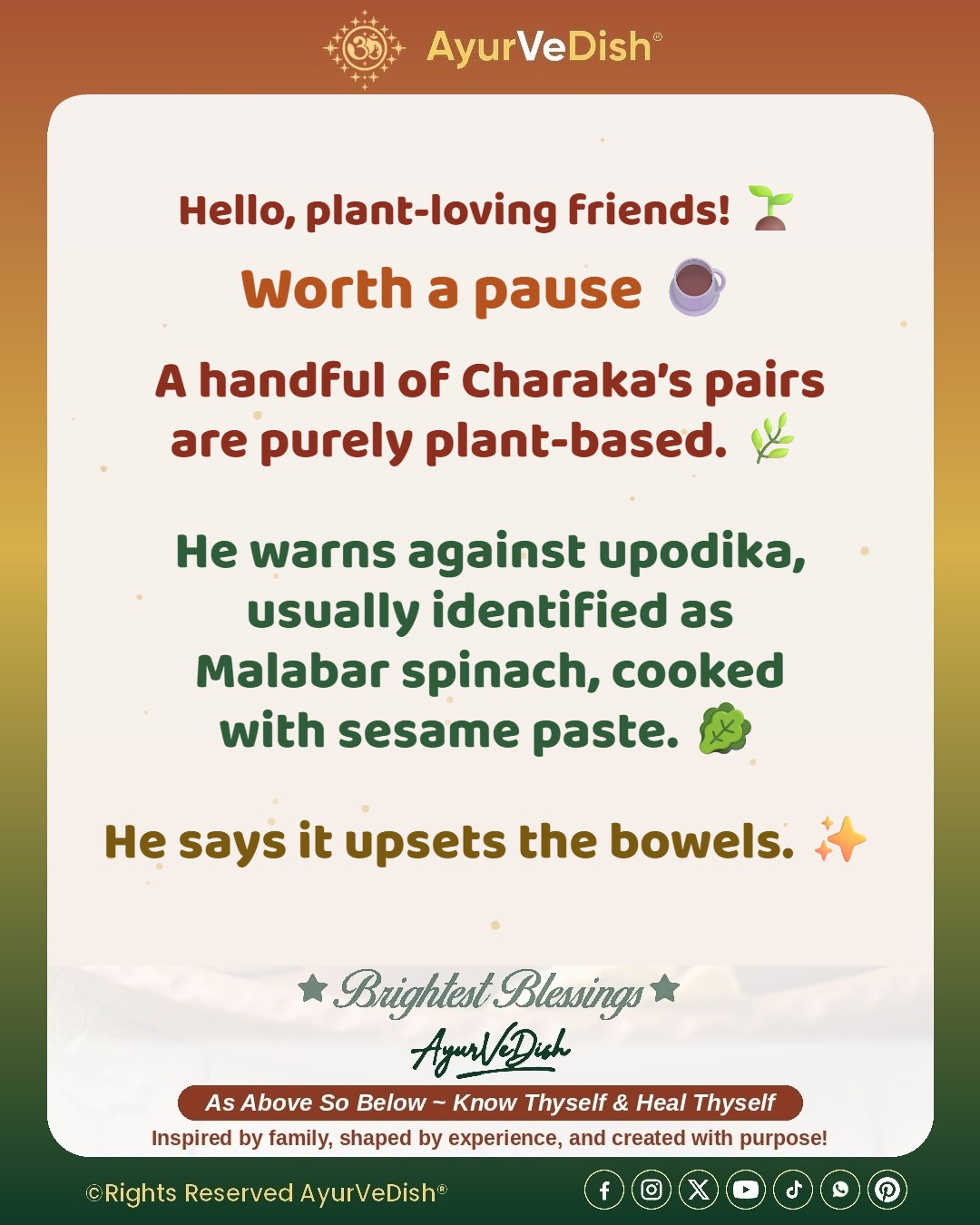
A handful of Charaka’s pairs are purely plant-based. He warns against upodika, usually identified as Malabar spinach, cooked with sesame paste, saying it upsets the bowels, and against kakamachi (black nightshade) kept until stale. These are rarely met in a British kitchen, but they show that the concern was specific combinations, not whole food groups. Many modern lists of forbidden combinations are not among the examples Charaka gives, and Sushruta actually places pomegranate at the start of a meal, so a blanket rule against fruit with meals is not classical.
A Weekly Meal-Planning Framework
This is our own practical adaptation of Charaka’s headings of place, season, quantity and habit. It keeps the week varied without asking you to plan every meal.
- Choose two pulses for the week, one light and one more substantial: split mung with chickpeas, or red lentils with horse gram. Soak and cook them on separate days rather than a single batch for seven days.
- Plan the main meal at midday where you can, and keep the evening meal lighter and earlier.
- Buy vegetables twice a week, so most meals are cooked from fresh produce rather than from a dish reheated for the third time.
- Give every day a bitter or leafy green: methi, chard, kale, watercress or chicory.
- Rotate the grain free base: quinoa early in the week, buckwheat midweek, amaranth or cassava at the weekend.
- Put mushrooms into at least three meals; they carry depth of flavour into an oil free pan.
- Check the forecast on Sunday. A cold, wet week calls for soups and dals; a warm, bright one for steamed vegetables and lighter pulses.
- Leave one meal unplanned, for whatever your appetite actually asks for on the day.
| Day | Pulse | Vegetable and green | Base |
|---|---|---|---|
| Monday | Split mung | Courgette and spinach | Quinoa |
| Tuesday | Split mung | Mushrooms and methi | Quinoa |
| Wednesday | Chickpeas | Cauliflower and chard | Buckwheat roti |
| Thursday | Chickpeas | Aubergine and kale | Buckwheat groats |
| Friday | Red lentils | Carrot, leek and watercress | Amaranth |
| Saturday | Horse gram (kulthi) | Mushrooms, peppers and spring greens | Cassava |
| Sunday | Unplanned | Whatever is freshest | Your choice |
What suits you will always depend on you as a person, your digestion, the season and how the food is prepared.
What Researchers Have Found
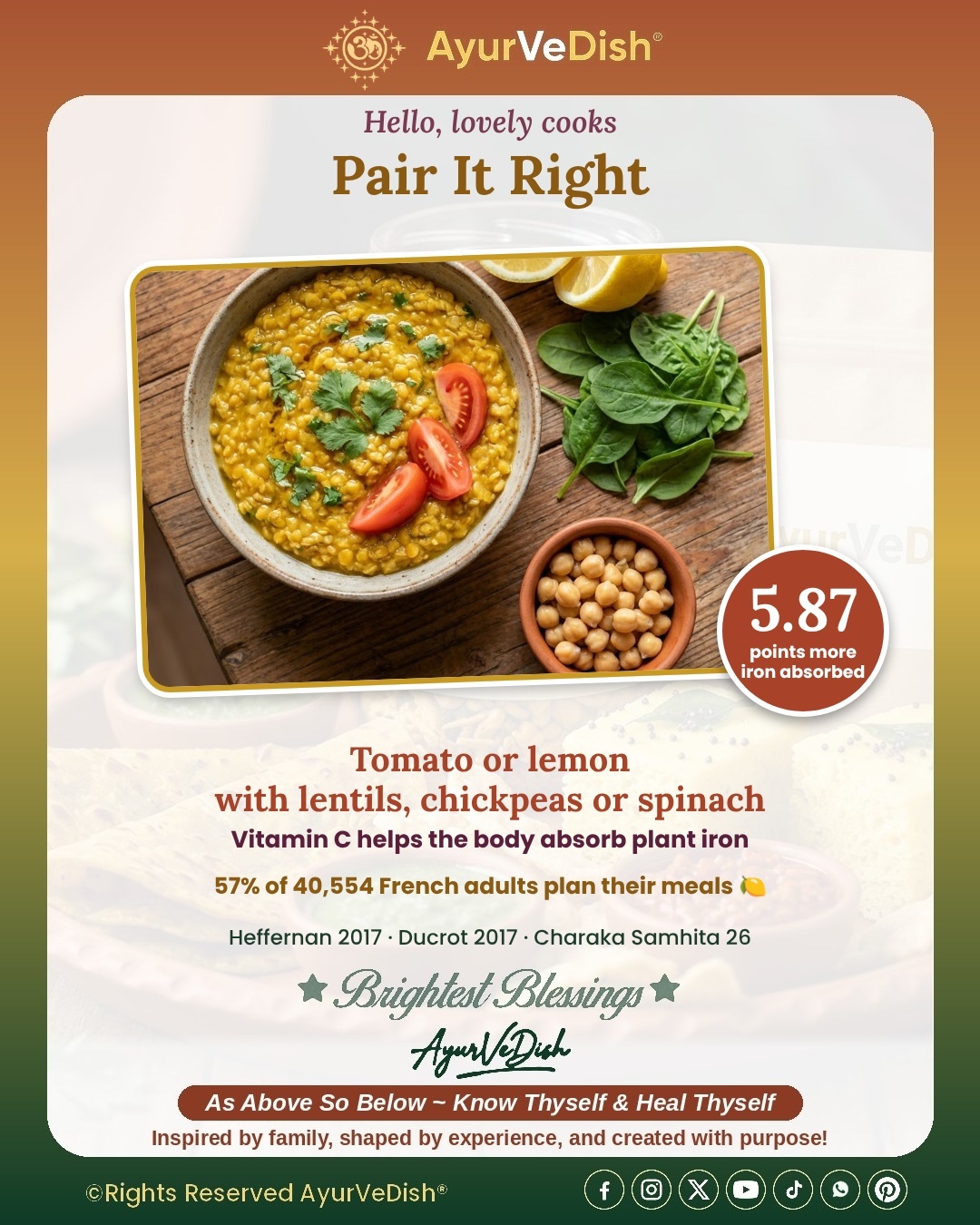
Modern research has its own good news about combining foods. A systematic review and meta-analysis by Anne Heffernan and colleagues at the University of Leeds was presented in the Proceedings of the Nutrition Society in 2017. It gathered 26 studies on vitamin C and iron. Across the short-term trials, adding vitamin C to a meal raised the share of iron absorbed by 5.87 percentage points on average, with very little inconsistency between studies (I² 14 per cent). In the longer trials that measured haemoglobin, vitamin C supplementation raised it by 8.26g/L. The authors concluded that vitamin C enhances absorption of non-haem iron, the kind found in plants. Pairing vitamin C-rich foods, such as tomato or lemon, with iron-containing plant foods like lentils, chickpeas and leafy greens is a simple, traditional-feeling combination that science also supports.
Planning ahead has its own research. In 2017, Pauline Ducrot and colleagues reported in the International Journal of Behavioral Nutrition and Physical Activity on 40,554 French adults in the NutriNet-Santé study. The 57 per cent who planned their meals had:
About 1.25 times the odds of being in the most varied-diet group.
About 1.13 times the odds of following national nutrition guidelines closely.
21 per cent lower odds of obesity in women and 19 per cent lower in men.
The study is a snapshot, so it shows a link, not a cause.
Simple Meal Planning for Everyday Life
Meal planning can be straightforward. Choose a few pulses and vegetables for the week, cook them with a flavourful blend and change the textures and seasoning to suit your taste. At AyurVeDish, our blends are complete, all-in-one mixes: add vegetables, pulses or beans and water, then cook. One 100g pouch of a curry or dal blend makes about 25 portions at Mild (4g), 14 at Medium (7g) or 10 at Extra Hot (10g), each for 200g of vegetables.
The range gives a week plenty of variety:
Punjabi Dal Makhani and Kadhi blends.
Gujarati Vegetable Kitchadi Premix.
Plain Gujarati Vaghar and South Indian tadka blends.
Our grain free Instant Gujarati Srikand Dessert Premix, dairy free and date-sweetened, or our grain free Kulfi Cupcake Premix, egg free and dairy free, to end the week on something sweet.
Plant-based herbal teas to finish.
They are made to help you enjoy good food without needing extensive cooking experience or detailed knowledge of Ayurveda.
Enjoy Food Without Anxiety
Ayurvedic inspiration should make food more interesting, not more stressful. You do not need to combine every taste in every meal. Begin with foods you enjoy, explore new vegetables, pulses, herbs and spices, and find combinations that make everyday meals satisfying and convenient.
Let Food Be Thy Medicine Before Medicine Becomes Thy Food.
As Above, So Below, Know Thyself and Heal Thyself.
Inspired by family, shaped by experience, and created with purpose!
Brightest Blessings

This page is for information only. For medical advice, please speak to a qualified professional.
Evidence and Sources
- Charaka Samhita, Sutrasthana 26 (Atreyabhadrakapyiya Adhyaya, Planet Ayurveda): planetayurveda.com/library/charak-samhita-sutrasthana-chapter-26-atreyabhadrakapyiya-adhyaya/
- Heffernan A, Evans C, Holmes M, Moore JB. The regulation of dietary iron bioavailability by vitamin C: a systematic review and meta-analysis. Proc Nutr Soc 2017;76(OCE4):E182: cambridge.org/core/journals/proceedings-of-the-nutrition-society/article/regulation-of-dietary-iron-bioavailability-by-vitamin-c-a-systematic-review-and-metaanalysis/013552A920BF94D2BEFA94133AA6AB29/core-reader
- Ducrot P et al. Meal planning is associated with food variety, diet quality and body weight status in a large sample of French adults. Int J Behav Nutr Phys Act 2017;14:12: pubmed.ncbi.nlm.nih.gov/28153017/
- Charak Samhita Research, Training and Skill Development Centre. Charaka Samhita, Sutrasthana 26, Atreyabhadrakapyiya Adhyaya (incompatible food and its eighteen headings). Charak Samhita Online, 2020. carakasamhitaonline.com
- Charak Samhita Research, Training and Skill Development Centre. Charaka Samhita, Vimanasthana 1, Rasa Vimana (the eight factors of diet). Charak Samhita Online, 2020. carakasamhitaonline.com
- Bhishagratna KL (trans.). Sushruta Samhita, Sutrasthana 46, Diet articles and regimen of diet. 1907, via Wisdom Library. wisdomlib.org