 AyurVeDish®
About us
Why AyurVeDish ExistsAyurveda at Our HeartOur Free-From PromiseWhole Food, Plant-Based LivingWhy Grain FreeWhy Oil FreeWhy Dairy FreeWhy Yeast FreeWhy Cane Sugar FreeWhy Soy FreeWhy Thoughtful IngredientsFresh and SeasonalHerbs and SpicesFood from Around the WorldGood Food for EveryoneA Recipe Should Inspire YouEat to LiveSalt, Spice and BalanceAyurveda
Ayurveda Made SimpleThe Five ElementsThe Three DoshasVataPittaKaphaPrakritiYour Dosha CombinationEating for Your ConstitutionChoosing Foods ThoughtfullyThe Six TastesSix Tastes on One PlateFood QualitiesAgni (Fire)Herbs and Spices in the Ayurvedic KitchenEating With the SeasonsAyurveda and the Body ClockFasting: The Ancient PauseBuilding a Plant-Based Ayurvedic MealAyurveda and Modern NutritionFood Combinations and Meal PlanningShop
Speciality All-in-One BlendsGrain Free Rice-Style BlendsSnack & Savoury PremixesGrain Free FloursBakes & DessertsChutneys, Dips & PicklesTadkas & Finishing SpicesDetox & Ayurvedic TeasHot & Cold Drinks





Building a Plant-Based Ayurvedic Meal
A Simple Way of Looking at Food
A good Ayurvedic meal does not need complicated rules, unusual ingredients or hours in the kitchen. The ancients gave us a way of looking at food, not a recipe card, and that is why it still works in a modern kitchen.
Start With Variety
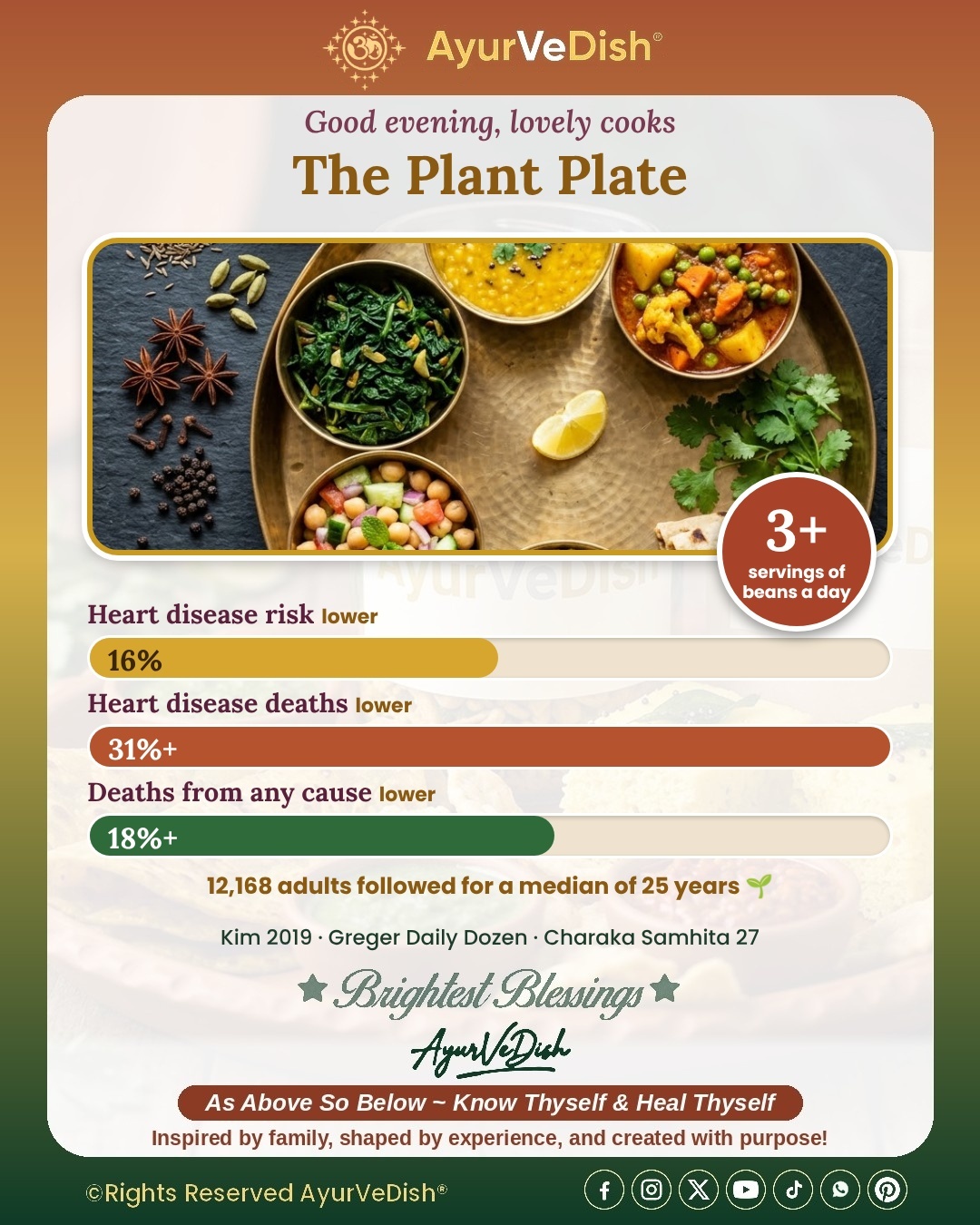
Build your meal around a selection of plant foods: colourful vegetables, beans, lentils, chickpeas and peas. Add herbs and spices for aroma, flavour and character. Let your appetite guide how much you eat.
Dr Michael Greger’s Daily Dozen puts beans first. He suggests at least three servings a day. A serving is a half cup of cooked beans, split peas or lentils, or a quarter cup of hummus. Greger counts pea soup and hummus with carrots as beans, so they all count.
Ayurveda also considers how food qualities may suit different constitutions. You may enjoy exploring this, and your health, preferences, allergies and circumstances should always come first.

What the Ancient Texts Say
The Charaka Samhita sorts foods into groups, and pulses and vegetables each have a place of their own (Sutrasthana 27). Among the pulses, it names green gram, called mudga, as the finest. The lesson is simple and timeless: choose good plant foods and prepare them with care.
Ayurveda recognises six tastes: sweet, sour, salty, pungent, bitter and astringent. You meet them naturally, through sweet vegetables, tomato or lemon, a little salt, aromatic spices, leafy greens and pulses. The Charaka Samhita (Sutrasthana 26.44) says the six tastes are good for all people when taken in appropriate amounts.
Not every meal needs all six. Let the tastes inspire variety, not become another set of rules.
The Structure of a Plate
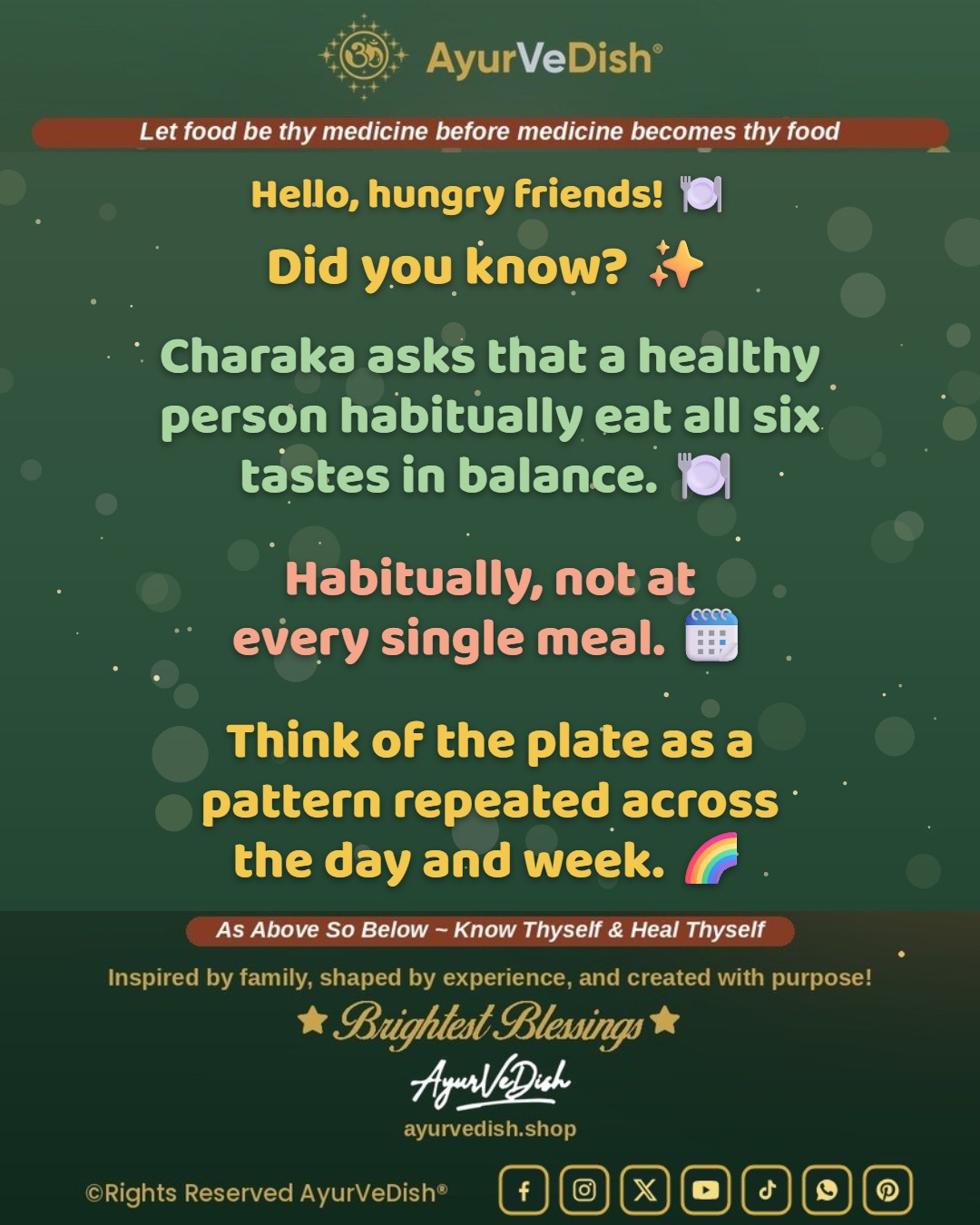
Charaka asks that a healthy person habitually eat all six tastes in balance. He says habitually, not at every single meal, so think of the plate as a pattern repeated across the day and week rather than a test each lunch must pass. In practice, a plate with five parts makes the pattern easy.
| Part | What it brings | Grain free, oil free examples |
|---|---|---|
| Pulse | Sweet and astringent; Charaka describes mung, chickpeas and lentils this way | Moong dal, chana masala, masoor soup, chickpea or red lentil tofu |
| Vegetable | Sweetness and substance from roots and gourds, depth from mushrooms | Lauki, carrot, beetroot, mushrooms, courgette |
| Bitter green | Bitter and astringent, the tastes most often missing | Methi, chard, kale, watercress, chicory, karela |
| Grain free base | Sweet and filling | Quinoa, buckwheat roti, amaranth rotli, cassava, sabudana |
| Chutney and finish | Sour, salty and pungent in small amounts | Amla, tamarind or green mango chutney, fresh ginger, lemon, rock salt |
The Order of Tastes in a Meal
Sushruta gives an order for serving a meal: sweet dishes first, sour and salty ones next, and pungent and the remaining tastes towards the close. He also says pomegranate and similar fruit belong at the start of a meal, while amalaka, the Indian gooseberry, is suitable at the beginning, middle or end. He notes that authorities disagreed about whether solid, thick food should come first or last, which is a useful reminder that even the classics left room for judgement. We did not find an equivalent order of tastes in the Charaka passages we checked, so we credit this to Sushruta alone.
On quantity, Charaka offers a simple picture: fill one third of the stomach with food, one third with liquid, and leave one third free. Sushruta adds that heavy food should be eaten only to half measure.
Putting the order on the table
- Begin with a few seeds of pomegranate or a spoon of something gently sweet from the plate, such as the base or a sweet vegetable.
- Move on to the dal and vegetables, where the sour and salty seasoning sits.
- Finish with the bitter green and a little pungent chutney or fresh ginger.
- Keep amla chutney on the side for any point in the meal.
- Take some liquid with the meal, such as warm water or a thin dal, in keeping with Charaka’s third for liquid.
Example Plates
| Plate | What is on it | Where the six tastes come from |
|---|---|---|
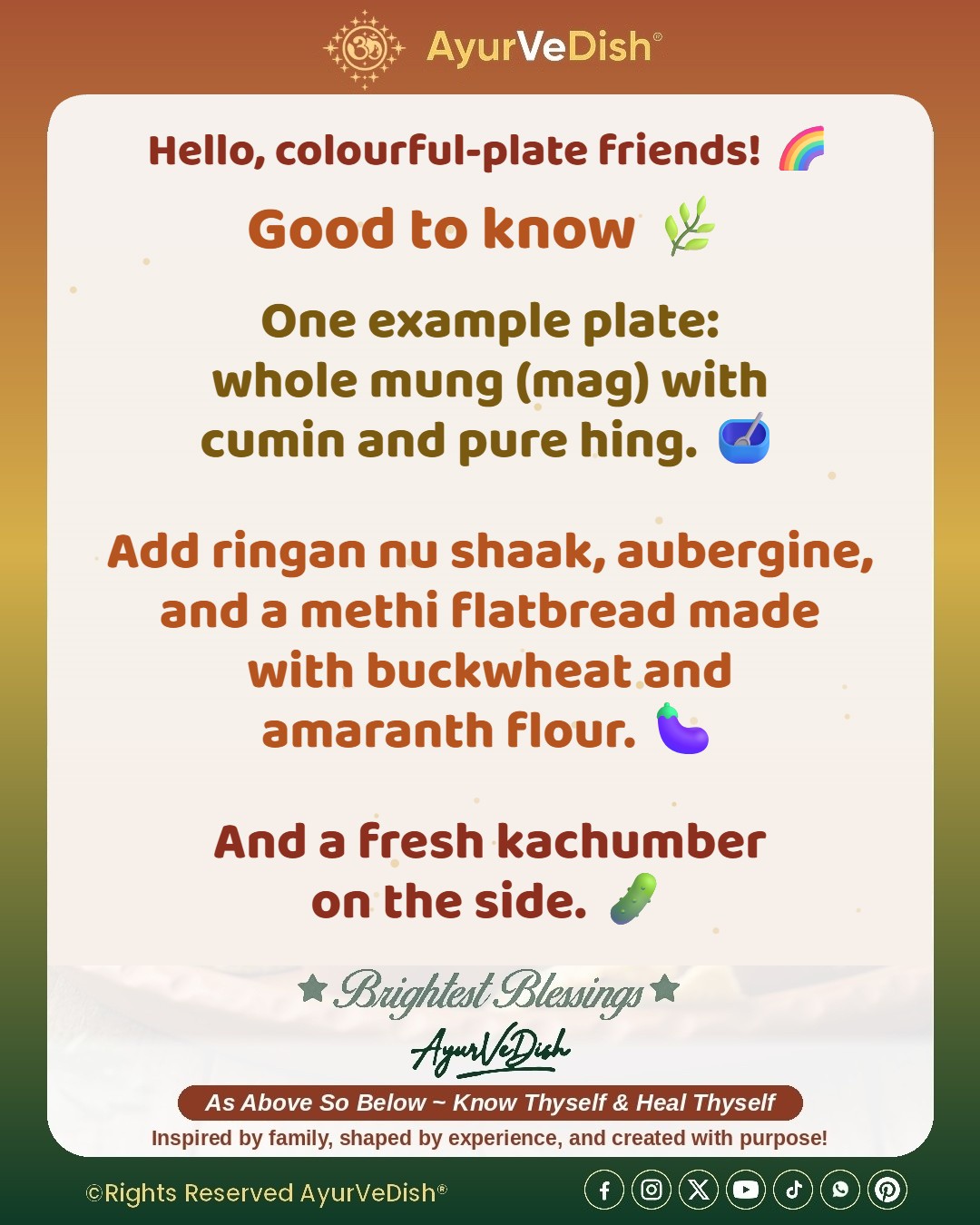
| Gujarati | Whole mung (mag) with cumin and pure hing, ringan nu shaak (aubergine), methi thepla-style flatbread made with buckwheat and amaranth flour, kachumber, and a coriander, mint and green chilli chutney | Sweet from mung and the flatbread; sour from lemon in the kachumber; salty from rock salt; pungent from chilli and ginger; bitter from methi and aubergine; astringent from mung |
| Punjabi | Chole with amchur and anardana, mushroom and pea masala, a spinach and methi saag in place of sarson (Charaka says mustard greens unsettle all three doshas), buckwheat roti, and mooli with lemon | Sweet from chickpeas and peas; sour from amchur, anardana and lemon; salty from black salt; pungent from mooli, ginger and garlic; bitter from methi; astringent from chickpeas and spinach |
| UK | Red lentil and leek dal with thyme, roast squash and mushrooms, watercress and chicory, quinoa, and a rhubarb and ginger chutney sweetened with dates | Sweet from squash, quinoa and dates; sour from rhubarb; salty from sea salt; pungent from watercress and ginger; bitter from chicory; astringent from lentils |
Squash, chilli and tomato have no classical taste assignment, so the tastes we give them are modern practice. Classical Gujarati and Punjabi cooking uses grain flours, jaggery and ghee; the plates above are our grain free, oil free versions.
What suits you will always depend on you as a person, your digestion, the season and how the food is prepared.
What Researchers Have Found
In 2019, Hyunju Kim and colleagues at Johns Hopkins followed 12,168 middle-aged adults from four US communities for a median of 25 years, from 1987 to 2016. They published the results in the Journal of the American Heart Association. People who ate the most plant foods, compared with those who ate the fewest, had:
A 16% lower risk of cardiovascular disease.
A 31% to 32% lower risk of dying from it.
An 18% to 25% lower risk of dying from any cause.
Eating mostly healthy plant foods, such as whole grains, fruit, vegetables, nuts and legumes, was linked with a 19% lower risk of cardiovascular death and an 11% lower risk of death from any cause. These are observational findings, so they show a link.
Make Everyday Cooking Easier
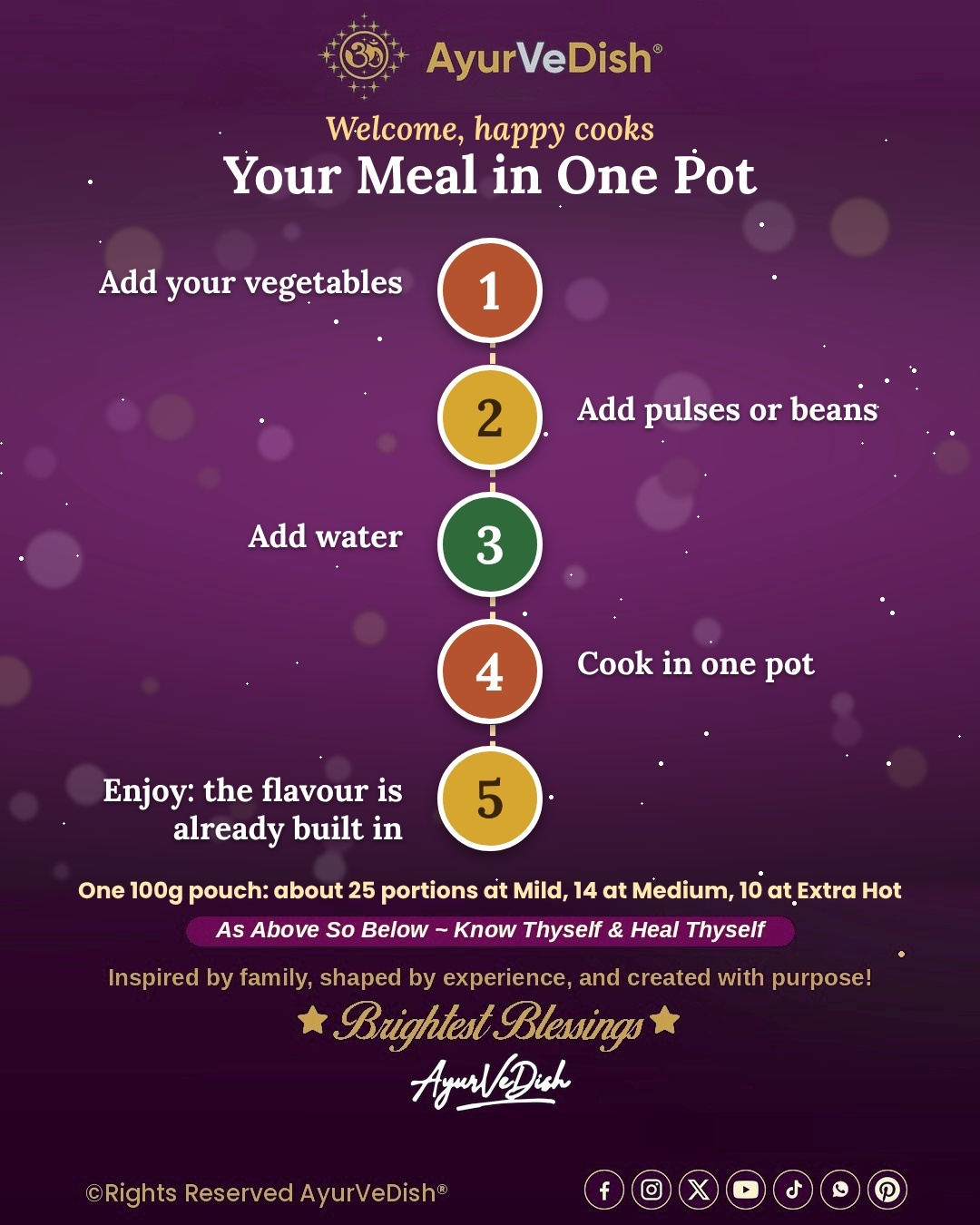
At AyurVeDish, our blends are complete, all-in-one mixes. Add vegetables, pulses or beans and water, then cook. Your meal comes together in one pot, with the flavour already built in. One 100g pouch of a curry or dal blend makes about 25 portions at Mild (4g), 14 at Medium (7g) or 10 at Extra Hot (10g), each for 200g of vegetables.
The range goes further than curry and dal.
Our Gujarati Toor Dal and Punjabi Dal Makhani blends cook the pulses.
Plain Gujarati Vaghar, Punjabi Masala and South Indian tadka blends finish them.
Our Hari chutney premix is grain and oil free.
Agni Spark brings the spices to your plate.
For something sweet, our grain free Banana Bread and Chocolate Cacao Cupcake premixes are made without cane sugar, egg or dairy. Just add plant milk and bake.
A Vata, Pitta or Kapha balance herbal tea (plant-based) closes the meal.
Keep your meals varied, enjoy your flavours and make good food a pleasure to return to every day.
Let Food Be Thy Medicine Before Medicine Becomes Thy Food.
As Above, So Below, Know Thyself and Heal Thyself.
Inspired by family, shaped by experience, and created with purpose!
Brightest Blessings

This page is for information only. For medical advice, please speak to a qualified professional.
Evidence and Sources
- Charaka Samhita, Sutrasthana 27 (Annapanavidhi Adhyaya, Planet Ayurveda): planetayurveda.com/library/charak-samhita-sutrasthana-chapter-27-annapanavidhi-adhyaya/
- Charaka Samhita, Sutrasthana 26, verse 44 (Atreyabhadrakapyiya Adhyaya, Planet Ayurveda): planetayurveda.com/library/charak-samhita-sutrasthana-chapter-26-atreyabhadrakapyiya-adhyaya/
- Greger M. Dr. Greger’s Daily Dozen (NutritionFacts.org): nutritionfacts.org/blog/dr-gregers-daily-dozen-healthiest-of-healthy-foods/
- Kim H et al. Plant-based diets are associated with a lower risk of incident cardiovascular disease, cardiovascular disease mortality, and all-cause mortality in a general population of middle-aged adults. J Am Heart Assoc 2019;8(16):e012865: pubmed.ncbi.nlm.nih.gov/31387433/
- Charak Samhita Research, Training and Skill Development Centre. Charaka Samhita, Sutrasthana 7, Naveganadharaniya Adhyaya (all six tastes in balance as a habitual diet). Charak Samhita Online, 2020. carakasamhitaonline.com
- Charak Samhita Research, Training and Skill Development Centre. Charaka Samhita, Vimanasthana 2, Trividhakukshiya Vimana (the stomach in three parts). Charak Samhita Online, 2020. carakasamhitaonline.com
- Charak Samhita Research, Training and Skill Development Centre. Charaka Samhita, Sutrasthana 27, Annapanavidhi Adhyaya (pulses; mustard greens). Charak Samhita Online, 2020. carakasamhitaonline.com
- Bhishagratna KL (trans.). Sushruta Samhita, Sutrasthana 46, Diet articles and regimen of diet (order of dishes, fruit at the start of a meal, half measure of heavy food). 1907, via Wisdom Library. wisdomlib.org