 AyurVeDish®
About us
Why AyurVeDish ExistsAyurveda at Our HeartOur Free-From PromiseWhole Food, Plant-Based LivingWhy Grain FreeWhy Oil FreeWhy Dairy FreeWhy Yeast FreeWhy Cane Sugar FreeWhy Soy FreeWhy Thoughtful IngredientsFresh and SeasonalHerbs and SpicesFood from Around the WorldGood Food for EveryoneA Recipe Should Inspire YouEat to LiveSalt, Spice and BalanceAyurveda
Ayurveda Made SimpleThe Five ElementsThe Three DoshasVataPittaKaphaPrakritiYour Dosha CombinationEating for Your ConstitutionChoosing Foods ThoughtfullyThe Six TastesSix Tastes on One PlateFood QualitiesAgni (Fire)Herbs and Spices in the Ayurvedic KitchenEating With the SeasonsAyurveda and the Body ClockFasting: The Ancient PauseBuilding a Plant-Based Ayurvedic MealAyurveda and Modern NutritionFood Combinations and Meal PlanningShop
Speciality All-in-One BlendsGrain Free Rice-Style BlendsSnack & Savoury PremixesGrain Free FloursBakes & DessertsChutneys, Dips & PicklesTadkas & Finishing SpicesDetox & Ayurvedic TeasHot & Cold Drinks




Ayurveda and the Body Clock
Ayurveda and the Body Clock: Living in Rhythm With the Day
Every morning, before you have decided anything, your body already knows what time it is. It wakes, it warms, it grows hungry, it grows sleepy, all in a rhythm that repeats about every twenty-four hours. Science calls this the circadian rhythm. Ayurveda noticed it thousands of years ago and built a whole way of living around it, called Dinacharya, the daily routine.
It is one of the most striking examples of the ancients telling us something indirectly. They had no laboratories and no clocks inside cells, but they watched the sun, the body and the appetite, and they wrote down what they saw.
What the Ancient Texts Say
The Ashtanga Hridaya, by Vagbhata, states that across the span of life, the day and night, and the course of digestion, the doshas take turns dominating the closing, middle and opening phases (Sutrasthana 1.8). The body is not the same at every hour.
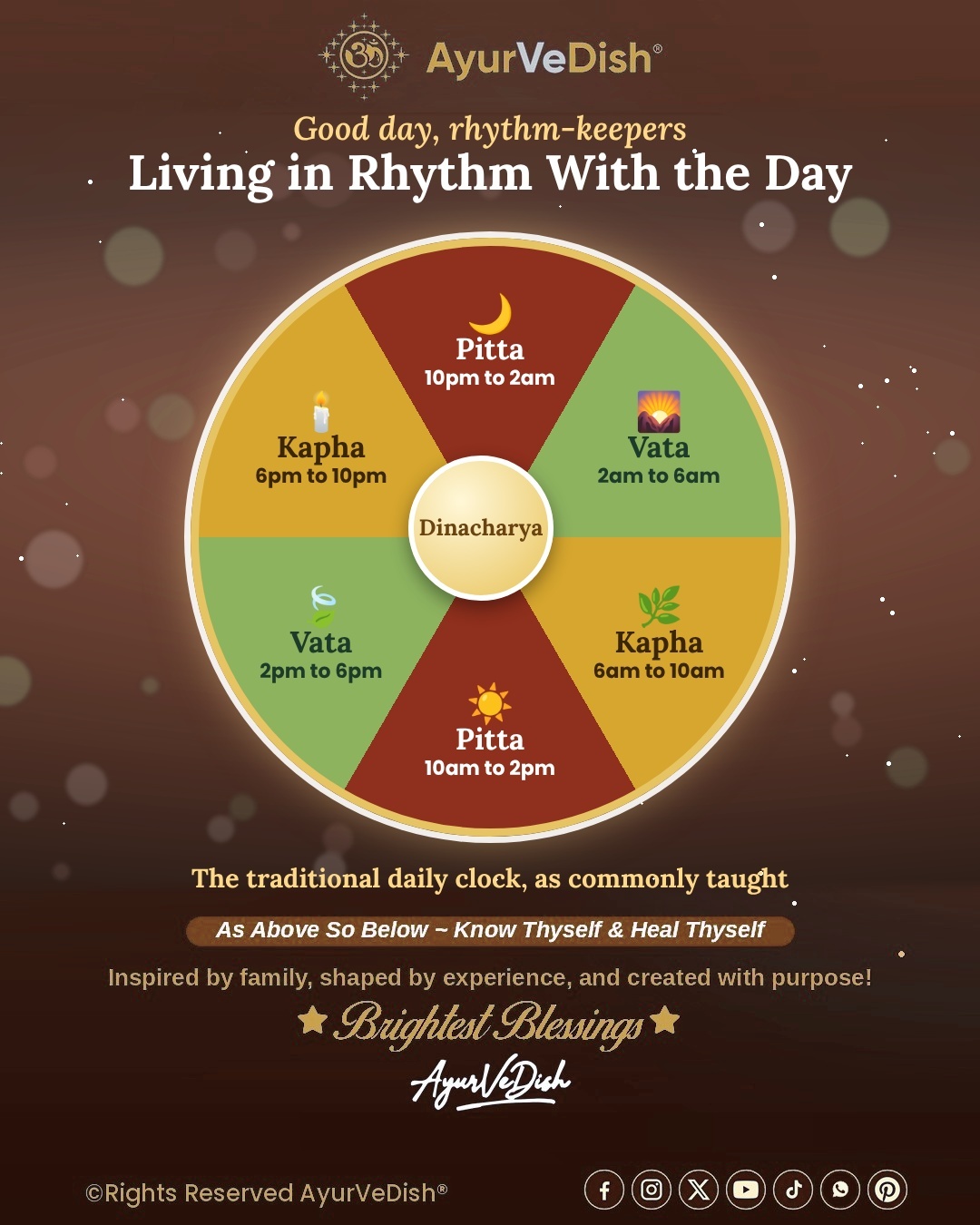
In the traditional daily clock as it is commonly taught, Kapha’s steady, heavy quality rules the early morning and early evening, Pitta’s fire rules midday and midnight, and Vata’s movement rules the hours before dawn and late afternoon. The same text advises the healthy person to rise at Brahma Muhurta, the last watch before dawn, to safeguard life (Sutrasthana 2.1).
The Charaka Samhita names food, sleep and Brahmacharya, the discipline of conduct, as the three supports that maintain life (Sutrasthana 11). Ayurveda treated a good night’s sleep as part of health, not a luxury.

The Day, Simply
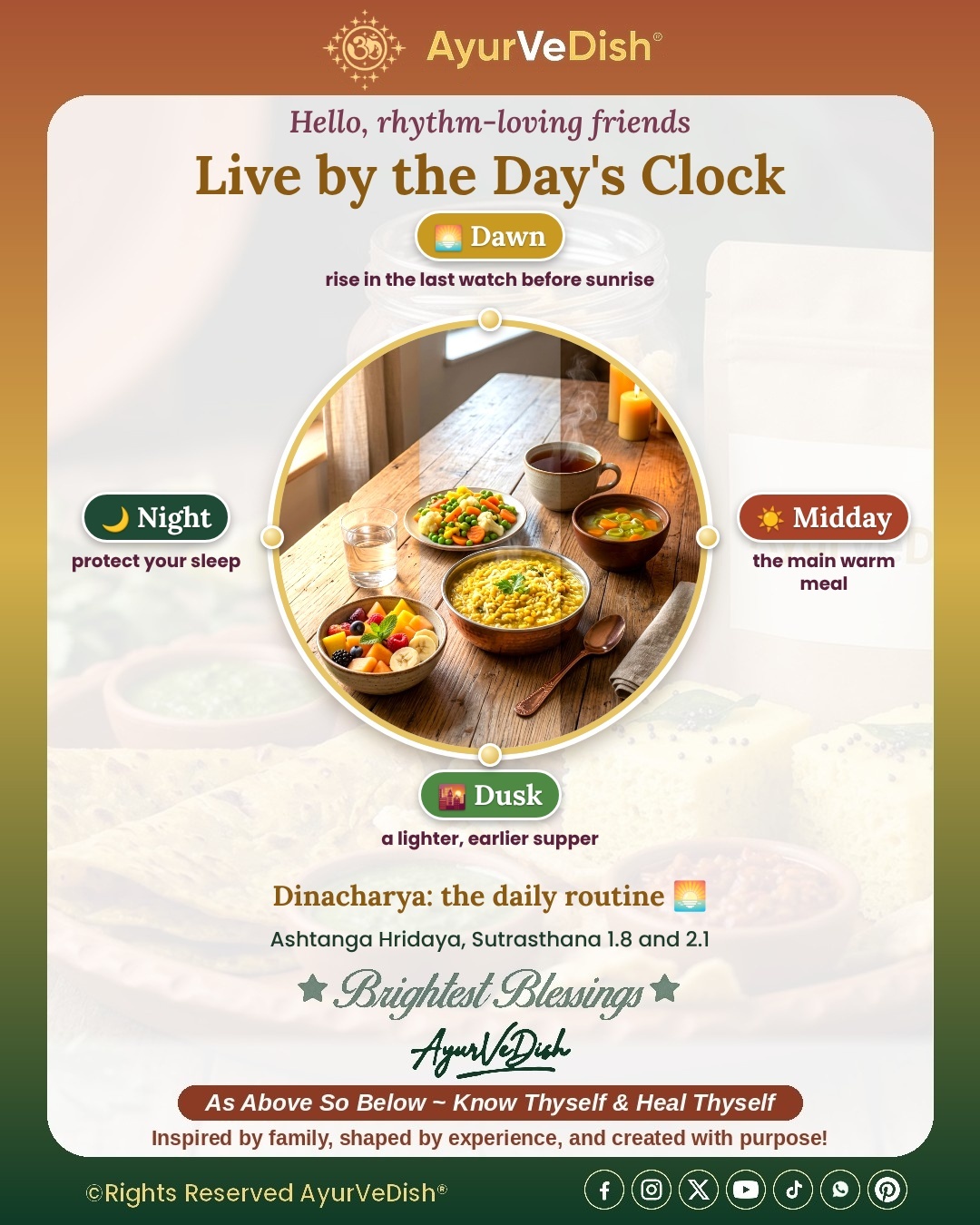
Wake at a regular time. Rise around the same hour each day, ideally early, and greet the morning light.
Make midday your main meal. Traditionally, digestion is strongest when the sun is highest, so lunch is the meal for fuller, warm, cooked food.
Keep the evening light. A lighter, earlier supper, then a quieter evening and an early bedtime.
Protect your sleep. The old texts guarded it carefully.
A Food-Centred Day From the Ashtanga Hridaya
Vagbhata’s daily routine covers far more than food. These are the parts that bear on eating and digestion, in the order the day unfolds.
Before dawn
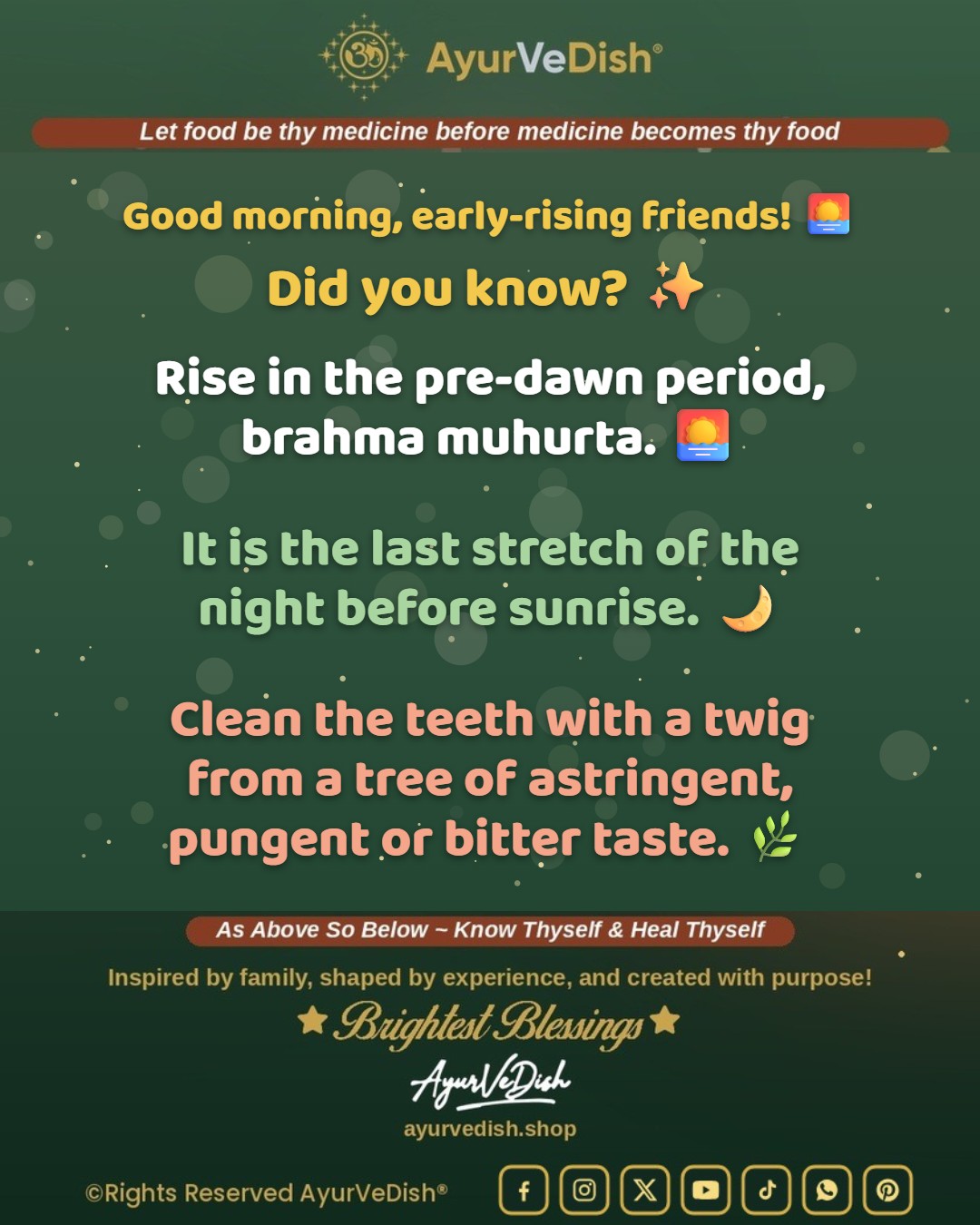
Rise in the pre-dawn period (brahma muhurta), the last stretch of the night before sunrise, then attend to the body’s natural calls. Clean the teeth with a twig from a tree of astringent, pungent or bitter taste; the text excludes this, among other conditions, during indigestion.
Morning movement
Vagbhata counts brighter digestion among the benefits of exercise. He advises exercising to half of your strength in the cold season and in spring and more gently in other seasons, and says it should be avoided while food is still undigested. Bathing, he adds, also kindles digestion, but it is not for just after a meal.
Meals
- Eat only when the last meal has digested, choosing wholesome food in measured quantity. This one line does more than any clock: it ties meal times to your own digestion.
- Avoid eating at the junctions of dawn, midday and dusk, which the text lists alongside sleep and study as things to set aside at those moments.
- Sit properly to eat, rather than slumped or twisted, which Vagbhata also names.
- Do not force natural urges, and do not push on with other work when one arises.
Sushruta, as summarised by the Charak Samhita Online team, asks that food be taken only when hungry and after the previous meal has digested, and favours two main meals a day over frequent eating.
The day in practice (AyurVeDish® adaptation)
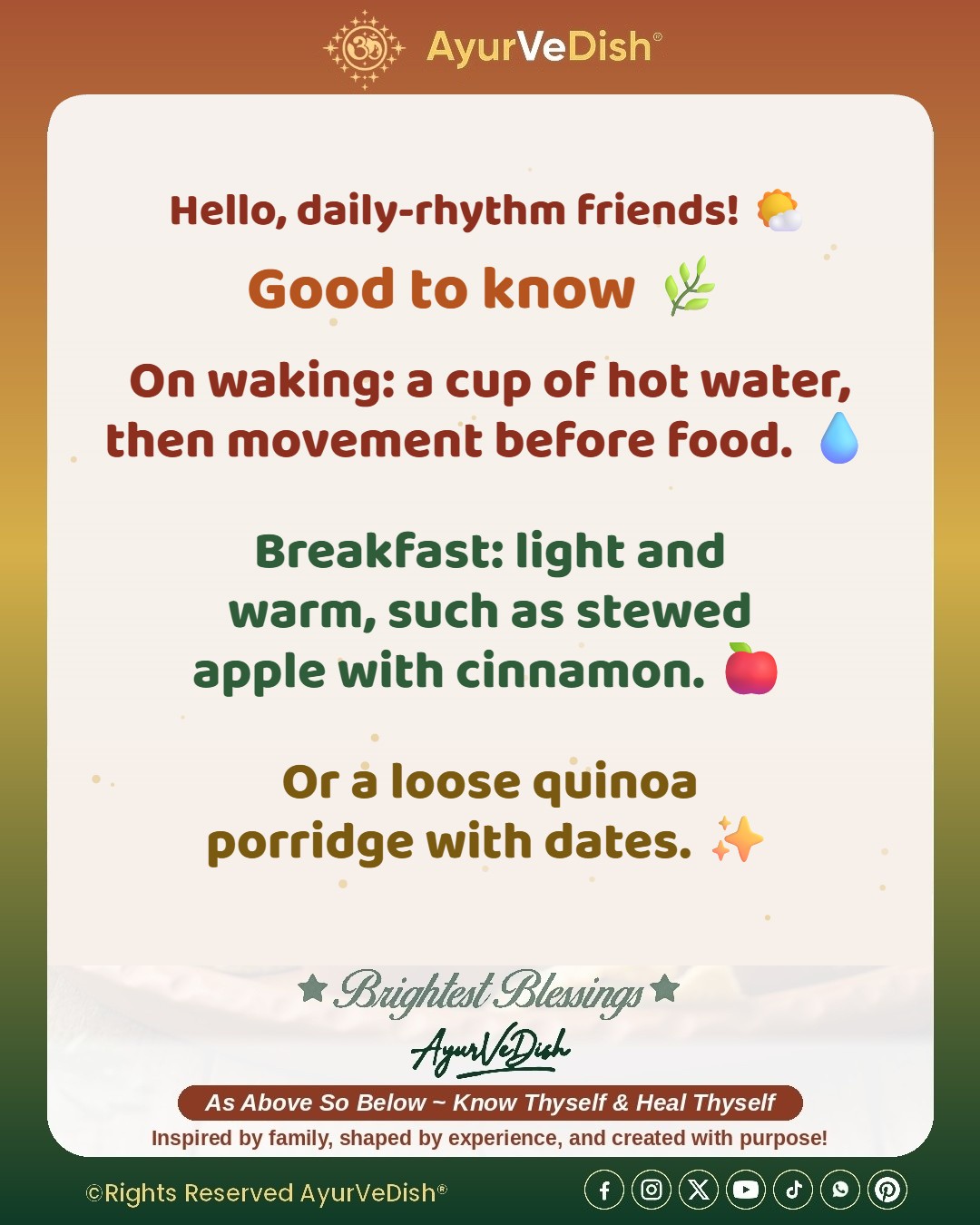
- On waking: a cup of hot water, then movement before food.
- Breakfast: light and warm, such as stewed apple with cinnamon or a loose quinoa porridge with dates, or simply wait until you are genuinely hungry.
- Midday: the main meal of the day, eaten a little after or before the stroke of noon rather than on it: a pulse, a vegetable dish, a rice-type base of quinoa or amaranth, and a sharp relish.
- Afternoon: ginger or fennel tea; if hungry, something soft such as a few soaked dates.
- Evening: a smaller supper, such as a vegetable and moong dal soup, finished two to three hours before bed.
Meal Timing: What Studies Show
Meal timing has been studied, and the picture is mixed. A small study of healthy men found that solid food left the stomach more slowly at 8pm than at 8am, which sits comfortably with a lighter evening meal. Small, short trials of eating earlier in the day have reported some metabolic changes, but larger trials of time-restricted eating found no clear advantage over eating the same food spread across the day. We read this as consistent with the classical advice, not as proof of it.
What suits you will always depend on you as a person, your digestion, the season and how the food is prepared.
What Researchers Have Found
The body really does have a clock, and living in step with it shows up in the data.
The Nobel Prize. In 2017, Jeffrey Hall, Michael Rosbash and Michael Young won the Nobel Prize in Physiology or Medicine for their discoveries of the molecular mechanisms controlling the circadian rhythm. The Nobel Assembly notes that the clock regulates behaviour, hormone levels, sleep, body temperature and metabolism.
Regular sleep (Windred et al., Sleep, 2024). 60,977 adults in the UK Biobank wore movement sensors, with over 10 million hours of data. Over about six years, those in the four most regular sleep groups had a 20% to 48% lower risk of dying from any cause than the least regular group, and a 22% to 57% lower risk of cardiometabolic death. Regularity predicted survival better than how long people slept.
A main meal before 3pm (Garaulet et al., International Journal of Obesity, 2013). In 420 people on a 20-week weight-loss programme in Spain, those who ate their main meal before 3pm lost more weight, and lost it faster, than late eaters (P = 0.002), even though their calorie intake and the make-up of their diet were similar.
The sleep study is observational, so it shows a strong link.
Bringing the Rhythm Home
You do not need an elaborate routine. Start with one small habit: a regular wake-up time, a warm midday meal or a lighter supper. Our blends are all-in-one, so a warm cooked lunch or simple supper is as easy as adding your vegetables, pulses or beans and water, then cooking.
One 100g pouch of our curry or dal blend makes about 25 portions at Mild (4g), 14 at Medium (7g) or 10 at Extra Hot (10g), per 200g of vegetables.
Our grain free kitchadi premixes and Detox Kitchadi Blend suit a simple supper, and our Vata, Pitta and Kapha balance herbal teas make an evening wind-down.
Live with the day, not against it.
Let Food Be Thy Medicine Before Medicine Becomes Thy Food.
As Above, So Below, Know Thyself and Heal Thyself.
Inspired by family, shaped by experience, and created with purpose!
Brightest Blessings

This page is for information only. For medical advice, please speak to a qualified professional.
Evidence and Sources
- Ashtanga Hridayam, Sutrasthana 1.8 (Satyori): satyori.com/source-texts/ashtanga-hridayam/sutrasthana/1/8/
- Ashtanga Hridayam, Sutrasthana 2.1 (Satyori): satyori.com/source-texts/ashtanga-hridayam/sutrasthana/2/1/
- Charaka Samhita, Sutrasthana 11 (Tistraishaniya Adhyaya, Planet Ayurveda): planetayurveda.com/library/charak-samhita-sutrasthana-chapter-11-tistraishaniya-adhyaya/
- The 2017 Nobel Prize in Physiology or Medicine, press release (NobelPrize.org): nobelprize.org/prizes/medicine/2017/press-release/
- Windred DP et al. Sleep regularity is a stronger predictor of mortality risk than sleep duration. Sleep 2024;47(1):zsad253: pubmed.ncbi.nlm.nih.gov/37738616/
- Garaulet M et al. Timing of food intake predicts weight loss effectiveness. Int J Obes 2013;37(4):604-611: pubmed.ncbi.nlm.nih.gov/23357955/
- Satyori, Ashtanga Hridayam, Sutrasthana 1, verse 8. satyori.com
- Satyori, Ashtanga Hridayam, Sutrasthana 2 (Dinacarya Adhyaya). satyori.com
- Satyori, Ashtanga Hridayam, Sutrasthana 2, verse 12. satyori.com
- Satyori, Ashtanga Hridayam, Sutrasthana 2, verse 19. satyori.com
- Satyori, Ashtanga Hridayam, Sutrasthana 2, verse 42. satyori.com
- Charak Samhita Research, Training and Development Centre (Jamnagar), Charak Samhita Online, Dinacharya (topic page). carakasamhitaonline.com
- Circadian variation in gastric emptying of meals in humans, Gastroenterology, 1987. pubmed.ncbi.nlm.nih.gov
- Sutton E.F. et al., early time-restricted feeding study, Cell Metabolism, 2018. pmc.ncbi.nlm.nih.gov
- TREAT randomised clinical trial of time-restricted eating, JAMA Internal Medicine, 2020. pubmed.ncbi.nlm.nih.gov
- Liu D. et al., randomised trial of time-restricted eating, New England Journal of Medicine, 2022. pubmed.ncbi.nlm.nih.gov