 AyurVeDish®
About us
Why AyurVeDish ExistsAyurveda at Our HeartOur Free-From PromiseWhole Food, Plant-Based LivingWhy Grain FreeWhy Oil FreeWhy Dairy FreeWhy Yeast FreeWhy Cane Sugar FreeWhy Soy FreeWhy Thoughtful IngredientsFresh and SeasonalHerbs and SpicesFood from Around the WorldGood Food for EveryoneA Recipe Should Inspire YouEat to LiveSalt, Spice and BalanceAyurveda
Ayurveda Made SimpleThe Five ElementsThe Three DoshasVataPittaKaphaPrakritiYour Dosha CombinationEating for Your ConstitutionChoosing Foods ThoughtfullyThe Six TastesSix Tastes on One PlateFood QualitiesAgni (Fire)Herbs and Spices in the Ayurvedic KitchenEating With the SeasonsAyurveda and the Body ClockFasting: The Ancient PauseBuilding a Plant-Based Ayurvedic MealAyurveda and Modern NutritionFood Combinations and Meal PlanningShop
Speciality All-in-One BlendsGrain Free Rice-Style BlendsSnack & Savoury PremixesGrain Free FloursBakes & DessertsChutneys, Dips & PicklesTadkas & Finishing SpicesDetox & Ayurvedic TeasHot & Cold Drinks





Eating With the Seasons
Eating With the Seasons: Ritucharya
Walk through a market as the year turns and you can see the seasons on the stalls: first greens in spring, juicy fruit in summer, pumpkins and roots in autumn, hearty vegetables in winter. Ayurveda noticed that our appetite and energy turn with the year too, and gave this idea a name: Ritucharya, “the way of the seasons”.
The idea is simple and lovely. Do not treat every day of the year as the same. Live and eat with greater awareness of the season you are in. It is one of the oldest and kindest ways to look after yourself.
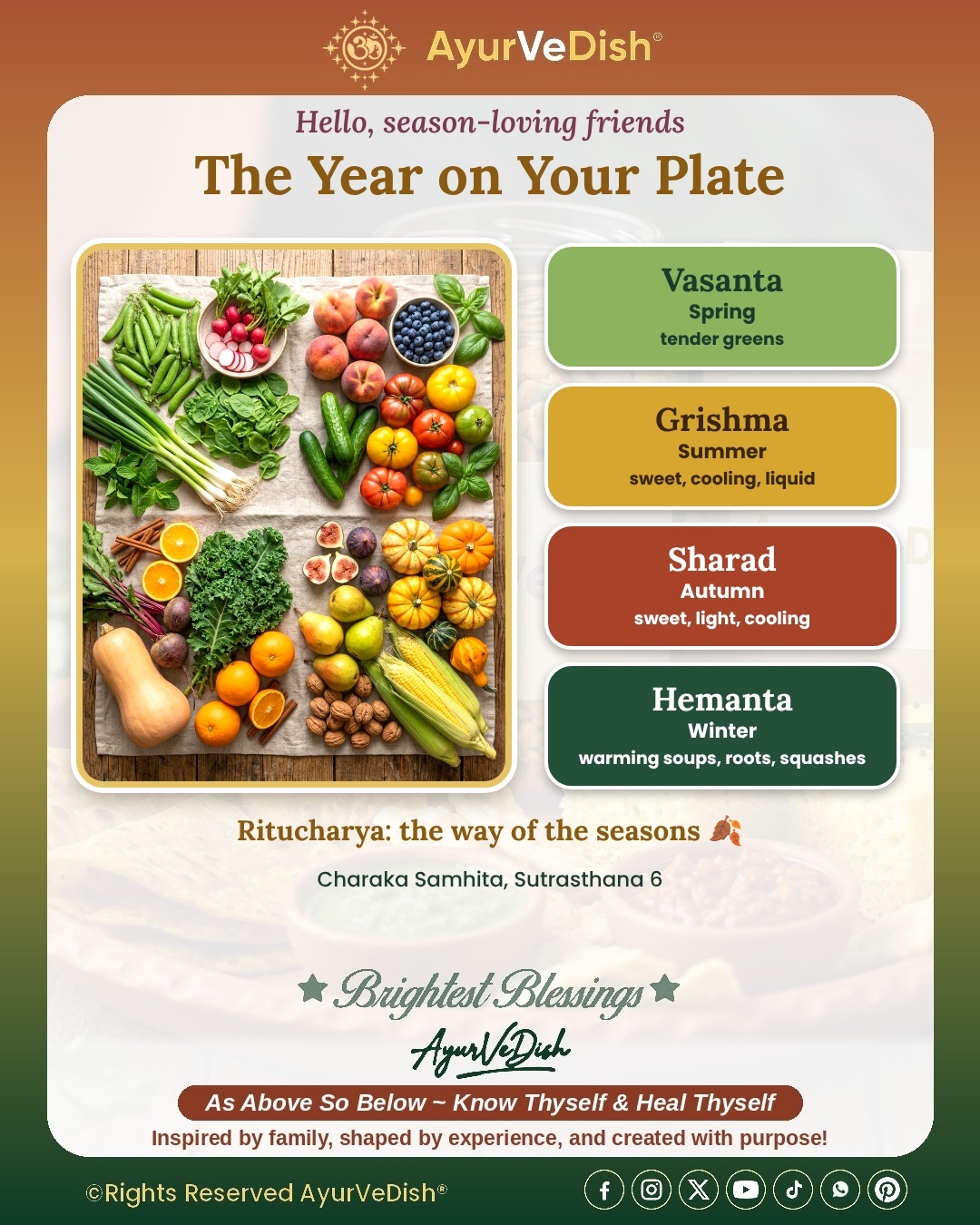
Eating With the Seasons
Seasonal produce is a wonderful way to bring variety, colour and freshness into your meals. In cooler weather, you might enjoy warming soups, cooked vegetables, lentil dishes and aromatic spices. In warmer weather, you may prefer lighter meals, refreshing fruits, crisp vegetables and fresh herbs. These are practical examples, not strict rules. Personal preference, availability, culture and nutritional needs all matter.

What the Ancient Texts Say
The Charaka Samhita devotes a whole chapter to the seasons (Sutrasthana 6). It divides the year into six seasons and into two halves: one in which the sun’s heat and drier winds draw moisture from the world, and one in which the weather turns softer (Sutrasthana 6.4 to 6.7).
It notes that strength rises and falls through the year: weakest at the start of the rains and the end of summer, and greatest at the end of Hemanta, the early cold season, and the start of Shishira, the late cold season (Sutrasthana 6.8). In the cold season, the digestion of strong people is traditionally powerful enough for heavier food in larger amounts (Sutrasthana 6.9).
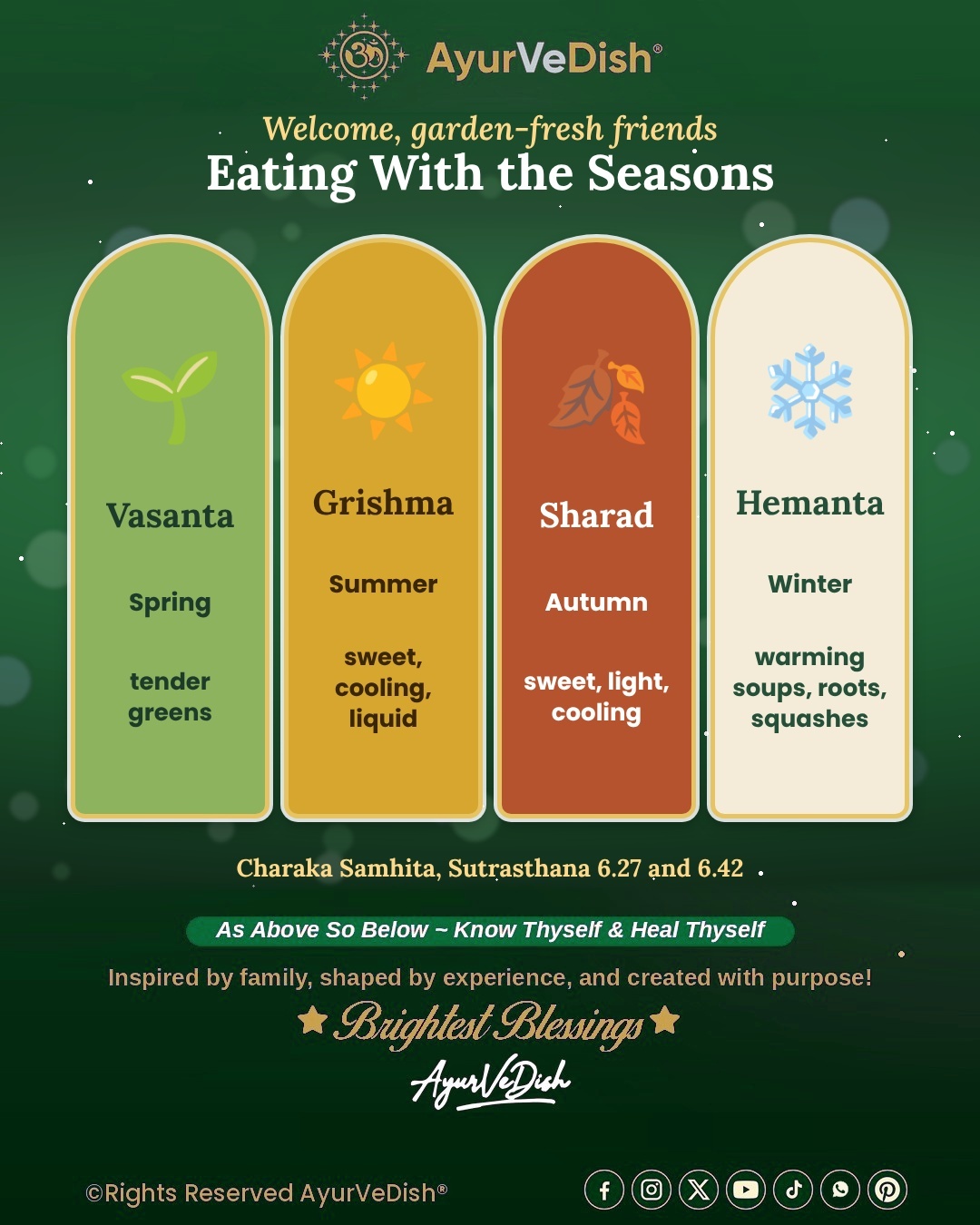
Its advice for summer is sweet, cooling, liquid and unctuous food and drink (Sutrasthana 6.27). In autumn it is sweet, light, cooling and slightly bitter food (Sutrasthana 6.42). That is the heart of Ritucharya: awareness and flexibility.
The Six Classical Seasons
Charaka divides the year into two halves. In the taking half (adana), as the sun moves north, sun and wind draw moisture and strength from living things; in the giving half (visarga), as the sun moves south, the cooler, lunar influence restores them. Each half holds three seasons, and each season brings forward one taste. Strength is lowest at the turn from summer into the rains and highest across the winter.
| Season | Half of the year | Taste that grows | Charaka’s food guidance (plant-based parts) | What he says to ease off |
|---|---|---|---|---|
| Hemanta (early winter) | Giving | Sweet | Digestion is strong and can take substantial meals; unctuous, sour and salty food; warm water to drink | Light, vata-provoking food and meagre meals |
| Shishira (late winter) | Taking | Bitter | As early winter, with even more shelter from cold and wind | Pungent, bitter and astringent food, and anything light or cold |
| Vasanta (spring) | Taking | Astringent | Kapha melts and dampens digestion; regular exercise | Heavy, sour, unctuous and sweet food, and sleeping by day |
| Grishma (summer) | Taking | Pungent | Sweet, cold, liquid and unctuous food and drink | Salty, sour, pungent and hot food, and strenuous exercise |
| Varsha (rains) | Giving | Sour | Digestion is weak; sour, salty and unctuous food on cold, wet days; water boiled and then cooled | Sleeping by day, exertion and strong sun |
| Sharad (autumn) | Giving | Salty | Sweet, light, cooling and slightly bitter food, eaten in measure once properly hungry | Fats, alkaline preparations, sleeping by day and strong sun |
The Ashtanga Hridaya traces each dosha through the year: vata builds in summer, flares in the rains and settles in autumn; pitta builds in the rains, flares in autumn and settles in early winter; kapha builds in late winter, flares in spring and settles in summer. Charaka’s teaching on spring tells us what to reduce rather than listing what to add; the common advice to favour pungent, bitter and astringent food then is an inference from that.
Changing between seasons
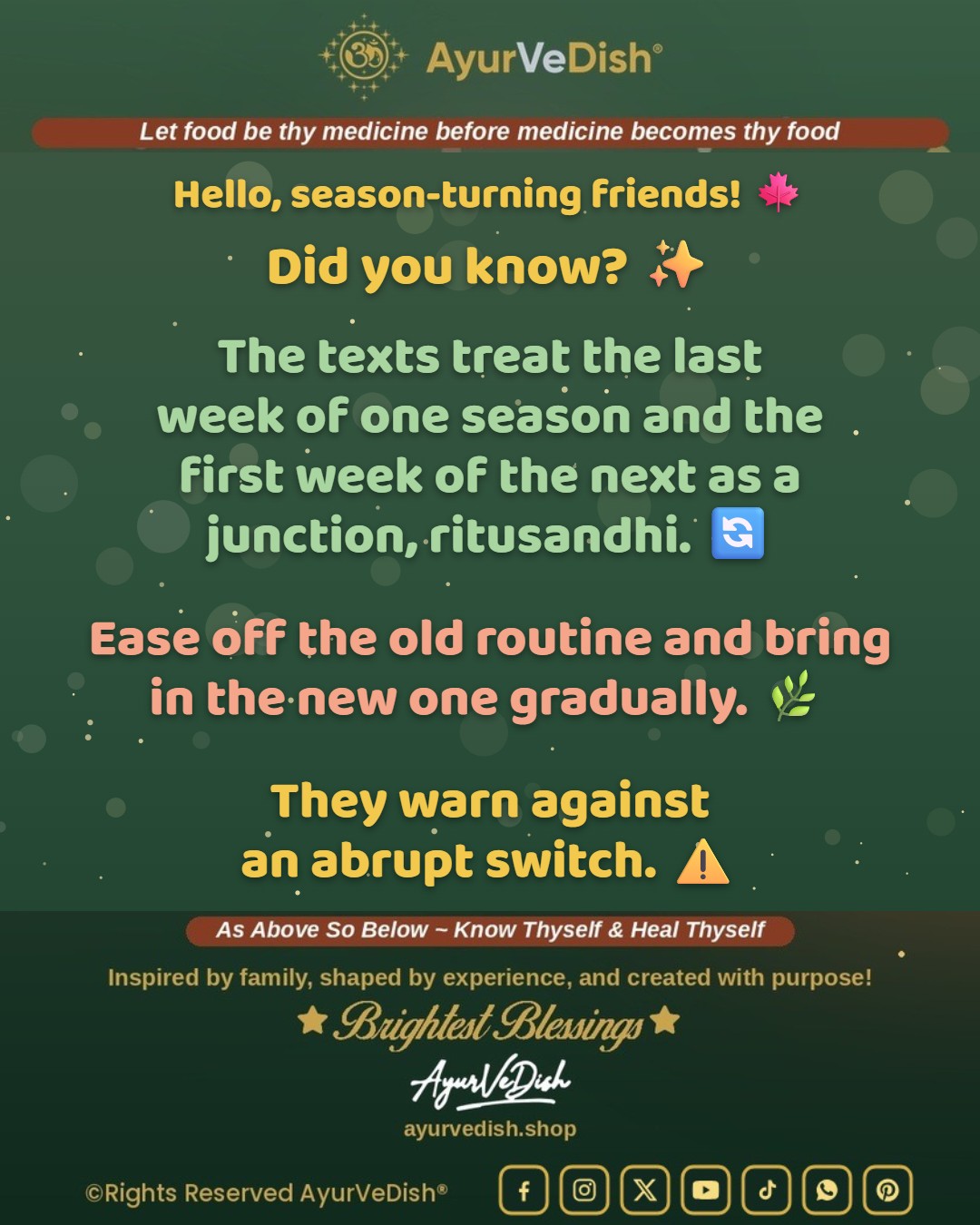
The texts regard the last week of one season and the first week of the next as a junction (ritusandhi), when the old routine is eased off and the new one brought in gradually; they warn that an abrupt switch can unsettle health. Charaka also says diet should run opposite to the qualities of the place you live, which gives us classical licence to read British weather rather than copy Indian months.
A UK Year, Month by Month
This calendar is an AyurVeDish® adaptation, not a classical text. The UK has no monsoon after summer: its wettest and darkest months run from October to January, its sunniest and driest from April to June, and the national average daytime maximum peaks below 20°C in July. We have therefore matched each month to the classical season whose qualities it most resembles. Produce follows the Vegetarian Society list reproduced by the British Dietetic Association; stored crops such as apples and onions appear in the colder months, early aubergines and peppers are usually glasshouse grown, and grains and chestnuts are left out under our food rules.
| Month | UK weather and classical match | Taste emphasis | In season (selection) |
|---|---|---|---|
| January | Cold, wet, darkest days; early winter logic | Sweet, sour and salty, warm and cooked | Beetroot, carrots, celeriac, parsnips, swede, turnips, leeks, kale, Brussels sprouts, Jerusalem artichokes, mushrooms, stored apples and pears |
| February | Cold and raw; late winter logic | Sweet, sour and salty; little bitter or raw food | Purple sprouting broccoli, celeriac, swede, leeks, kale, spring greens, chicory, squash, stored apples and pears |
| March | Brightening, kapha begins to melt; spring logic | Lighter and drier; ease off heavy, sweet and sour | Purple sprouting broccoli, radishes, sorrel, spring greens, spring onions, watercress, rhubarb (sour, so cook it and use modestly) |
| April | Drier and sunnier; spring logic | Bitter, pungent and astringent to the fore, with ginger | Watercress, rocket, spinach, radishes, spring greens, sorrel, chicory, new potatoes, morel mushrooms |
| May | The sunniest month on average; a mild early summer | Begin moving towards sweet and cooling | Asparagus, peas, lettuce, spinach, radishes, rocket, samphire, strawberries, elderflowers |
| June | Warm and long days; mild summer logic | Sweet, cooling and liquid; go easy on salt and sour | Broad beans, courgettes, cucumber, chard, runner beans, cauliflower, broccoli, cherries, raspberries, strawberries, gooseberries |
| July | The warmest month; mild summer logic | Sweet, cooling and liquid; plenty of fluids | Cucumber, courgettes, fennel, French beans, kohlrabi, peas, blueberries, raspberries, cherries, greengages, blackcurrants |
| August | Warm, with rain returning; summer turning | Sweet and cooling, with a little warming spice on wet days | Plums, greengages, blackberries, beetroot, fennel, French and runner beans, mangetout, courgettes, mushrooms |
| September | Cooling, sun softening; autumn logic for pitta | Sweet, light and slightly bitter | Butternut squash, pumpkin, kale, chard, Brussels sprouts, leeks, plums, pears, blackberries, wild mushrooms |
| October | Wetter and windier; a blend of rains and autumn | Warm, light, easy to digest; sour and salty creeping back | Celeriac, winter squash, pumpkin, beetroot, cauliflower, kale, apples, pears, elderberries, wild mushrooms |
| November | Cold, very wet and windy; vata weather by our reading | Warmer, moister and more nourishing; sweet, sour and salty | Jerusalem artichokes, parsnips, swede, celeriac, cabbage, cranberries, apples, pears, winter squash, wild mushrooms |
| December | Cold, dark and the wettest month; early winter logic | Sweet, sour and salty, warm and substantial | Red cabbage, Brussels sprouts, parsnips, celeriac, swede, leeks, Jerusalem artichokes, cranberries, mushrooms, stored apples and pears |
Reading your own weather
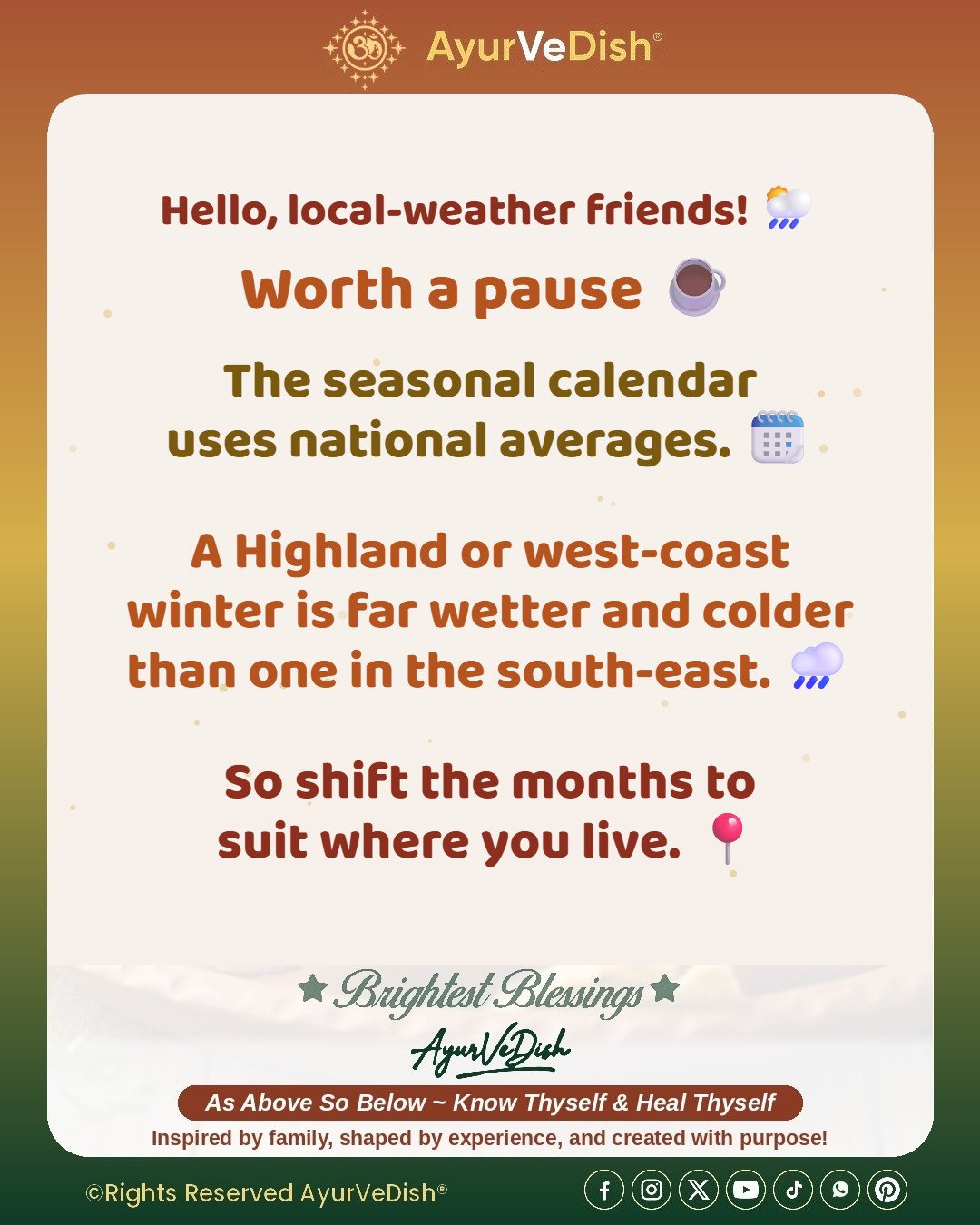
- The figures behind this calendar are national averages; a Highland or west-coast winter is far wetter and colder than a winter in the south-east, so shift the months to suit where you live.
- A cold snap in May or a warm week in October calls for the food of the weather you actually have.
- Make changes gradually across a fortnight at the turn of each window, especially in early March, early May, early September and early December.
What suits you will always depend on you as a person, your digestion, the season and how the food is prepared.
What Researchers Have Found
Eating with the seasons does not mean going without, and frozen vegetables and fruit are a nutritious choice when fresh seasonal produce is out of reach.
A University of California, Davis study compared refrigerated and frozen storage of eight fruits and vegetables: corn, carrots, broccoli, spinach, peas, green beans, strawberries and blueberries (Bouzari, Holstege and Barrett, Journal of Agricultural and Food Chemistry, 2015). For vitamin C, five of the eight showed no significant difference, and the other three were higher when frozen. Frozen produce was comparable to refrigerated in vitamin content, and occasionally higher.
Rickman, Barrett and Bruhn reviewed fresh, frozen and canned fruit and vegetables for vitamin C, B vitamins and phenolics (Journal of the Science of Food and Agriculture, 2007). They found that nutrient losses in fresh produce during storage and cooking may be greater than commonly assumed, and concluded that exclusive recommendations of fresh produce ignore the nutrient benefits of canned and frozen products.
Results varied by food and by nutrient.
Bringing Seasonality Into Your Kitchen
We celebrate flavourful plant-based cooking through vegetables, pulses, herbs and spices that can be enjoyed all year round. Adapt the vegetables, accompaniments and cooking methods to the season while keeping meals convenient and satisfying. In spring, add tender greens. In summer, add crisp, cooling vegetables. In autumn and winter, add roots and squashes.
One 100g pouch of our curry or dal blend makes about 25 portions at Mild (4g), 14 at Medium (7g) or 10 at Extra Hot (10g), per 200g of vegetables, so the same pouch suits a light summer vegetable dish and a hearty winter lentil one, with frozen vegetables as good a choice as fresh.
Mint is traditionally cooling, and it features in our Saunf Pudina & Gulab Sharbat. Our Vata, Pitta and Kapha balance herbal teas are three plant-based hot drinks for exploring how you feel as the year turns. Our Plant-Based Kimchi Blend is another way to add variety to a seasonal plate, and our grain free cupcake, banana bread and muffin premixes, made without cane sugar, egg or dairy, make a treat for any season.
Eat with the seasons when you can, embrace variety and make the most of the ingredients available to you.
Let Food Be Thy Medicine Before Medicine Becomes Thy Food.
As Above, So Below, Know Thyself and Heal Thyself.
Inspired by family, shaped by experience, and created with purpose!
Brightest Blessings

This page is for information only. For medical advice, please speak to a qualified professional.
Evidence and Sources
- Charaka Samhita, Sutrasthana 6, verses 4 to 9, 27 and 42 (Tasyashiteeya Adhyaya, Planet Ayurveda): planetayurveda.com/library/charak-samhita-sutrasthana-chapter-6-tasyashiteeya-adhyaya/
- Bouzari A, Holstege D, Barrett DM. Vitamin retention in eight fruits and vegetables: a comparison of refrigerated and frozen storage. J Agric Food Chem 2015;63(3):957-962: pubmed.ncbi.nlm.nih.gov/25526594/
- Rickman JC, Barrett DM, Bruhn CM. Nutritional comparison of fresh, frozen and canned fruits and vegetables. Part 1. Vitamins C and B and phenolic compounds. J Sci Food Agric 2007;87(6):930-944: agris.fao.org/search/fr/records/65df64bf0f3e94b9e5d81c55
- Charak Samhita Research, Training and Development Centre (Jamnagar), Charak Samhita Online, Tasyashiteeya Adhyaya (Charaka, Sutra Sthana 6). carakasamhitaonline.com
- Charak Samhita Research, Training and Development Centre (Jamnagar), Charak Samhita Online, Ritucharya (topic page). carakasamhitaonline.com
- siva.sh, Astanga Hrudaya, Sutra Sthana 3. siva.sh
- siva.sh, Astanga Hrudaya, Sutra Sthana 12. siva.sh
- Met Office, UK climate averages 1991-2020. metoffice.gov.uk
- Vegetarian Society, Seasonal UK grown produce, 2022. vegsoc.org
- British Dietetic Association, Seasonal fruit and veg: a handy guide. bda.uk.com