 AyurVeDish®
About us
Why AyurVeDish ExistsAyurveda at Our HeartOur Free-From PromiseWhole Food, Plant-Based LivingWhy Grain FreeWhy Oil FreeWhy Dairy FreeWhy Yeast FreeWhy Cane Sugar FreeWhy Soy FreeWhy Thoughtful IngredientsFresh and SeasonalHerbs and SpicesFood from Around the WorldGood Food for EveryoneA Recipe Should Inspire YouEat to LiveSalt, Spice and BalanceAyurveda
Ayurveda Made SimpleThe Five ElementsThe Three DoshasVataPittaKaphaPrakritiYour Dosha CombinationEating for Your ConstitutionChoosing Foods ThoughtfullyThe Six TastesSix Tastes on One PlateFood QualitiesAgni (Fire)Herbs and Spices in the Ayurvedic KitchenEating With the SeasonsAyurveda and the Body ClockFasting: The Ancient PauseBuilding a Plant-Based Ayurvedic MealAyurveda and Modern NutritionFood Combinations and Meal PlanningShop
Speciality All-in-One BlendsGrain Free Rice-Style BlendsSnack & Savoury PremixesGrain Free FloursBakes & DessertsChutneys, Dips & PicklesTadkas & Finishing SpicesDetox & Ayurvedic TeasHot & Cold Drinks





Herbs and Spices in the Ayurvedic Kitchen
Herbs and Spices in the Ayurvedic Kitchen
Open a spice drawer and the room fills with warm, earthy, bright and sweet aromas all at once. Herbs and spices are central to Indian cooking traditions. They bring aroma, colour, depth and character to everyday meals, and Ayurveda has always valued them for more than flavour.
Spices are where the ancients’ knowledge of food becomes easiest to taste.
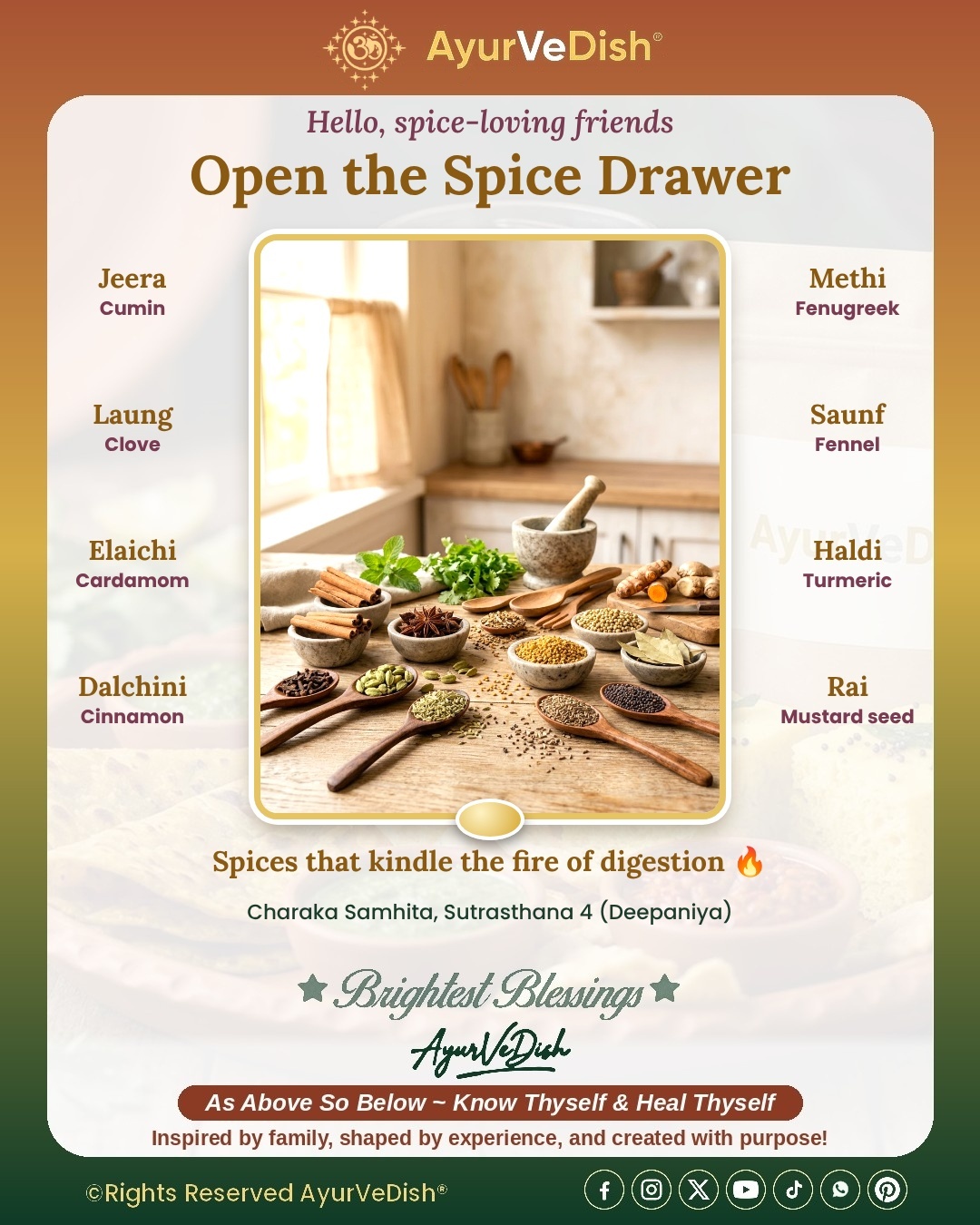
Getting to Know Your Spices
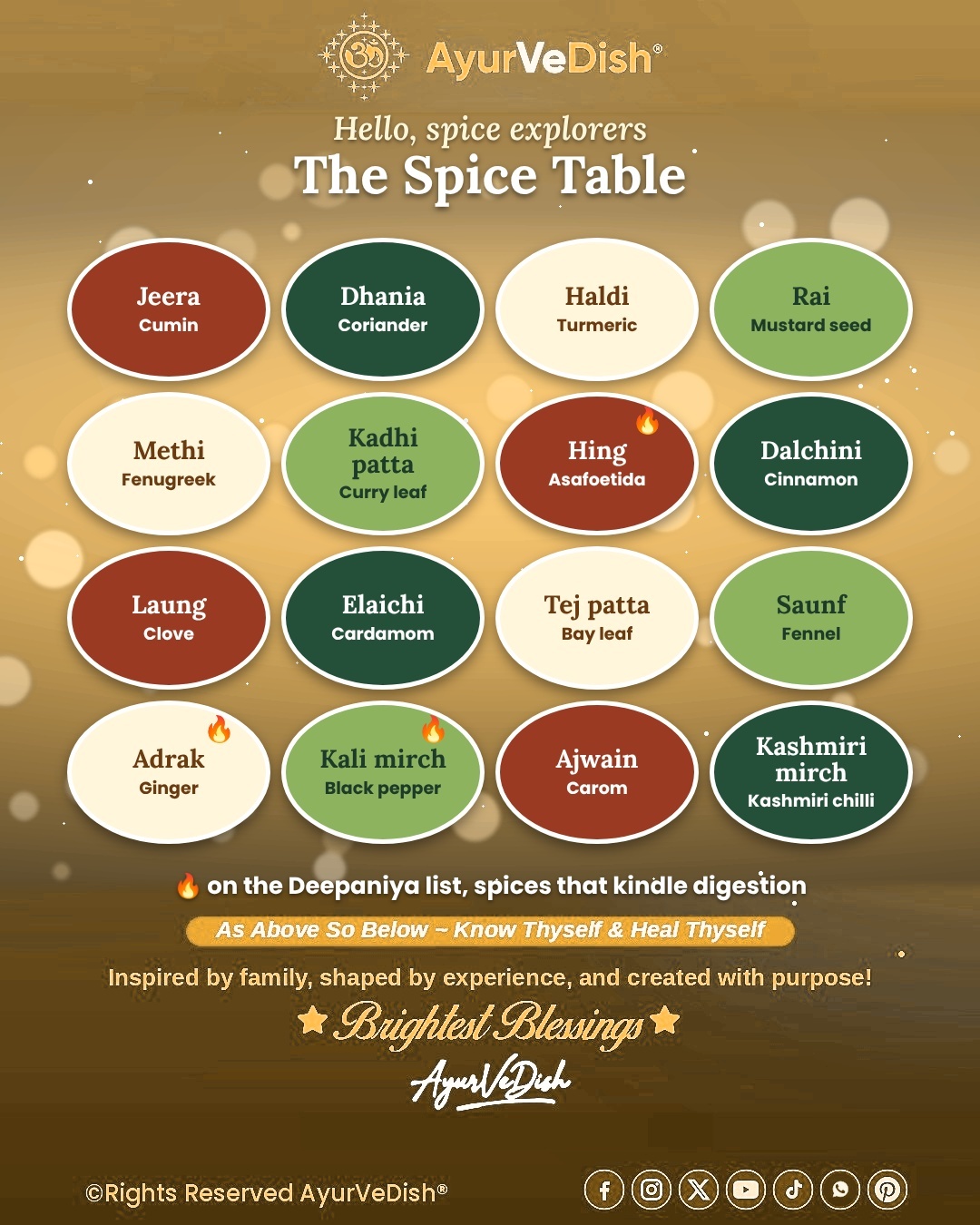
Cumin (jeera) offers an earthy, savoury depth.
Coriander (dhania) adds a fresh, gently citrus-like note.
Turmeric (haldi) contributes colour and an earthy flavour.
Mustard seed (rai) pops in the pan and brings a sharp, nutty bite.
Fenugreek (methi) gives a savoury, slightly bitter edge, and kasuri methi, its dried leaf, adds a mellow, maple-like aroma.
Curry leaf (kadhi patta) brings a fresh, citrusy fragrance.
Asafoetida (hing) adds a deep, savoury note, like onion and garlic.
Cinnamon (dalchini), clove (laung) and green cardamom (elaichi) bring sweet, warm, perfumed depth.
Bay leaf (tej patta) adds a gentle, tea-like background note.
Fennel (saunf) offers a distinctive, gently sweet aroma. It features in our Saunf Pudina & Gulab Sharbat, alongside mint.
Ginger (adrak) brings warmth and a lively flavour.
Black pepper (kali mirch) and long pepper (pippali) bring pungency and intensity.
Ajwain (carom) and nigella (kalonji) add aromatic, savoury seeds.
Kashmiri chilli (kashmiri mirch) gives a vibrant ruby-red colour with gentle heat.
Amchur (dried mango powder) and tamarind (imli) bring a bright, sour tang.
Fresh herbs, such as mint and coriander leaves, add brightness and freshness to a dish.

What the Ancient Texts Say
The Charaka Samhita groups herbs by what they do. One group, Deepaniya, lists plants that kindle the digestive fire. Ginger (shunthi) and black pepper (maricha) both appear on it, alongside long pepper (pippali), chavya, chitraka, ajamoda, a plant in the ajwain family, and asafoetida (hingu) (Sutrasthana 4). The ancients did not treat spices as decoration. They saw them as the part of cooking that wakes up the appetite and supports the fire of digestion you met on the last page.
Fresh Herbs: The Green Side of the Spice Box
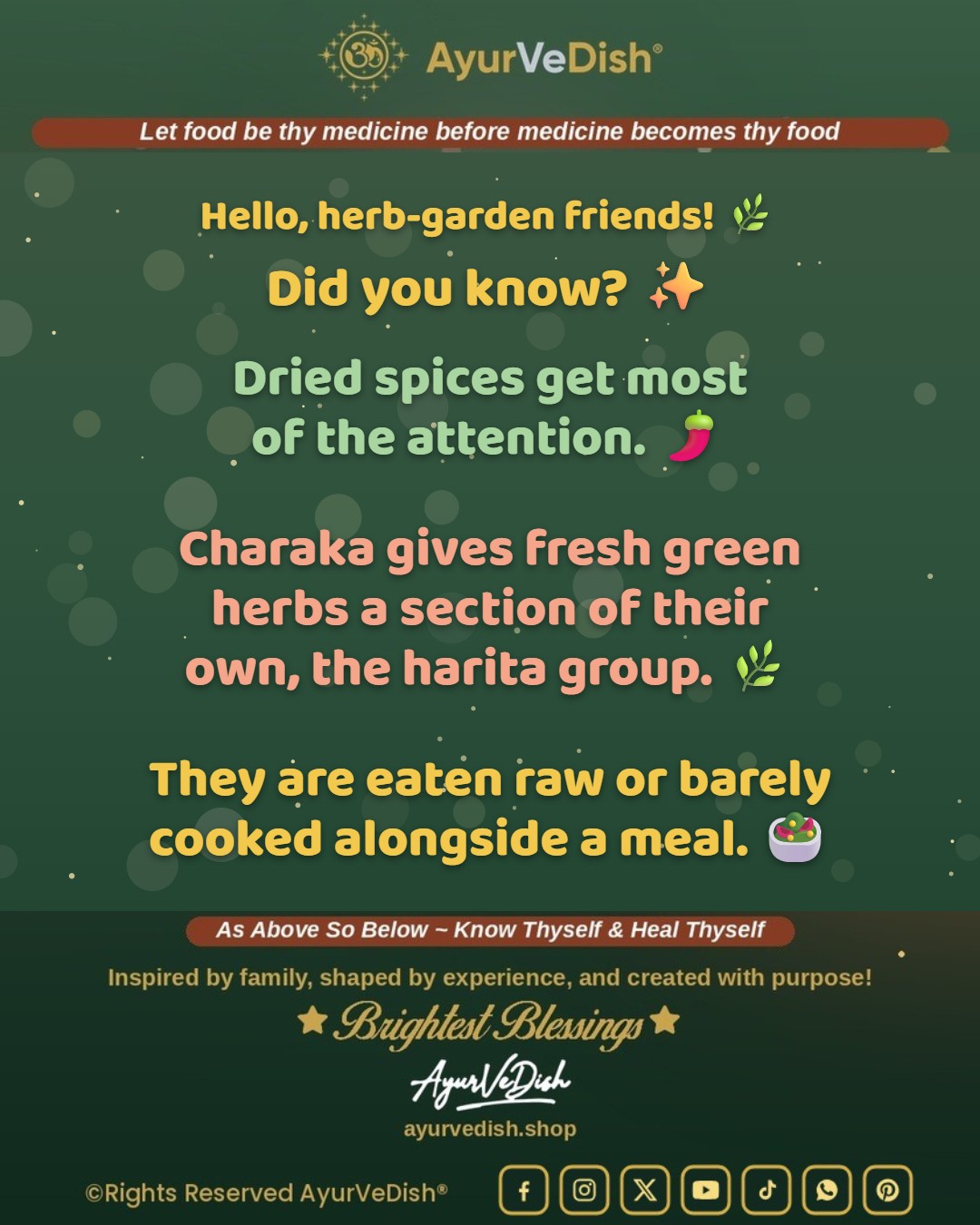
Dried spices get most of the attention, but Charaka gives fresh green herbs a section of their own, the harita group, eaten raw or barely cooked alongside a meal. He describes the group as a whole as appetising and as easing kapha and vata, and he is frank that several of its members raise pitta. He adds that once dried, these herbs still ease kapha and vata. Of the six herbs below, only two appear in his list, so for the others we say plainly that their place in the kitchen is later tradition or modern practice.
| Herb | What the classics say | How we use it |
|---|---|---|
| Coriander leaf (hara dhania) | Charaka groups coriander with two other fragrant herbs as appetising, aromatic and not very pungent, and adds that they can stir up the doshas. Its modern reputation as cooling is later practice, not his wording | A generous handful over dal or shaak off the heat; blended into green chutney |
| Holy basil (tulsi) | Charaka says it eases kapha and vata and freshens foul odour, and he warns that it raises pitta | A few leaves steeped in hot water as tea, or torn into a ginger broth in cold, damp weather; lightly in hot spells |
| Mint (pudina) | No entry in Charaka’s green herbs as we read them; it is regarded today as cooling and refreshing | Mint and coriander chutney, mint tea, and torn leaves through cucumber raita made with coconut yoghurt |
| Curry leaf (mitho limdo) | No entry in the food chapters of Charaka or the Ashtanga Hridaya; see our Spice Explorer | Dropped into a dry tempering or simmered whole in rasam-style broths |
| Fenugreek leaf (methi) | Not among the herbs Charaka lists for eating fresh; modern practice regards the leaf as bitter | Methi shaak, methi in buckwheat flatbread dough, and a handful wilted into moong dal |
| Dill (suva) | We did not find dill leaf among Charaka’s green herbs | Gujarati suva bhaji with moong dal, and chopped through potato or squash shaak |
Two classical notes worth knowing
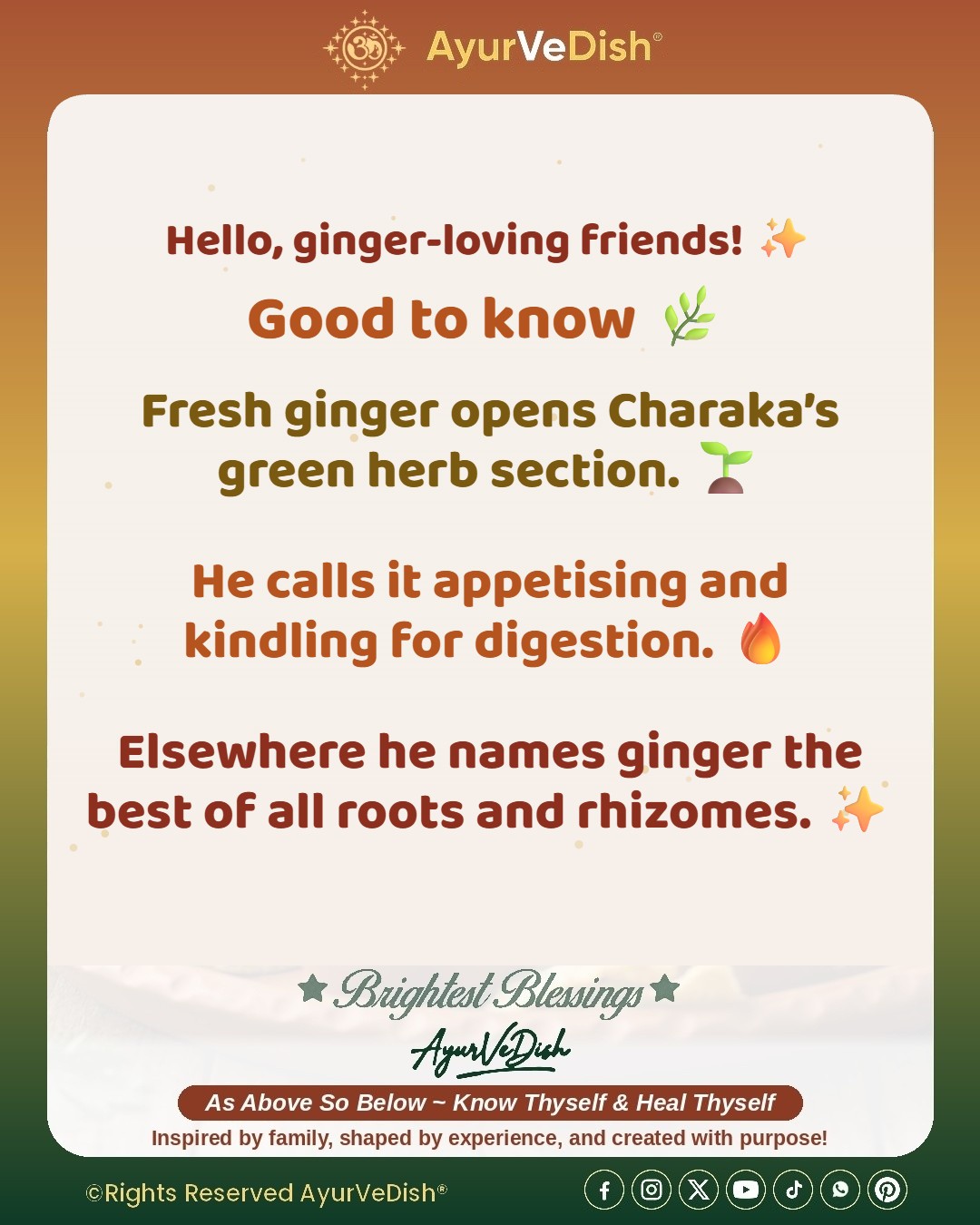
- Fresh ginger opens Charaka’s green herb section and he calls it appetising and kindling for digestion; elsewhere he names ginger the best of all roots and rhizomes.
- He makes a point about radish that applies to most leaves and roots: tender and young, it settles the doshas; overgrown, it unsettles them. Buy herbs young and fresh, and use them quickly.
Buying and Storing Fresh Herbs
- Coriander, mint and dill: trim the stems and stand them in a jar half filled with cold water, loosely cover the leaves with a bag, and keep in the fridge door, changing the water every few days.
- Tulsi bruises and darkens quickly, so buy it close to use, or grow a pot on a sunny windowsill.
- Methi bunches: pick the leaves from the stems as soon as you get home, wash and dry them well, and store between sheets of kitchen paper in a closed box.
- Curry leaves: keep the sprigs wrapped in the fridge, or freeze them; dried curry leaves keep little aroma.
- To freeze any of these, wash and dry them, then freeze whole in bags, or chop them into ice cube trays and cover with water. They keep for up to six months, best used in cooked dishes rather than as a garnish.
- Use the stems too: coriander stems carry more flavour than the leaves and belong in the chutney or the masala.
For the dried spices, with taste, potency and post-digestive effect for each, open our Spice Explorer.
What suits you will always depend on you as a person, your digestion, the season and how the food is prepared.
What Researchers Have Found
Spices and herbs top the antioxidant tables. A Norwegian-led team measured the antioxidant content of 3,139 foods, drinks, herbs and spices (Carlsen et al., Nutrition Journal, 2010). Spices and herbs were the richest group: across the 425 tested, the average was 29 mmol per 100g, against 0.3 for meat. Dried cloves scored 277, dried mint leaves 116, allspice 100, cinnamon 77, oregano 63, thyme 56, rosemary 45, sage 44 and dried ginger 20. The authors noted that spices add little weight to a meal yet may still be important contributors to our antioxidant intake. This is a laboratory measure.
Cinnamon and blood sugar. A meta-analysis of 10 randomised controlled trials with 543 adults with type 2 diabetes (Allen et al., Annals of Family Medicine, 2013) found that cinnamon lowered fasting blood glucose by 24.6 mg/dL (95% CI 8.7 to 40.5). Total cholesterol fell by 15.6 mg/dL, LDL cholesterol by 9.4 mg/dL and triglycerides by 29.6 mg/dL, while HDL cholesterol rose by 1.7 mg/dL.
Ginger and digestion. In a placebo-controlled trial (Wu et al., European Journal of Gastroenterology & Hepatology, 2008), 24 healthy volunteers took 1.2g of ginger in capsules, then ate a light soup meal. Half of the meal had left the stomach after 13 minutes with ginger, against 27 minutes with the placebo (P < 0.01).
Immune cells in the laboratory. In a 2010 study in the Journal of Medicinal Food (Majdalawieh and Carr), water extracts of black pepper and cardamom enhanced the activity of natural killer cells, the immune system’s patrol cells, in laboratory dishes.
Bringing the Tradition Into Your Kitchen
A few carefully chosen spices can turn lentils, chickpeas, vegetables and other plant-based ingredients into memorable meals. At AyurVeDish, the art of blending is about bringing ingredients together in thoughtful proportions to create convenient, delicious food inspired by Indian cooking and complementary culinary influences.
Our blends come complete, so every herb and spice is already in the pouch, in balance. You add vegetables, pulses or beans and water, then cook. One 100g pouch of our curry or dal blend makes about 25 portions at Mild (4g), 14 at Medium (7g) or 10 at Extra Hot (10g), per 200g of vegetables. Our optional tadka blends bring mustard, cumin, fenugreek, hing, cinnamon and clove to the pan for a final aroma, our Agni Spark finishing spice adds roasted cumin, ginger, black pepper, long pepper, ajwain and hing at the table, and our grain and oil free chutney premixes bring amchur, tamarind, mint and chilli. Our herbal teas and hot drinks bring cardamom, ginger and cinnamon to the end of a meal, and our grain free cupcake and banana bread premixes, made without cane sugar, egg or dairy, use cinnamon and vanilla.
Explore their aromas, discover the combinations you love and let herbs and spices bring your cooking to life.
Let Food Be Thy Medicine Before Medicine Becomes Thy Food.
As Above, So Below, Know Thyself and Heal Thyself.
Inspired by family, shaped by experience, and created with purpose!
Brightest Blessings

This page is for information only. For medical advice, please speak to a qualified professional.
Evidence and Sources
- Charaka Samhita, Sutrasthana 4, Deepaniya group (Planet Ayurveda): planetayurveda.com/library/sutrasthana-chapter-4-shadvirechan-shatashrityam/
- Carlsen MH et al., The total antioxidant content of more than 3100 foods, beverages, spices, herbs and supplements used worldwide. Nutr J 2010;9:3: pmc.ncbi.nlm.nih.gov/articles/PMC2841576/
- Allen RW et al., Cinnamon use in type 2 diabetes: an updated systematic review and meta-analysis. Ann Fam Med 2013;11(5):452-459: annfammed.org/content/11/5/452
- Wu K et al., Effects of ginger on gastric emptying and motility in healthy humans. Eur J Gastroenterol Hepatol 2008;20(5):436-440: pubmed.ncbi.nlm.nih.gov/18403946/
- Majdalawieh AF, Carr RI. In vitro investigation of the potential immunomodulatory and anti-cancer activities of black pepper and cardamom. J Med Food 2010;13(2):371-381: pubmed.ncbi.nlm.nih.gov/20210607/
- Charak Samhita Research, Training and Skill Development Centre. Charaka Samhita, Sutrasthana 27, Annapanavidhi Adhyaya (the group of green herbs: fresh ginger, radish, holy basil, coriander; dried herbs). Charak Samhita Online, 2020. carakasamhitaonline.com
- Charaka Samhita, Sutrasthana 27, verses 171 to 175: green herbs including coriander, leek and onion. siva.sh
- Wisdom Library. Charaka Samhita (English translation), Sutrasthana 27f, The group of greens (Harita). wisdomlib.org
- Charak Samhita Research, Training and Skill Development Centre. Charaka Samhita, Sutrasthana 25, Yajjah Purushiya Adhyaya (ginger as the best of roots and rhizomes). Charak Samhita Online, 2020. carakasamhitaonline.com
- Worcestershire County Council. Let’s Waste Less: herbs storage tips. worcestershire.gov.uk
- Love Food Hate Waste. Herbs: storage and freezing. beta.lovefoodhatewaste.com