 AyurVeDish®
About us
Why AyurVeDish ExistsAyurveda at Our HeartOur Free-From PromiseWhole Food, Plant-Based LivingWhy Grain FreeWhy Oil FreeWhy Dairy FreeWhy Yeast FreeWhy Cane Sugar FreeWhy Soy FreeWhy Thoughtful IngredientsFresh and SeasonalHerbs and SpicesFood from Around the WorldGood Food for EveryoneA Recipe Should Inspire YouEat to LiveSalt, Spice and BalanceAyurveda
Ayurveda Made SimpleThe Five ElementsThe Three DoshasVataPittaKaphaPrakritiYour Dosha CombinationEating for Your ConstitutionChoosing Foods ThoughtfullyThe Six TastesSix Tastes on One PlateFood QualitiesAgni (Fire)Herbs and Spices in the Ayurvedic KitchenEating With the SeasonsAyurveda and the Body ClockFasting: The Ancient PauseBuilding a Plant-Based Ayurvedic MealAyurveda and Modern NutritionFood Combinations and Meal PlanningShop
Speciality All-in-One BlendsGrain Free Rice-Style BlendsSnack & Savoury PremixesGrain Free FloursBakes & DessertsChutneys, Dips & PicklesTadkas & Finishing SpicesDetox & Ayurvedic TeasHot & Cold Drinks





Agni(Fire)
Agni: The Fire of Digestion
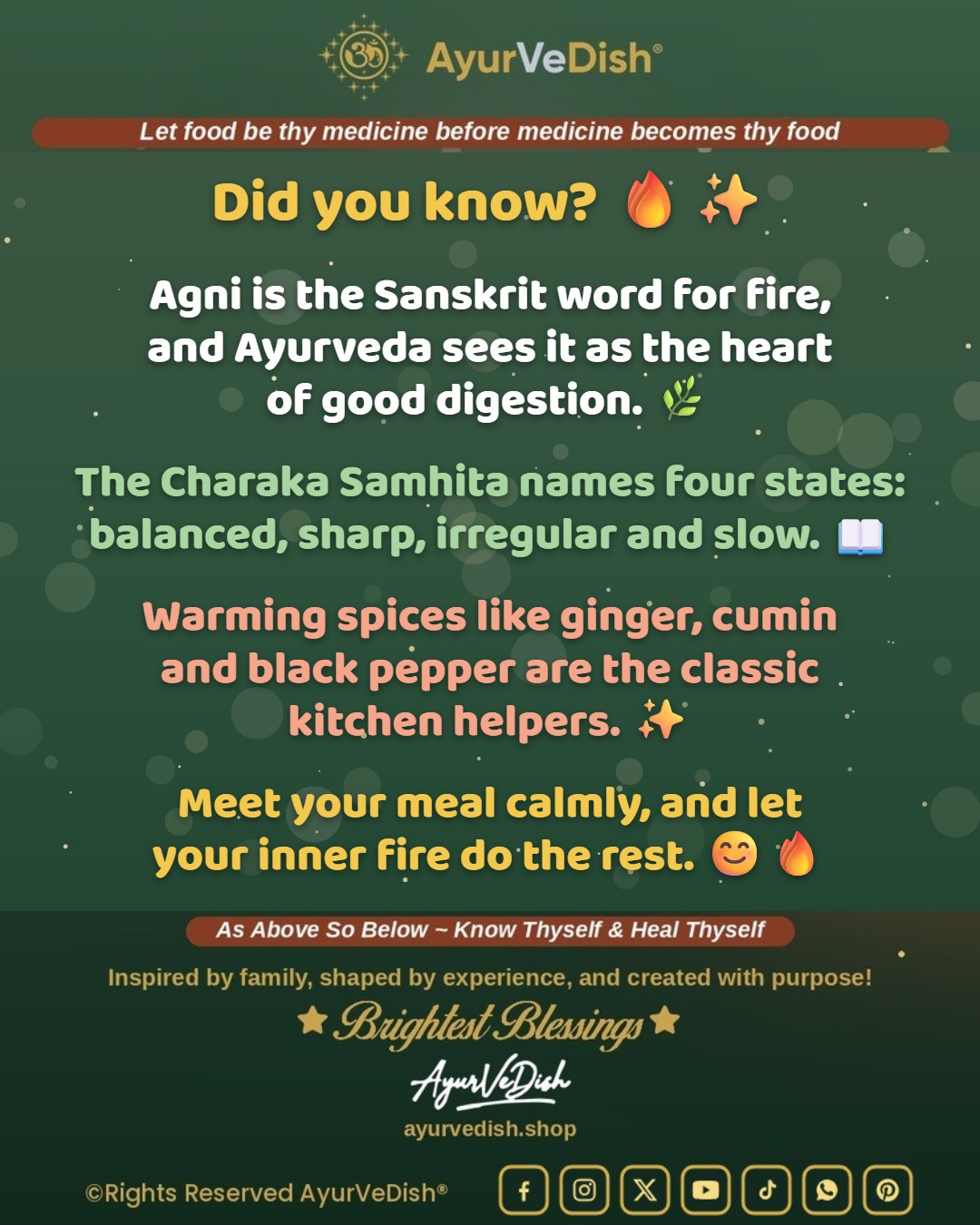
Every kitchen has a fire. It is what turns raw ingredients into a meal. Ayurveda says our bodies have one too. It calls it Agni, the Sanskrit word for fire, and uses it to describe everything involved in digesting and transforming the food we eat.
This is one of the kindest ideas in Ayurveda. It reminds us that a good meal is not only about what is on the plate. It is also about how we meet it.
What Is Agni?
In Ayurveda, Agni is the fire of digestion and transformation. It reflects the traditional view that how we digest and process food matters alongside the food itself. Two people can eat the same meal and have very different experiences of it, and Agni is the word the tradition uses for that difference.
What the Ancient Texts Say
The Charaka Samhita calls the grahani, which holds the food just above the navel, the seat of Agni (Chikitsasthana 15.56). It names four kinds of Agni: sharp (tikshna), low (manda), balanced (sama) and irregular (vishama) (Vimanasthana 6.12). It also says that Agni is the root cause of long life, good complexion, strength and health (Chikitsasthana 15.3).
The ancients were not talking about fashion or fads. They were describing how food becomes us, and saying that this process deserves our attention.
Agni and Everyday Eating
Traditional guidance often encourages regular mealtimes, freshly prepared food where practical, mindful eating and attention to your own appetite. Warm, cooked meals, soups, vegetables and gently spiced dishes feature in many traditional approaches.
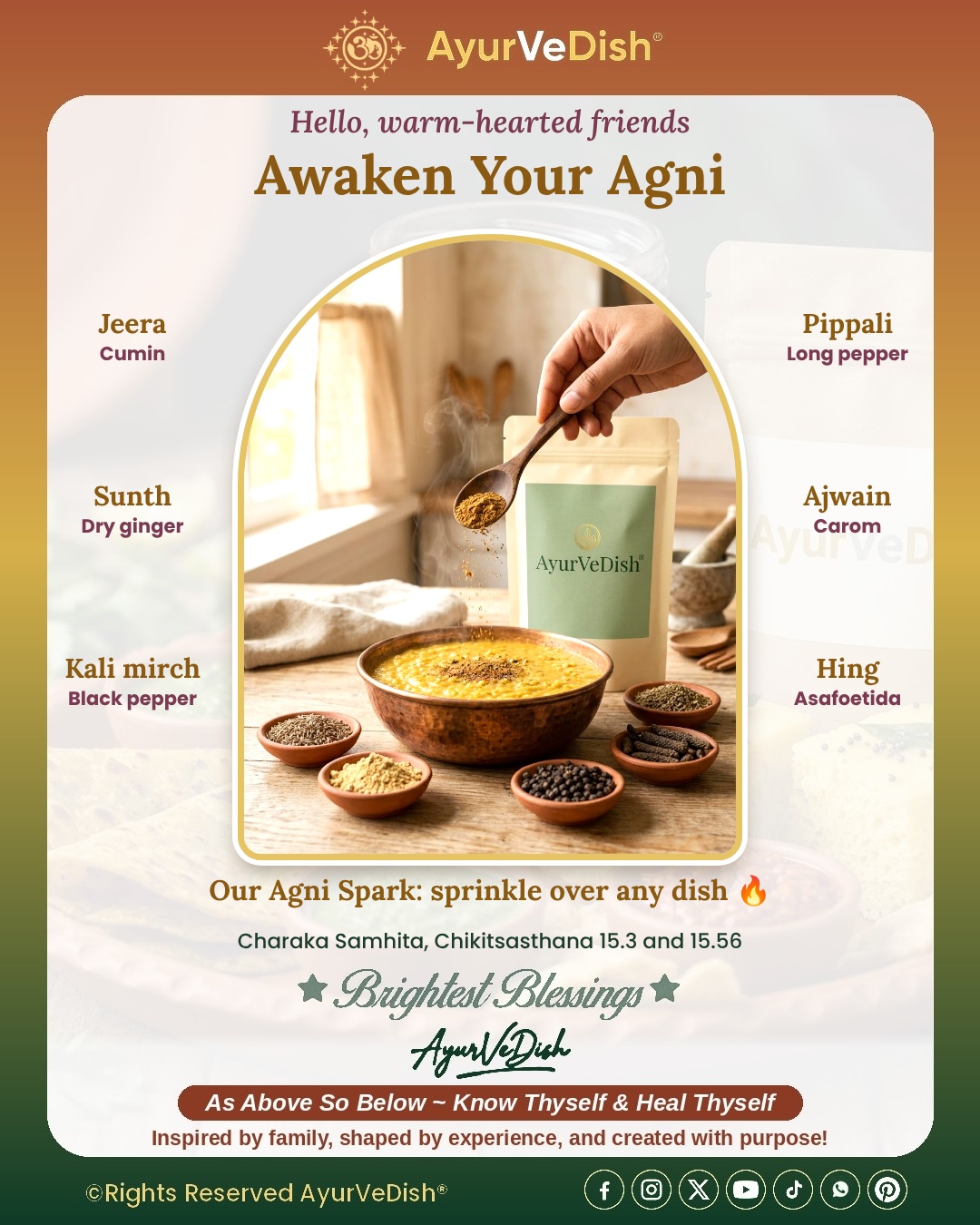
Our Agni Spark is a sprinkle-on finishing spice of roasted cumin, ginger, black pepper, long pepper, ajwain and hing, made to be added at the table over dals, soups, vegetables and chaat. One 100g pouch makes about 25 teaspoon portions. For a simple, warming bowl, our Detox Kitchadi Blend goes into our grain free Plain Kitchadi Base Premix of moong dal, buckwheat and sabudana, where 50g makes a bowl of kitchadi.
The Four States of Agni
Charaka sorts digestive fire by strength into four kinds, and Vagbhata’s Ashtanga Hridaya ties each one to the dosha that steers it: vata makes the fire irregular, pitta makes it sharp, kapha makes it slow, and when the three are in balance the fire is even. Sushruta adds the bodily signs that go with each. The last column is our own kitchen reading, not a classical instruction.
| State | Linked with | How it behaves in the texts | Our kitchen reading (AyurVeDish® adaptation) |
|---|---|---|---|
| Sama (even) | Doshas in balance | Digests a properly taken meal on time and without fuss; Charaka notes that even this fire can be upset by careless habits | Keep doing what works: regular meals, all six tastes across the day, sensible portions |
| Vishama (irregular) | Vata | Sometimes digests well and sometimes not; Sushruta lists distension, colic and an unsettled bowel among its signs | Fixed meal times, warm and moist food, soupy dals, cumin, fennel and fresh ginger; nothing iced |
| Tikshna (sharp) | Pitta | Copes with irregularity and digests even a large meal quickly; Sushruta notes a dry throat, lips and palate and a feeling of heat | Do not skip or delay meals; cooling, substantial food such as gourds, mung and coconut, with coriander and fennel |
| Manda (slow) | Kapha | Upset by the slightest lapse; even a small meal sits heavily, with a heavy feeling in the abdomen and head | Smaller, lighter, warm meals; brothy soups, dry-cooked greens, black pepper and dry ginger; hot water rather than chilled drinks |
Charaka also explains why the uneven states matter: an irregular fire builds the body’s tissues unevenly, a sharp fire given too little food begins to wear on them, and a weak fire leaves food only partly digested.
The thirteen agnis, briefly
The digestive fire in the belly is only the first of thirteen. Charaka calls it the master of all the others, since their strength rises and falls with it.
- Jatharagni (one): the main digestive fire in the gut, which breaks food down.
- Bhutagni (five): one for each element, earth, water, fire, air and space, each working on the matching part of the food.
- Dhatvagni (seven): one for each tissue in turn, from plasma through blood, muscle, fat, bone and marrow to the reproductive tissue, each splitting its nourishment into a usable part and a waste part.
How to Tell a Meal Has Been Digested
Charaka’s rule is to eat only once the previous meal has been digested, and he describes what that feels like. When the last meal is done:
- Belching is clean.
- The digestive fire is kindled and real hunger returns.
- There is an easy flow of wind, urine and stool, each at its natural urge.
- The chest feels clear and the body’s channels feel open.
In a separate passage he gives the signs that the quantity was right: no pressure on the abdomen, heart or sides, no heaviness, hunger and thirst satisfied, easy movement, speech and breathing, the meal digested comfortably by the evening or the next morning, and strength and complexion supported.
Ama: When Food Is Left Half Done
Ama is the classical name for food that the fire has not fully processed. Charaka says that when agni is disturbed, even light food is not properly digested; it turns sour and, if the pattern continues, becomes poison-like in the body. He names what disturbs agni: fasting, eating before the last meal is digested, overeating, irregular meals, food that is unsuitable, heavy, cold or very dry, sudden changes of place, season or routine, and holding back natural urges. Among the signs he describes are heaviness, bloating, a dull appetite, body ache and a general sense of malaise. Two other causes stand out for a modern cook: Charaka says wholesome food in the right amount still digests poorly when we eat anxious, grieving, fearful, angry or short of sleep, and he lists eating at the wrong time alongside the wrong food. Any persistent digestive symptom deserves a conversation with your GP rather than a change of menu alone.
Practical Habits From the Texts
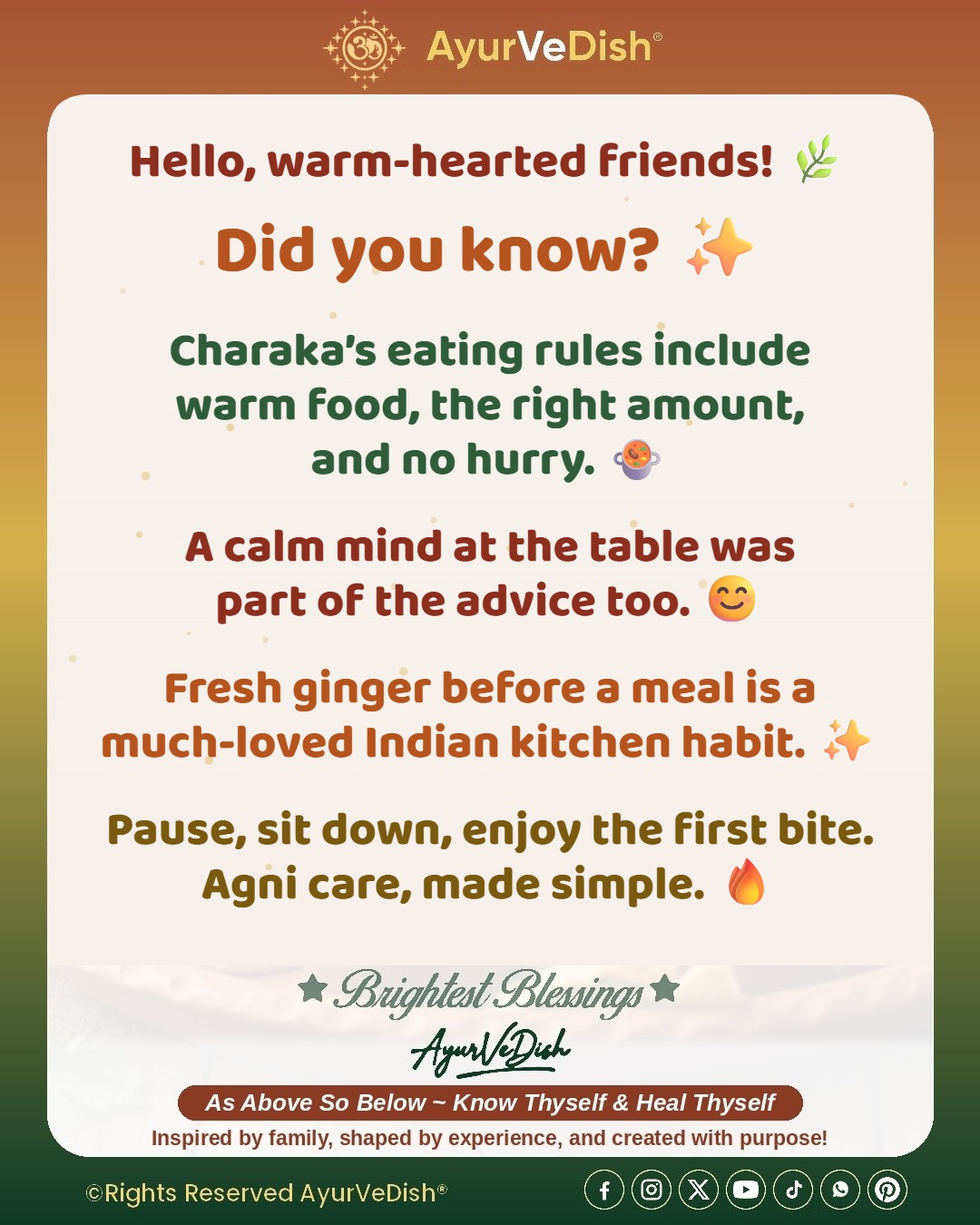
Charaka’s rules of eating
| Rule | The reason Charaka gives | In an oil free, grain free kitchen |
|---|---|---|
| Eat warm food | It tastes better, kindles agni, moves through well and settles vata and kapha | Serve food freshly cooked and warm; sip hot water rather than iced |
| Eat unctuous food | It is pleasing, wakes a sluggish fire, nourishes and supports strength and complexion | Our adaptation: unctuousness from whole foods such as sesame, coconut, avocado, soaked seeds and slow-cooked pulses |
| Eat the right quantity | It keeps the doshas steady and digests without strain | See the portions below |
| Eat after the last meal is digested | New food on top of half-digested food quickly unsettles the doshas | Wait for the signs above rather than the clock alone |
| Avoid conflicting foods | Incompatible combinations cause disorder | Keep combinations simple and suited to you |
| Eat in a pleasant place | A calm setting and proper utensils keep the mind settled | Sit down at a table, away from the screen |
| Not too fast | Food goes down the wrong way and you cannot judge it | Put the spoon down between mouthfuls |
| Not too slow | The meal goes cold, satisfaction never arrives and you overeat | Around the length of a relaxed conversation |
| Without talking or laughing, with attention | Distraction brings the same faults as speed | Talk before and after; give the plate your attention |
| Know what suits you | Each person should eat according to their own constitution | Notice how you feel two to three hours later |
Quantity
Charaka is clear that the right amount depends first on the strength of your fire, then on the food itself. Light foods such as mung are forgiving; heavy foods such as urad dal or sesame should fill only a third to a half of your appetite, and even light food should not be taken to the point of fullness. He also warns against piling heavy food on top of a meal already eaten. In his three-part picture of the stomach, one part is for solid food, one for liquid and one is left empty so digestion has room to work.
Ginger before meals
Charaka describes fresh ginger as appetising and as kindling digestion, and lemon in the same way. A thin slice of fresh ginger with a pinch of rock salt and a few drops of lemon, chewed a little before lunch, is a widely followed traditional practice built on that description rather than a rule set down in the classical texts. If you have reflux or take medication that ginger may affect, speak to your GP or pharmacist first.
What suits you will always depend on you as a person, your digestion, the season and how the food is prepared.
What Researchers Have Found
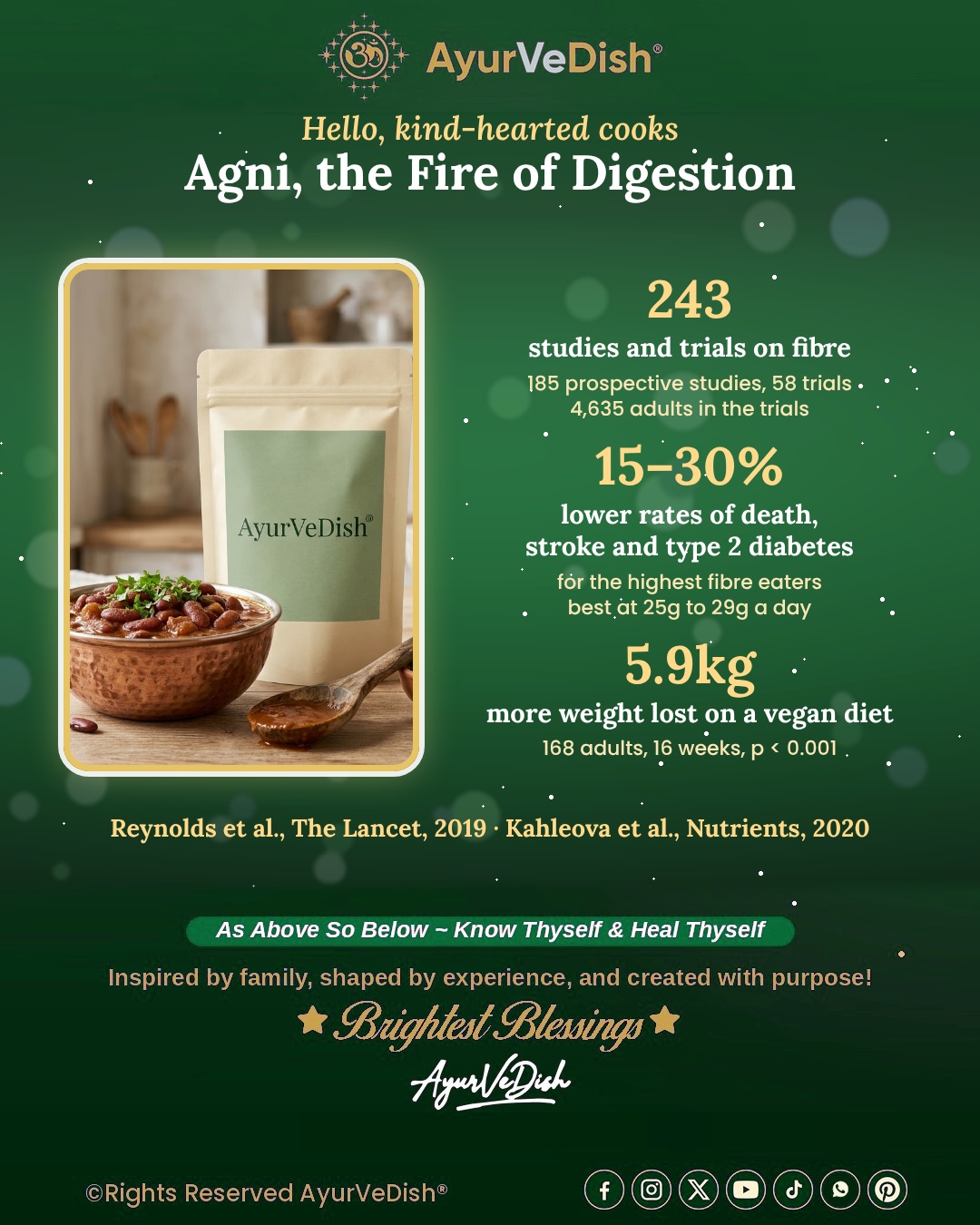
Digestion starts in the kitchen, with what we put on the plate, and the research on plant-rich eating is encouraging.
A Lancet review of dietary fibre (Reynolds et al., 2019) pooled 185 prospective studies and 58 clinical trials, with 4,635 adults in the trials.
People eating the most fibre had 15% to 30% lower rates of death from any cause and from heart disease, and lower rates of stroke, type 2 diabetes and colorectal cancer.
The trials showed lower body weight, blood pressure and total cholesterol. Benefits were greatest at 25g to 29g of fibre a day.
A randomised trial co-authored by Dr Neal Barnard and colleagues at the Physicians Committee for Responsible Medicine (Kahleova et al., Nutrients, 2020) followed 168 overweight adults for 16 weeks.
On a low-fat vegan diet, body weight fell by 5.9kg more than on their usual diet (95% CI 4.9 to 7.0kg, p < 0.001) and insulin sensitivity improved.
The gut bacterium Faecalibacterium prausnitzii rose by 5.1% (p < 0.001) and was linked to a drop in weight, fat mass and visceral fat.
Making Digestion Part of Your Food Choices
Eat slowly, chew well, stay hydrated and keep your meals varied and full of plants. Give yourself time to sit down, and notice how you feel before, during and after a meal. That attention is part of the practice.
Our curry and dal blends make a plant-rich meal easy: one 100g pouch makes about 25 portions at Mild (4g), 14 at Medium (7g) or 10 at Extra Hot (10g), per 200g of vegetables. Our herbal teas and hot drinks give a warm, unhurried end to a meal.
Give yourself time to enjoy your food, pay attention to your needs and make everyday meals a pleasure.
Let Food Be Thy Medicine Before Medicine Becomes Thy Food.
As Above, So Below, Know Thyself and Heal Thyself.
Inspired by family, shaped by experience, and created with purpose!
Brightest Blessings

This page is for information only. For medical advice, please speak to a qualified professional.
Evidence and Sources
- Charaka Samhita, Chikitsasthana 15, verses 3 and 56 (Grahani Chikitsa): carakasamhitaonline.com/index.php/Grahani_Chikitsa
- Charaka Samhita, Vimanasthana 6, verse 12 (Roganika Vimana): carakasamhitaonline.com/index.php/Roganika_Vimana
- Reynolds A et al., Carbohydrate quality and human health: a series of systematic reviews and meta-analyses. Lancet 2019;393(10170):434-445: pubmed.ncbi.nlm.nih.gov/30638909/
- Kahleova H et al., Effects of a low-fat vegan diet on gut microbiota in overweight individuals and relationships with body weight, body composition, and insulin sensitivity. A randomized clinical trial. Nutrients 2020;12(10):2917: pubmed.ncbi.nlm.nih.gov/32987642/
- Charak Samhita Research, Training and Development Centre (Jamnagar), Charak Samhita Online, Grahani Chikitsa (Charaka, Chikitsa Sthana 15). carakasamhitaonline.com
- Charak Samhita Research, Training and Development Centre (Jamnagar), Charak Samhita Online, Agni (topic page). carakasamhitaonline.com
- Charak Samhita Research, Training and Development Centre (Jamnagar), Charak Samhita Online, Rasa Vimana (Charaka, Vimana Sthana 1). carakasamhitaonline.com
- Charak Samhita Research, Training and Development Centre (Jamnagar), Charak Samhita Online, Trividhakukshiya Vimana (Charaka, Vimana Sthana 2). carakasamhitaonline.com
- Charak Samhita Research, Training and Development Centre (Jamnagar), Charak Samhita Online, Matrashiteeya Adhyaya (Charaka, Sutra Sthana 5). carakasamhitaonline.com
- Charak Samhita Research, Training and Development Centre (Jamnagar), Charak Samhita Online, Annapanavidhi Adhyaya (Charaka, Sutra Sthana 27). carakasamhitaonline.com
- siva.sh, Caraka Samhita, Vimana Sthana 6. siva.sh
- siva.sh, Astanga Hrudaya, Sharira Sthana 3. siva.sh
- Satyori, Ashtanga Hridayam, Sutrasthana 1, verse 8. satyori.com
- Bhishagratna K.K. (trans.), Sushruta Samhita, Sutrasthana 35, 1907, via Wisdom Library. wisdomlib.org