 AyurVeDish®
About us
Why AyurVeDish ExistsAyurveda at Our HeartOur Free-From PromiseWhole Food, Plant-Based LivingWhy Grain FreeWhy Oil FreeWhy Dairy FreeWhy Yeast FreeWhy Cane Sugar FreeWhy Soy FreeWhy Thoughtful IngredientsFresh and SeasonalHerbs and SpicesFood from Around the WorldGood Food for EveryoneA Recipe Should Inspire YouEat to LiveSalt, Spice and BalanceAyurveda
Ayurveda Made SimpleThe Five ElementsThe Three DoshasVataPittaKaphaPrakritiYour Dosha CombinationEating for Your ConstitutionChoosing Foods ThoughtfullyThe Six TastesSix Tastes on One PlateFood QualitiesAgni (Fire)Herbs and Spices in the Ayurvedic KitchenEating With the SeasonsAyurveda and the Body ClockFasting: The Ancient PauseBuilding a Plant-Based Ayurvedic MealAyurveda and Modern NutritionFood Combinations and Meal PlanningShop
Speciality All-in-One BlendsGrain Free Rice-Style BlendsSnack & Savoury PremixesGrain Free FloursBakes & DessertsChutneys, Dips & PicklesTadkas & Finishing SpicesDetox & Ayurvedic TeasHot & Cold Drinks





Food Qualities
Food Qualities: Warming, Cooling, Light and Heavy
Think about a bowl of hot soup on a cold evening, or a crisp cucumber on a summer day. Neither is only a taste. Each has a character you feel as well as taste, and Ayurveda paid close attention to it.
It is one of the most practical ideas in the tradition, and you already know it, because you have been choosing food by its qualities all your life.
What Are Food Qualities?
Alongside the six tastes, Ayurveda describes food by its qualities (gunas): warming or cooling, light or heavy, oily or dry, soft or hard. Taste tells you what a food is. Quality tells you how it feels to eat and how it sits afterwards. Together they explain why traditional guidance looks at how ingredients are prepared, combined and enjoyed.
What the Ancient Texts Say
The Charaka Samhita opens its list of properties with guru, heavy (Sutrasthana 1.49). The Ashtanga Hridaya then shows how they fall into ten pairs of opposites: heavy and light, dull and sharp, cold and hot, oily and dry, smooth and rough, dense and liquid, soft and hard, stable and mobile, subtle and gross, clear and slimy (Sutrasthana 1.18).
The Charaka Samhita also gives a practical rule for heavy and light foods. Light foods stimulate digestion, while heavy foods do not by nature, so heavy foods are best taken up to one third or one half of one’s fill, and even light foods are not taken to excess, to keep digestion strong (Sutrasthana 5.6 to 5.7). The ancients taught us to look at food with all our senses, not just the tongue.

Warming and Cooling Foods
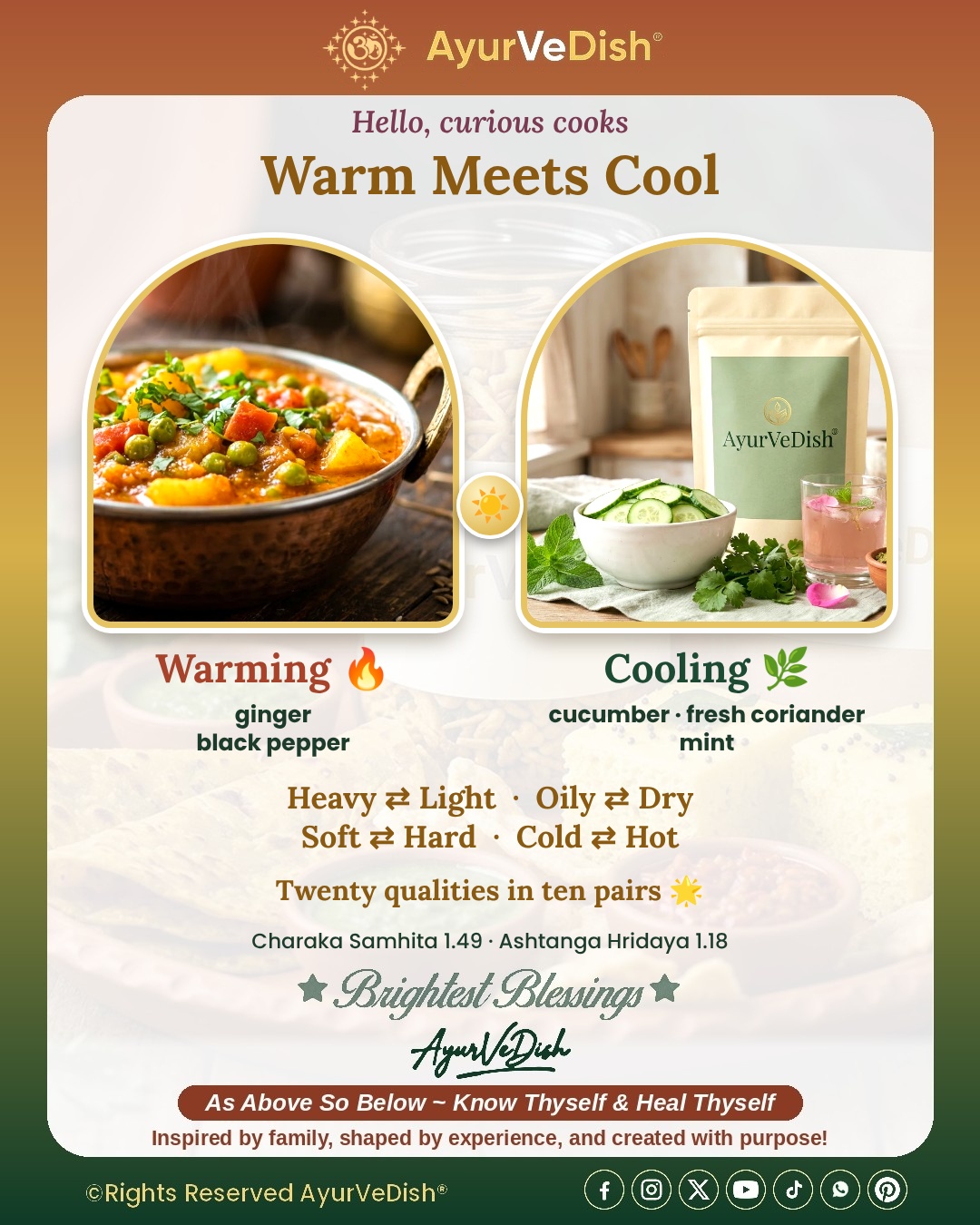
Warming qualities are traditionally linked with ginger, black pepper and other spices. Cooling qualities are traditionally linked with cucumber, fresh coriander and mint. Our Saunf Pudina & Gulab Sharbat brings mint, fennel and rose together as a cooling drink, and a spoonful of our grain and oil free Hari chutney premix adds a fresh, green note to a warm plate.
Light and Heavy Foods
Soups, cooked vegetables and lighter meals are traditionally described as easier to digest, while dense, rich dishes are described as heavier. Our curry and dal blends suit both ends of the table: one 100g pouch makes about 25 portions at Mild (4g), 14 at Medium (7g) or 10 at Extra Hot (10g), per 200g of vegetables, so a light vegetable soup and a thick chickpea curry can come from the same pouch. At the richer end, our grain free cupcake, banana bread and muffin premixes, made without cane sugar, egg or dairy, are a treat to enjoy in smaller portions, just as the Charaka Samhita advises for heavy foods.
The Twenty Qualities as Ten Pairs
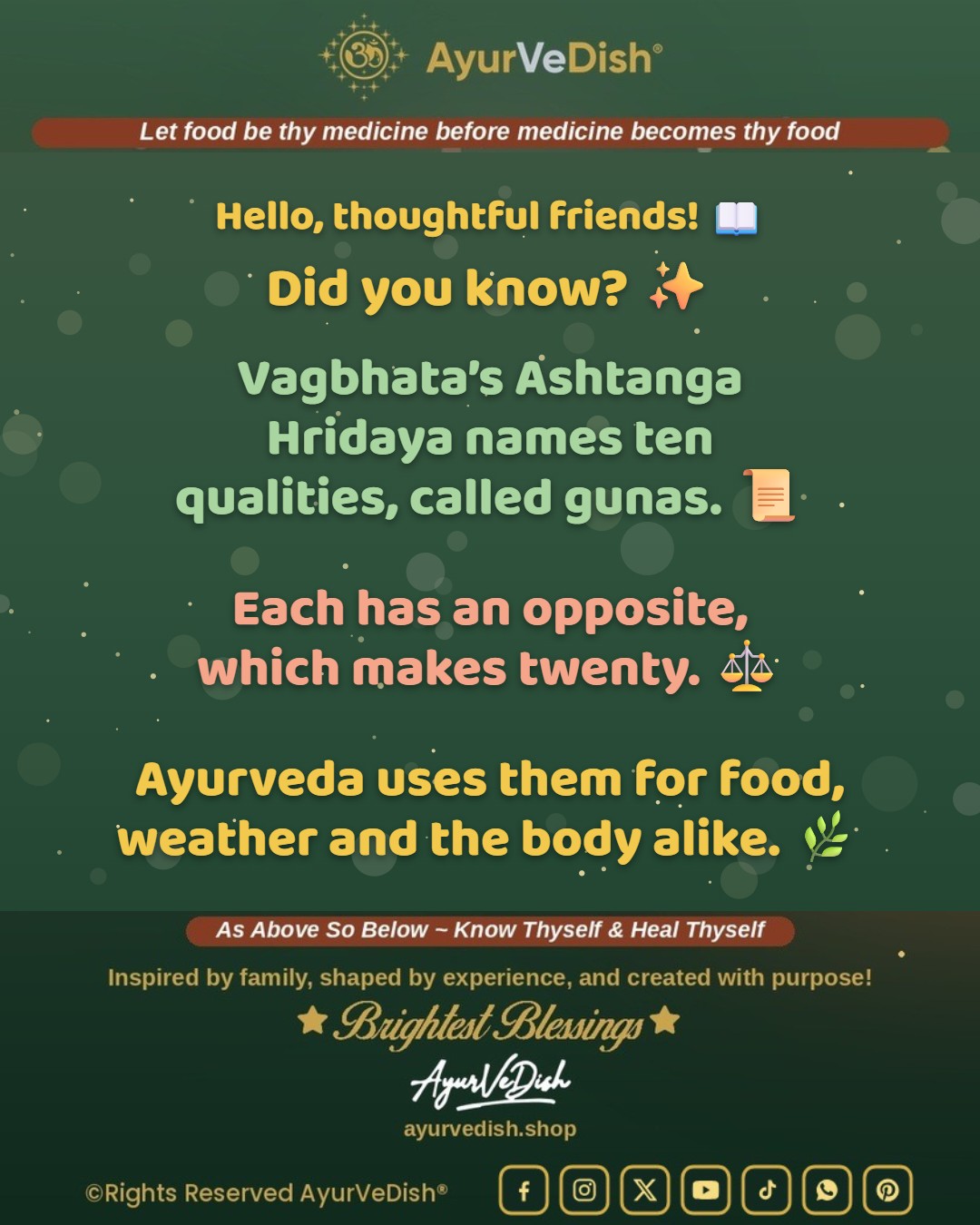
Vagbhata’s Ashtanga Hridaya names ten qualities (gunas) and says each has an opposite, making twenty. They are the vocabulary Ayurveda uses for food, weather and the body alike, and Charaka builds his description of the doshas from them: vata is dry, cold, light, subtle, mobile, clear and rough; pitta is slightly unctuous, hot, sharp, liquid and flowing; kapha is heavy, cold, soft, unctuous, stable and slimy. The working rule is that like increases like and opposites bring balance. The dosha notes follow the Charak Samhita Online summary; the kitchen examples are ours, all grain free and oil free.
| Pair | What it means | Its effect | Kitchen examples | Dosha effect |
|---|---|---|---|---|
| Heavy (guru) / Light (laghu) | Hard work to digest and filling, against easy to digest | Heavy builds and nourishes; light clears and lightens | Heavy: urad dal, chickpeas, sweet potato, dates, chickpea tofu. Light: mung, moong dal soup, steamed greens, puffed amaranth, hot water | Heavy raises kapha and settles vata; light raises vata and settles kapha |
| Slow (manda) / Sharp (tikshna) | Gentle, gradual action against quick, penetrating action | Slow acts mildly; sharp acts fast and strongly | Slow: pumpkin, coconut, chickpea tofu. Sharp: black pepper, mustard seed, raw garlic, horseradish | Slow raises kapha and settles pitta; sharp raises pitta and settles kapha |
| Cold (shita) / Hot (ushna) | Cooling against heating, in effect rather than serving temperature | Cold soothes burning and thirst; hot promotes sweating and digestion | Cold: cucumber, coconut water, coriander, mint, melon. Hot: fresh ginger, black pepper, mustard seed, cloves, salt | Cold raises vata and kapha and settles pitta; hot raises pitta and settles vata and kapha |
| Unctuous (snigdha) / Dry (ruksha) | Moist and smooth-running against dry and absorbent | Unctuous softens and nourishes; dry absorbs moisture | Unctuous, oil free: sesame paste, avocado, coconut milk, soaked chia. Dry: buckwheat, dry-roasted chickpeas, puffed amaranth | Unctuous raises kapha and settles vata; dry raises vata and settles kapha |
| Stable (sthira) / Mobile (sara) | Settling and firming against moving and loosening | Stable steadies; mobile gets things moving, including the bowel | Stable: thick root and pulse stews. Mobile: soaked figs and prunes, cooked greens, amla | Stable raises kapha and settles vata; mobile raises vata and settles kapha |
| Soft (mridu) / Hard (kathina) | Yielding against firm | Soft eases and soothes; hard firms | Soft: steamed squash, soft-cooked mung, ripe banana. Hard: raw carrot, hard apple, crisp dry-roasted pulses | Soft raises kapha and settles pitta; hard raises vata and settles kapha |
| Clear (vishada) / Slimy (picchila) | Clean and non-sticky against sticky and coating | Clear dries and cleans; slimy coats and binds | Clear: clear broth, radish, lemon water. Slimy: okra, chia or flax gel, cooked sabudana | Clear raises vata and settles kapha; slimy raises kapha and settles vata |
| Smooth (shlakshna) / Rough (khara) | Silky against coarse | Smooth soothes; rough scrapes | Smooth: purées, coconut cream, smooth dal. Rough: raw kale, buckwheat crackers, seed husks | Smooth raises kapha and settles vata; rough raises vata and settles kapha |
| Subtle (sukshma) / Gross (sthula) | Fine and penetrating against bulky | Subtle reaches the fine channels; gross is bulky and can clog | Subtle: pure hing, fresh ginger juice, black pepper. Gross: chunky bean stews, whole chickpeas, large mushrooms | Subtle raises vata and settles kapha; gross raises kapha and settles vata |
| Dense (sandra) / Liquid (drava) | Thick and compact against runny | Dense compacts; liquid moistens and spreads | Dense: thick dal, chickpea purée, mashed roots. Liquid: rasam-style broth, coconut water, thin soups | Both are listed as raising kapha; liquid is also one of pitta’s own qualities |
Putting the Qualities to Work
Cooking changes qualities
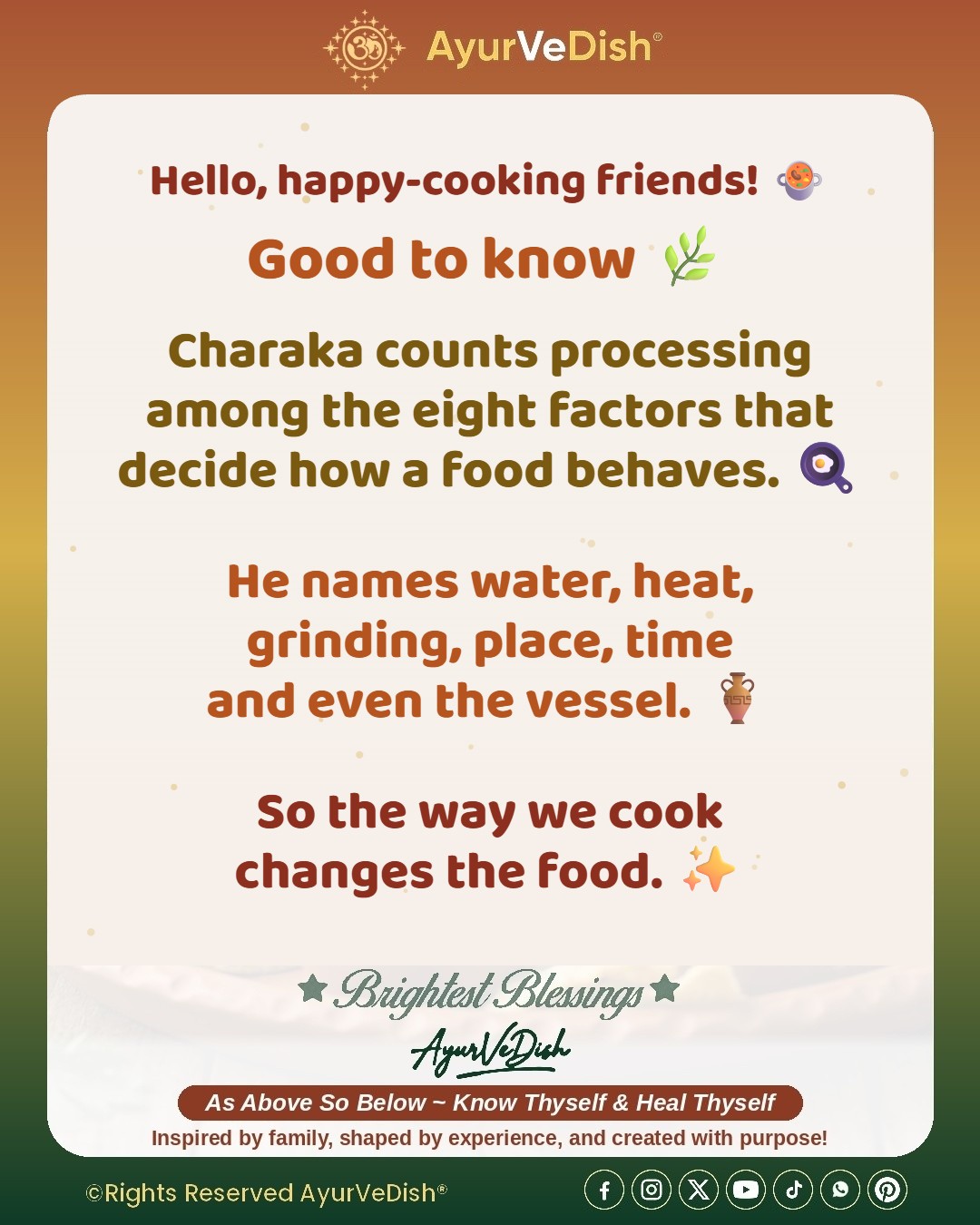
Charaka counts processing among the eight factors that decide how a food behaves, naming water, heat, grinding, place, time and even the vessel. In practice:
- Soaking and slow simmering move pulses towards soft, liquid and smooth, which is why a loose moong dal is easier going than dry-roasted chickpeas.
- Dry-roasting, baking and air-frying push food towards dry, light, rough and hard.
- Spicing adds hot, sharp and subtle qualities, so a pinch of black pepper or pure hing can lighten a heavy pulse dish.
- Blending turns rough into smooth, and coarse raw leaves into a soft green purée.
- Serving temperature matters on top of a food’s own quality: Charaka’s first rule of eating is to eat warm.
Quality outranks taste, sometimes
Taste is the first clue to a food’s qualities, not the final word. Charaka names exceptions: amla is sour yet not heating, rock salt is salty yet not heating, and some bitter or sweet substances are heating. He also teaches that when a food’s potency and post-digestive effect pull against its taste, they can win out. Read the qualities of the whole dish, not just its dominant taste.
Matching qualities to the day
- On a cold, windy day (dry, cold, mobile), lean towards warm, moist, stable meals: a thick pulse and root stew rather than a raw salad.
- On a hot, bright day (hot, sharp), lean towards cooling, soft and liquid: cucumber, gourds, coconut water.
- On a damp, heavy, grey day (cold, heavy, slimy), lean towards light, warm, dry and clear: brothy soups, dry-cooked brassicas and ginger.
What suits you will always depend on you as a person, your digestion, the season and how the food is prepared.
What Researchers Have Found
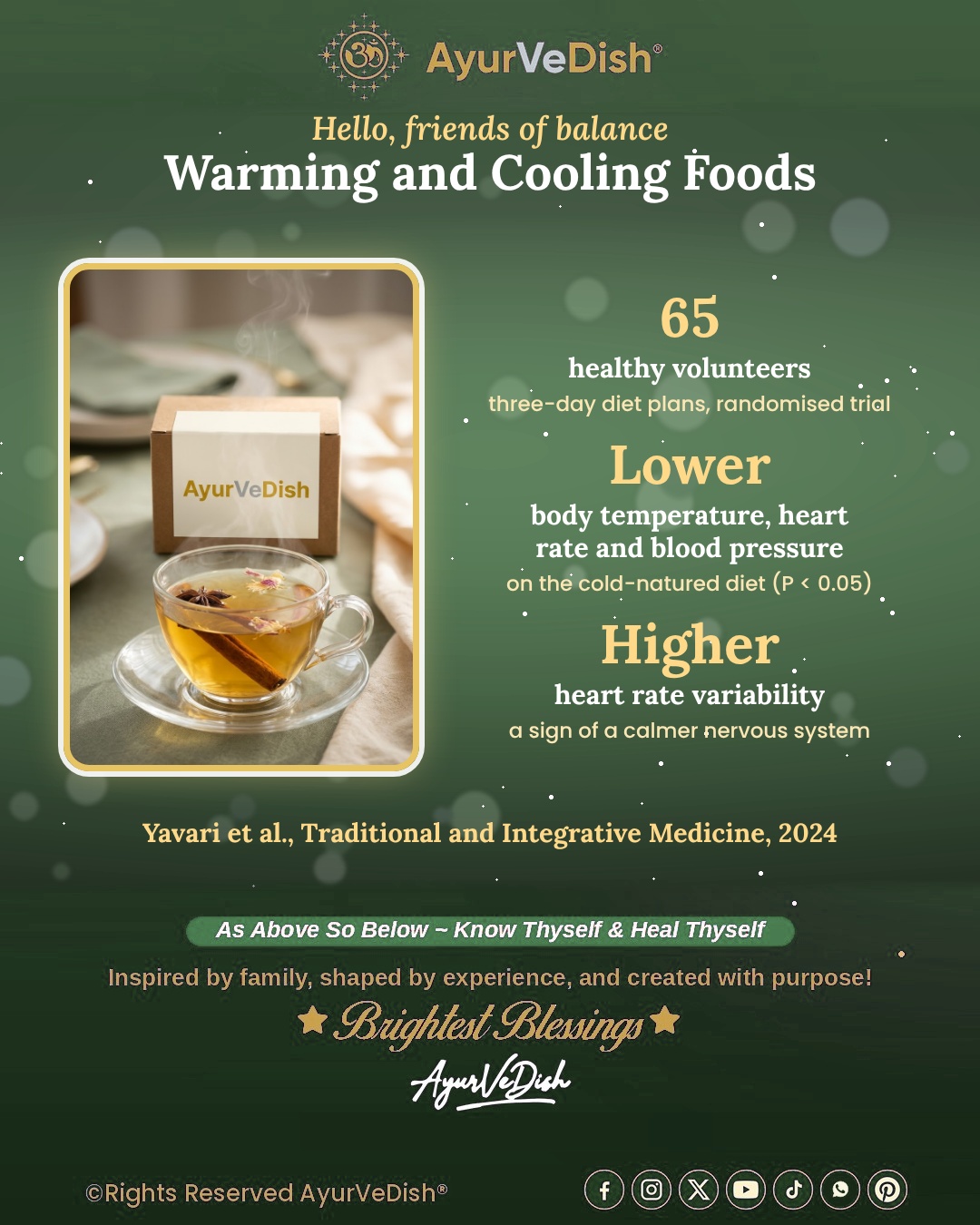
Researchers have begun to test these ideas. In 2024, Yavari and colleagues in Iran (Traditional and Integrative Medicine) ran a randomised trial using the hot and cold food classification of Persian medicine, a related tradition that also sorts foods by warming and cooling character.
65 healthy volunteers followed three-day diet plans, including a cold-natured diet.
On the cold-natured diet, body temperature, heart rate and blood pressure were all significantly lower (P < 0.05).
Heart rate variability, a sign of a calmer nervous system, was significantly higher (P < 0.05).
It is an encouraging sign that the old idea of warming and cooling foods can be studied and measured.
Exploring Qualities in Plant-Based Cooking
Mix vegetables, lentils, chickpeas, herbs and spices to create different textures and flavours. A light vegetable soup offers a different eating experience from a thick chickpea curry, and both have a place. Our optional tadka blends add a finishing aroma, and our herbal teas and hot drinks bring their own warming or cooling character to the end of a meal.
Explore different food qualities, enjoy variety and discover the meals that work well for you.
Let Food Be Thy Medicine Before Medicine Becomes Thy Food.
As Above, So Below, Know Thyself and Heal Thyself.
Inspired by family, shaped by experience, and created with purpose!
Brightest Blessings

This page is for information only. For medical advice, please speak to a qualified professional.
Evidence and Sources
- Charaka Samhita, Sutrasthana 1, verse 49 (Deerghanjiviteeya Adhyaya): carakasamhitaonline.com/index.php/Deerghanjiviteeya_Adhyaya
- Charaka Samhita, Sutrasthana 5, verses 6 to 7 (Matrashiteeya Adhyaya): carakasamhitaonline.com/index.php/Matrashiteeya_Adhyaya
- Ashtanga Hridayam, Sutrasthana 1.18: satyori.com/source-texts/ashtanga-hridayam/sutrasthana/1/18/
- Yavari M et al., The Effects of Dietary Interventions on Cardiovascular Indexes among Individuals with Cold and Hot Temperaments Based on Persian Medicine. Trad Integr Med 2024;9(1):45-52: jtim.tums.ac.ir/index.php/jtim/article/view/1204
- Satyori, Ashtanga Hridayam, Sutrasthana 1, verse 18. satyori.com
- Charak Samhita Research, Training and Development Centre (Jamnagar), Charak Samhita Online, Guna (topic page). carakasamhitaonline.com
- Charak Samhita Research, Training and Development Centre (Jamnagar), Charak Samhita Online, Atreyabhadrakapyiya Adhyaya (Charaka, Sutra Sthana 26). carakasamhitaonline.com
- Charak Samhita Research, Training and Development Centre (Jamnagar), Charak Samhita Online, Rasa Vimana (Charaka, Vimana Sthana 1). carakasamhitaonline.com
- siva.sh, Caraka Samhita, Sutra Sthana 26. siva.sh