 AyurVeDish®
About us
Why AyurVeDish ExistsAyurveda at Our HeartOur Free-From PromiseWhole Food, Plant-Based LivingWhy Grain FreeWhy Oil FreeWhy Dairy FreeWhy Yeast FreeWhy Cane Sugar FreeWhy Soy FreeWhy Thoughtful IngredientsFresh and SeasonalHerbs and SpicesFood from Around the WorldGood Food for EveryoneA Recipe Should Inspire YouEat to LiveSalt, Spice and BalanceAyurveda
Ayurveda Made SimpleThe Five ElementsThe Three DoshasVataPittaKaphaPrakritiYour Dosha CombinationEating for Your ConstitutionChoosing Foods ThoughtfullyThe Six TastesSix Tastes on One PlateFood QualitiesAgni (Fire)Herbs and Spices in the Ayurvedic KitchenEating With the SeasonsAyurveda and the Body ClockFasting: The Ancient PauseBuilding a Plant-Based Ayurvedic MealAyurveda and Modern NutritionFood Combinations and Meal PlanningShop
Speciality All-in-One BlendsGrain Free Rice-Style BlendsSnack & Savoury PremixesGrain Free FloursBakes & DessertsChutneys, Dips & PicklesTadkas & Finishing SpicesDetox & Ayurvedic TeasHot & Cold Drinks





Choosing Foods Thoughtfully
Choosing Foods Thoughtfully: Quality Before Quantity
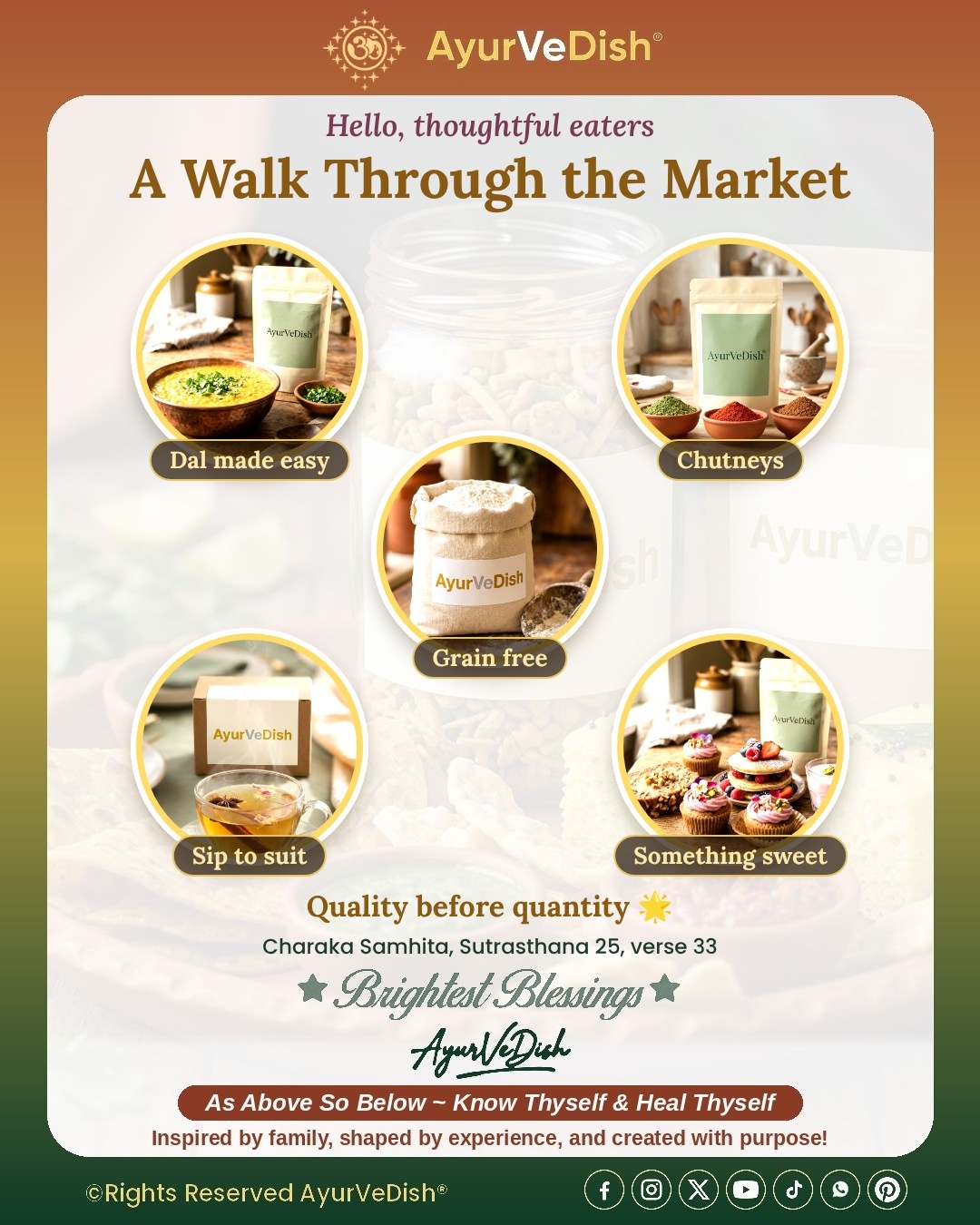
Walk through a market and you will see how much variety nature offers. Some foods are crisp and cooling, some soft and sweet, some sharp and aromatic. A thoughtful cook does not just ask “what shall I make?” but “what is this ingredient like, and who is it for?”
That is the heart of Ayurveda’s approach to food. It asks us to do something very simple that we often forget: pay attention to the food in front of us.
What the Ancient Texts Say
The Charaka Samhita is clear about how much food matters: “Ingesting wholesome food is the only cause of the nourishment of Purusha” (Sutrasthana 25.31), the whole person. It then defines wholesome food in a practical way: food that keeps the body’s tissues in balance (Sutrasthana 25.33). Nothing in these passages says one food is good and another bad for everyone. They teach us to look at qualities and at context.
The text also describes individual foods. Green gram (mung) is named the best of the pulses: astringent and sweet, light and dry, cold in potency, said to calm vitiated Kapha and Pitta (Sutrasthana 27.23). Long before laboratories, the ancients were describing food by how it acts in the body.

Choosing From the Plant Kingdom
Plant-based cooking offers a wonderful variety to explore: vegetables, beans, lentils, chickpeas, herbs, spices, fruits, seeds and suitable grain free alternatives. Traditional guidance may favour different qualities for different constitutions, and you will find the principles for each in their own pages. Your appetite, preferences and nutritional needs always come first.
Best and Least in Each Class: Charaka’s Food Rankings
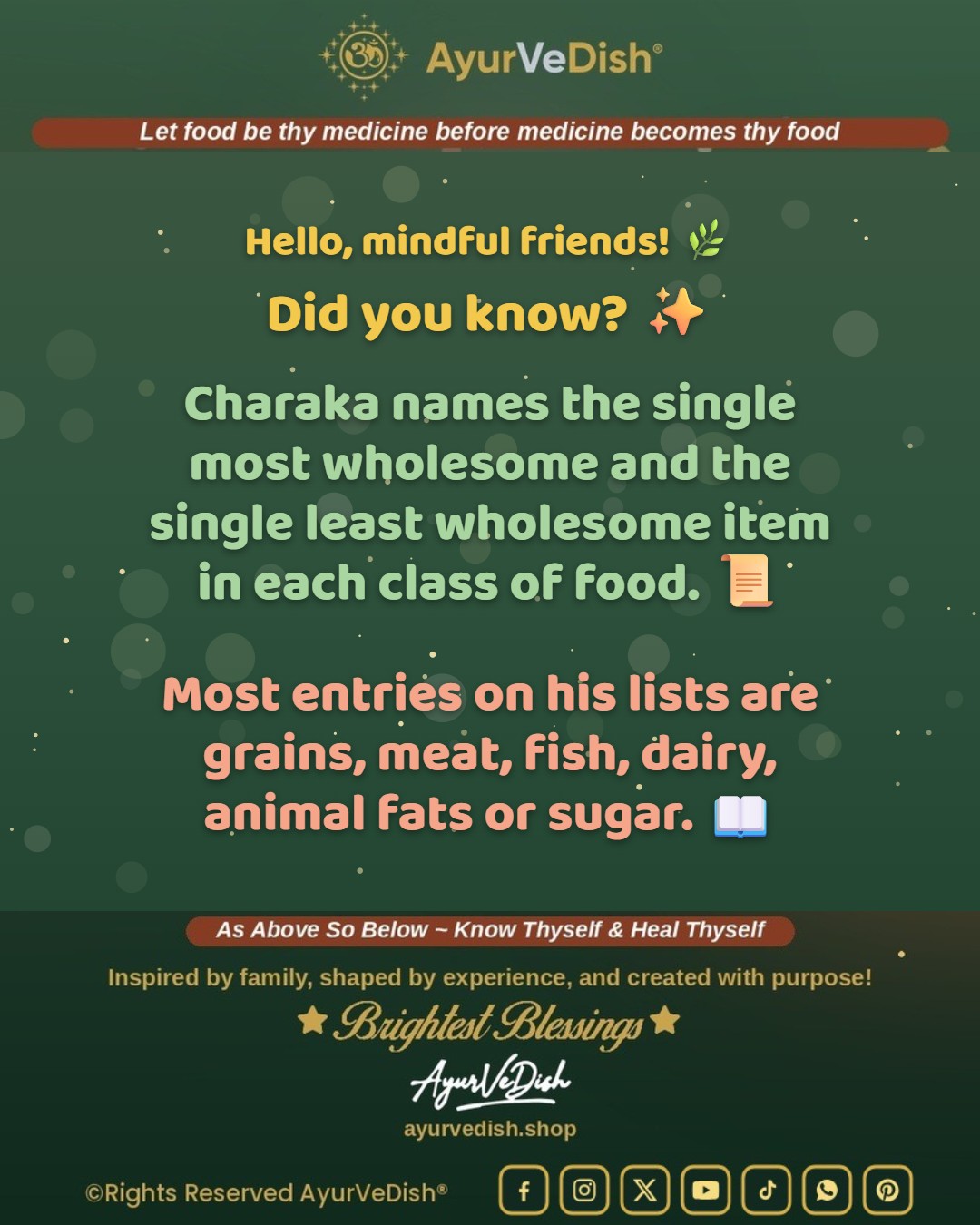
Charaka does something few food writers dare: he names the single most wholesome and the single least wholesome item in each class of food. The lists are long and most entries are grains, meat, fish, dairy, animal fats or sugar, which sit outside our kitchen. The plant entries that remain are still a useful guide, as long as we read them as he meant them, as a ranking for everyday eating rather than a list of miracle foods.
| Class | Most wholesome | Least wholesome | What we take from it |
|---|---|---|---|
| Pulses | Mung | Urad (black gram) | Mung is our everyday pulse; urad is kept for occasional dishes, soaked and well cooked |
| Salt | Rock salt | Salt scraped from saline earth | Pink Himalayan salt, used with a measured hand |
| Leafy vegetables | Jivanti, a leafy plant rarely sold in the UK | Mustard leaves | Spinach, methi, chard and kale take the daily place; sarson is left out |
| Fruit | Grapes and raisins | Nikucha, a fruit whose identity is debated | Sweet grapes and soaked raisins as an everyday fruit |
| Roots and bulbs | Ginger | Aluka, a bulb | Fresh ginger in almost every pot |
| Drinking water | Rain caught before it touches the ground | River water in the rainy season | The principle is clean water; drink safe tap or filtered water, never collected rainwater |
Everyday Foods and Occasional Foods
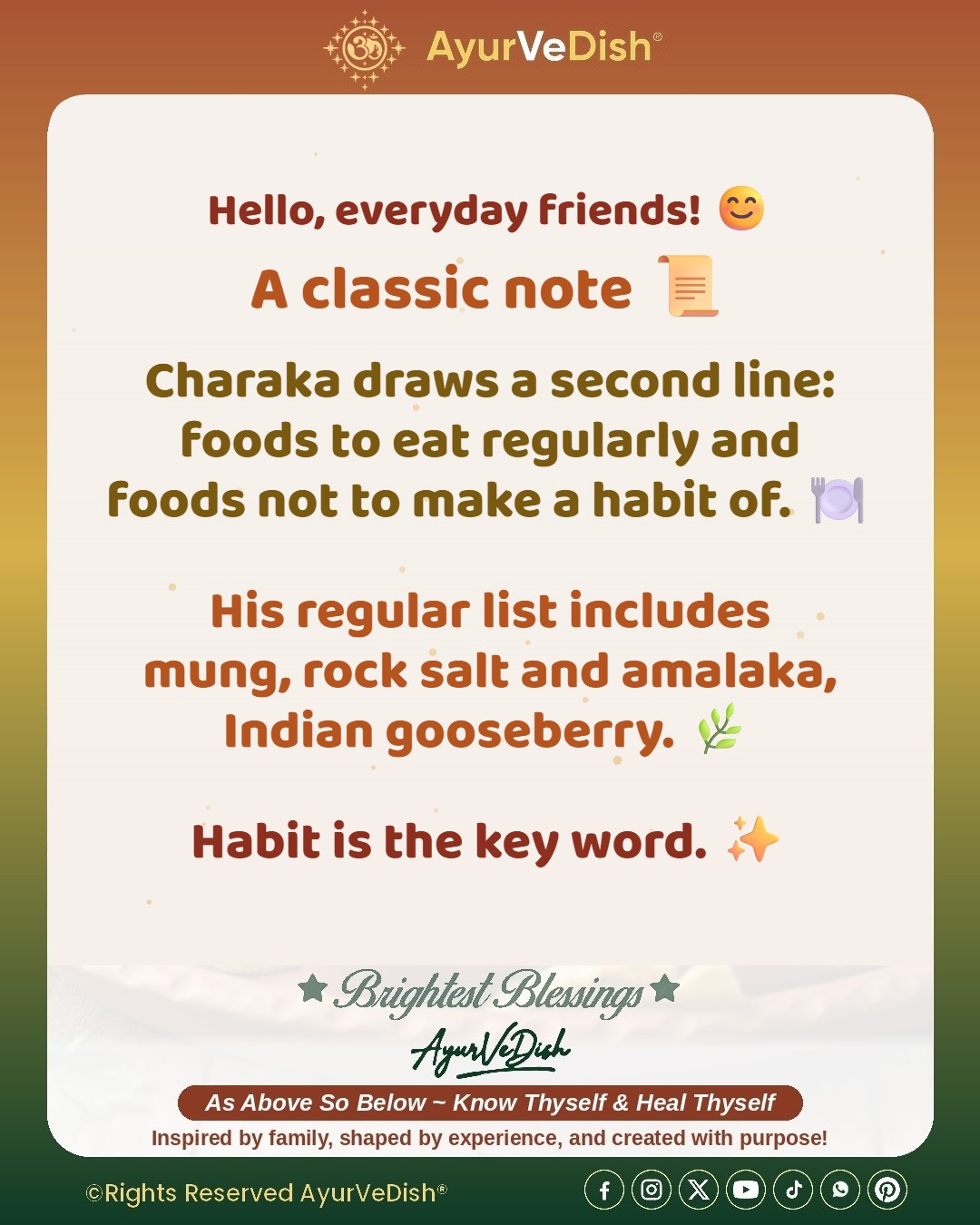
In a separate passage Charaka draws a second line, between foods to eat regularly and foods not to make a habit of. His regular list includes mung, rock salt and amalaka (Indian gooseberry), alongside items outside our range. His list of things not to eat habitually includes dried vegetables, the lotus tuber and stalk, and urad, again alongside animal and dairy foods.
The word that matters is habitually. Charaka is not banning these foods; he is warning against building a diet on them. That is a mature way to think about choosing food: most of what we eat should be the plain, reliable, easily digested things, with richer or harder foods taken now and then, when appetite and season allow.
Putting it into the basket
- Make mung your default pulse, with lentils and chickpeas alongside, and urad and rajma as weekend dishes.
- Keep amla in the house in some form: fresh in season, frozen, or as a chutney.
- Choose fresh greens over dried ones for daily eating; keep dried methi (kasuri methi) as a seasoning rather than the vegetable of the meal.
- Buy ginger fresh every week and use it generously.
- Take a ranking as a starting point. Charaka himself makes the eater, their habits and their digestion part of every food choice.
What suits you will always depend on you as a person, your digestion, the season and how the food is prepared.
What Researchers Have Found
Beans and lentils have a strong record.
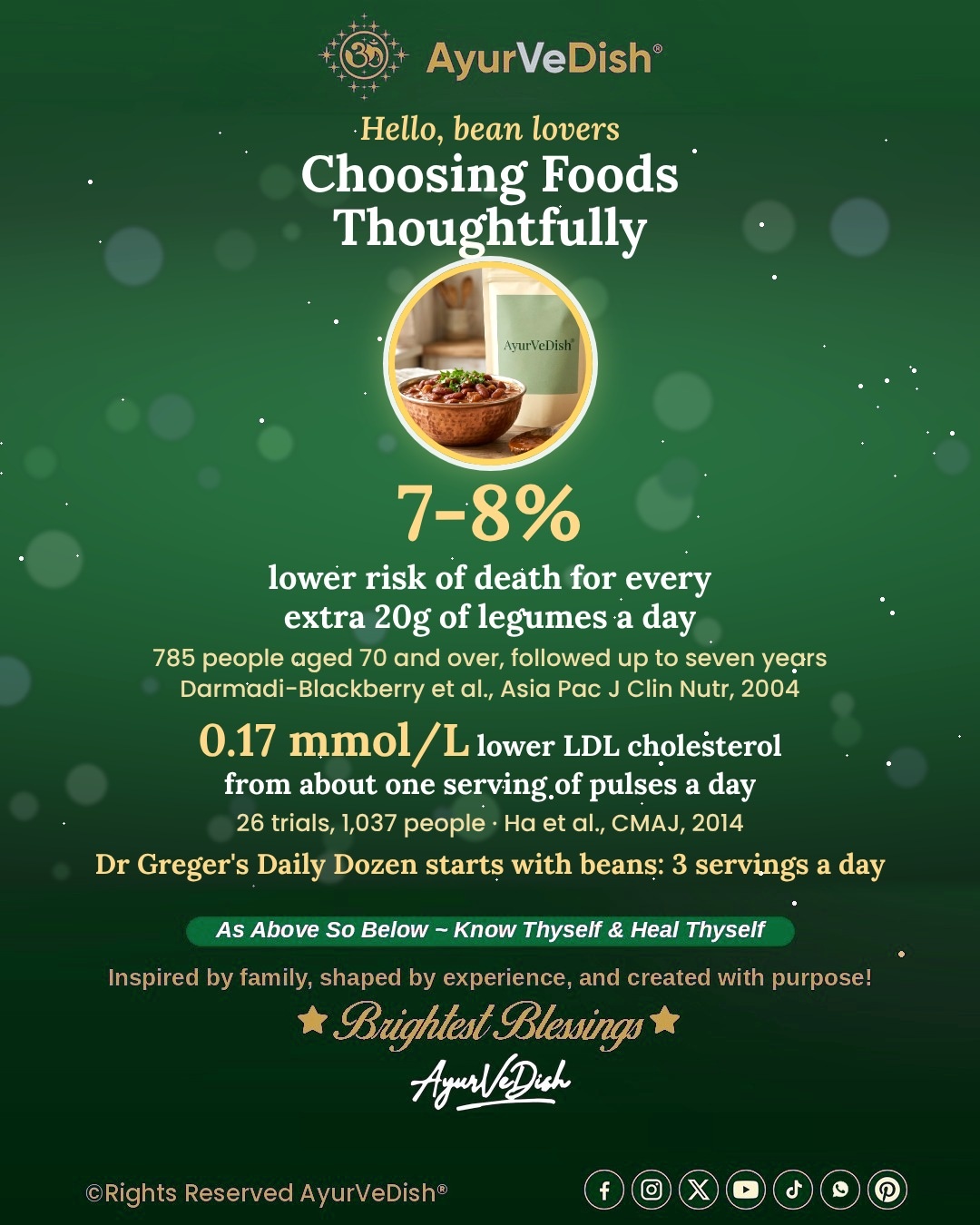
Legumes and longevity (Darmadi-Blackberry et al., Asia Pacific Journal of Clinical Nutrition, 2004): 785 people aged 70 and over, in five cohorts across Japan, Sweden, Greece and Australia, were followed for up to seven years. Every extra 20g of legumes a day went with a 7-8% lower risk of death (RR 0.92, 95% CI 0.85-0.99), and legumes were the one food group that predicted survival consistently across the cohorts. This was an observational study of older adults.
Legumes and cholesterol (Ha et al., CMAJ, 2014): 26 randomised trials with 1,037 people found that a median of 130g of pulses a day, about one serving, lowered LDL cholesterol by 0.17 mmol/L (95% CI 0.09 to 0.25).
Dr Greger’s Daily Dozen puts beans first among its daily checklist, at 3 servings a day (½ cup cooked each), alongside a daily serving of herbs and spices.
Making It Practical
You do not need a complicated plan. Start with varied, satisfying meals, explore herbs and spices, and notice what you enjoy and tolerate well.
Dal made easy. Our Gujarati Toor Dal and Punjabi Dal Makhani blends take the guesswork out of seasoning. One 100g pouch makes about 25 portions at Mild (4g), 14 at Medium (7g) or 10 at Extra Hot (10g), per 200g of vegetables, and a tadka is always optional.
Mung beans. Our Detox Kitchadi Blend contains mung.
Grain free, no fuss. Our grain free premixes need no extra raising agent, and our grain free self raising flour already contains its own and is used weight for weight. Our chutneys are grain and oil free.
Sip to suit. Our Vata, Pitta and Kapha Balance herbal teas are each caffeine free and plant-based.
Something sweet. Our grain free cupcake, banana bread, muffin and pancake premixes and srikand dessert are made without cane sugar, egg or dairy.
Let tradition inspire your choices, while keeping your own needs at the heart of how you eat.
Let Food Be Thy Medicine Before Medicine Becomes Thy Food.
As Above, So Below, Know Thyself and Heal Thyself.
Inspired by family, shaped by experience, and created with purpose!
Brightest Blessings

This page is for information only. For medical advice, please speak to a qualified professional.
Evidence and Sources
- Charaka Samhita, Sutrasthana 25, verses 31 and 33 (Yajjah Purushiya Adhyaya): www.carakasamhitaonline.com/index.php/Yajjah_Purushiya_Adhyaya
- Charaka Samhita, Sutrasthana 27, verse 23 (Annapanavidhi Adhyaya): www.carakasamhitaonline.com/index.php/Annapanavidhi_Adhyaya
- Darmadi-Blackberry I et al., Legumes: the most important dietary predictor of survival in older people of different ethnicities. Asia Pac J Clin Nutr 2004;13(2):217-220: pubmed.ncbi.nlm.nih.gov/15228991/
- Ha V et al., Effect of dietary pulse intake on established therapeutic lipid targets for cardiovascular risk reduction. CMAJ 2014;186(8):E252-262: pubmed.ncbi.nlm.nih.gov/24710915/
- Dr Greger’s Daily Dozen, NutritionFacts.org: nutritionfacts.org/daily-dozen/
- Charak Samhita Research, Training and Skill Development Centre. Charaka Samhita, Sutrasthana 25, Yajjah Purushiya Adhyaya (the most and least wholesome item in each class). Charak Samhita Online, 2020. carakasamhitaonline.com
- Charaka Samhita, Sutrasthana 25, verse 38: the most wholesome of each class. siva.sh
- Charak Samhita Research, Training and Skill Development Centre. Charaka Samhita, Sutrasthana 5, Matrashiteeya Adhyaya (foods for regular use and foods not to take habitually). Charak Samhita Online, 2020. carakasamhitaonline.com
- Charak Samhita Research, Training and Skill Development Centre. Charaka Samhita, Vimanasthana 1, Rasa Vimana (the eater as a factor of diet). Charak Samhita Online, 2020. carakasamhitaonline.com