 AyurVeDish®
About us
Why AyurVeDish ExistsAyurveda at Our HeartOur Free-From PromiseWhole Food, Plant-Based LivingWhy Grain FreeWhy Oil FreeWhy Dairy FreeWhy Yeast FreeWhy Cane Sugar FreeWhy Soy FreeWhy Thoughtful IngredientsFresh and SeasonalHerbs and SpicesFood from Around the WorldGood Food for EveryoneA Recipe Should Inspire YouEat to LiveSalt, Spice and BalanceAyurveda
Ayurveda Made SimpleThe Five ElementsThe Three DoshasVataPittaKaphaPrakritiYour Dosha CombinationEating for Your ConstitutionChoosing Foods ThoughtfullyThe Six TastesSix Tastes on One PlateFood QualitiesAgni (Fire)Herbs and Spices in the Ayurvedic KitchenEating With the SeasonsAyurveda and the Body ClockFasting: The Ancient PauseBuilding a Plant-Based Ayurvedic MealAyurveda and Modern NutritionFood Combinations and Meal PlanningShop
Speciality All-in-One BlendsGrain Free Rice-Style BlendsSnack & Savoury PremixesGrain Free FloursBakes & DessertsChutneys, Dips & PicklesTadkas & Finishing SpicesDetox & Ayurvedic TeasHot & Cold Drinks





Eating for Your Constitution
Eating for Your Constitution: What Suits You
Ask ten people for the best meal after a long day and you will get ten answers. One wants something warm and soothing, another something fresh and light, another something with a little fire in it. Ayurveda took that everyday observation seriously and built a whole way of thinking about food around it.
The idea is simple and kind. There is no single diet for everyone. Your constitution, your digestion, the season and your own habits all shape what suits you, and that is a far more realistic place to begin than any rule claiming to fit the whole world.
What the Ancient Texts Say
The Charaka Samhita has a word for this: satmya, “that which suits the self” (Vimanasthana 1.20). It links suitability to place and season (Vimanasthana 1.22), and advises eating “with due consideration to self”, knowing your own constitution and tastes (Vimanasthana 1.25). It also says habits should be changed gradually, because familiar things cause little harm when given up slowly (Vimanasthana 1.19).
So the ancient advice was never to follow a list. It was to learn what suits you and move towards it gently.
Changing Slowly: Habit, Suitability and the Quarter Step
Knowing which foods suit your constitution is the easy part. The harder part is changing what you actually eat, and here the classics are more careful than most modern advice. Charaka regards a sudden change of diet as a problem in its own right.
Why habit counts
Charaka uses the word satmya for what has become suitable to a person through steady use. He lists the eater, including their habits, among the eight factors that decide whether a food does good or harm, and he counts the switch from one habit to its opposite as a form of incompatible eating: giving sweet, cold food to someone used to pungent, hot food is his example. The point is not that habit is always right, but that the body needs time to accept a new pattern, even a better one. He applies the same caution to overuse of salt, advising that a long habit be withdrawn gradually rather than stopped at once.
The quarter step
For giving up an unwholesome habit and taking up a wholesome one, Charaka describes a stepwise method: reduce the old habit by a quarter, then by a half, then by three quarters, while the new habit is brought in by the same steps. Done this way, he says, the old habit does not return. The text sets this out over a matter of days; for a whole way of eating we find it more realistic to take each step over a week or two, which is our own adaptation.
| Step | Example: a pitta-leaning cook used to fiery, salty food | Example: a kapha-leaning cook used to heavy, sweet breakfasts |
|---|---|---|
| First quarter | Halve the chilli in one daily dish; add fresh coriander and a cooling cucumber side | Swap one sweet breakfast a week for hot water with ginger and a buckwheat chilla |
| Half | Measure salt rather than pouring it; bring in a bitter green at lunch | Make breakfast lighter on half the days; move the main meal to midday |
| Three quarters | Chilli becomes a side, not a base; sour pickles give way to amla chutney | Sweet breakfasts become an occasional pleasure; stewed apple with cinnamon on other days |
| Settled | The new pattern feels normal, and fiery food is an occasional choice | A light, warm start is the habit, and appetite arrives on time |
Watching how it lands
- Charaka’s test for the right quantity is practical: no pressure in the abdomen or chest, hunger and thirst satisfied, and easy movement, speech and breathing after the meal.
- He says even wholesome food in the right quantity does not digest well when you eat anxious, grieving, fearful or angry, so change one thing at a time and keep meals calm.
- His final rule of eating is to eat with regard for oneself, knowing what suits you. Keep a short note for a fortnight of what you ate and how you felt three hours later.
- If a change leaves you weaker, colder or more unsettled, step back a quarter and stay there longer.
What suits you will always depend on you as a person, your digestion, the season and how the food is prepared.
What Researchers Have Found
Modern science has reached the same place. People really do respond to the same food differently, and the studies are large.
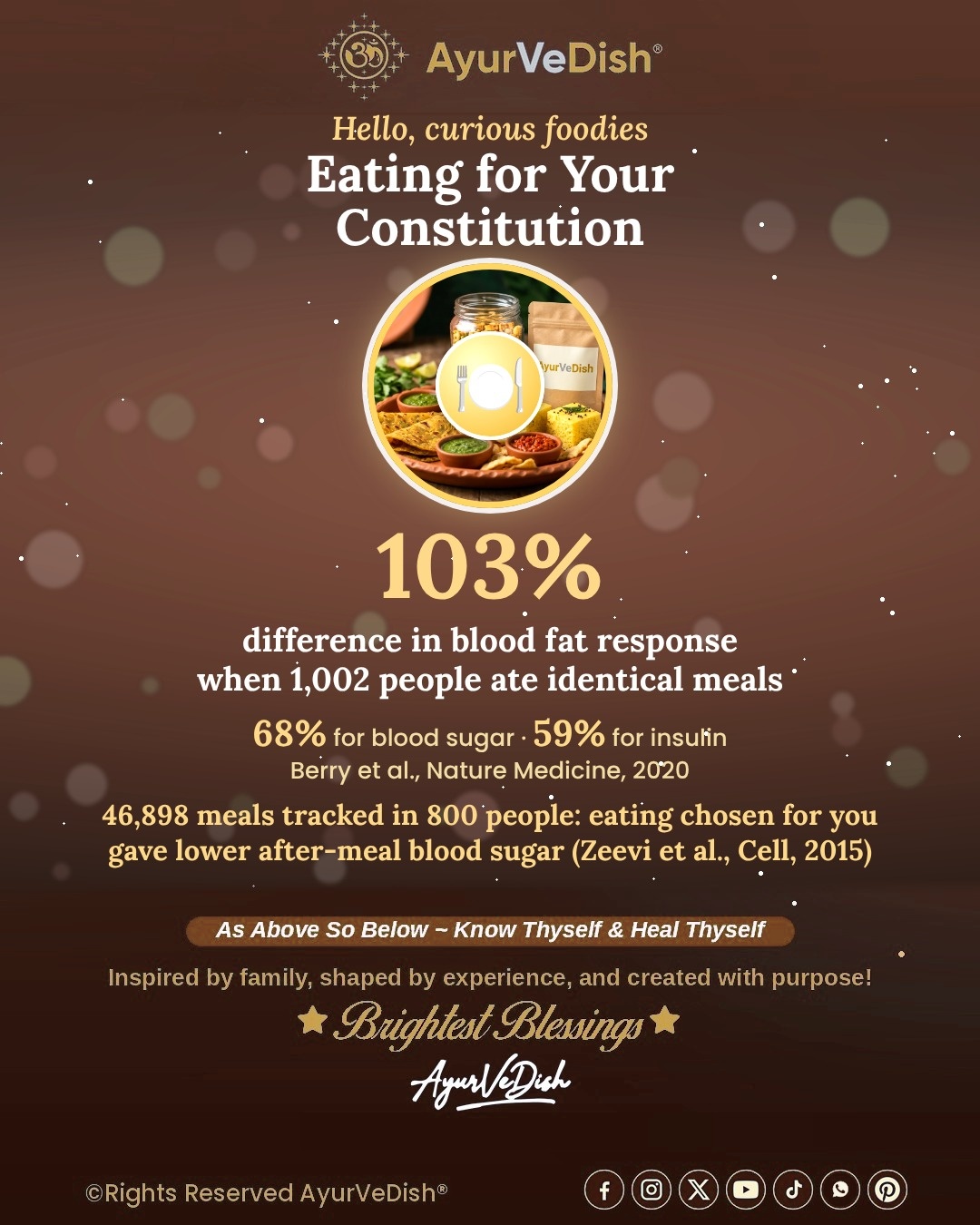
In 2020, in Nature Medicine, Berry and colleagues ran PREDICT 1, a study of 1,002 healthy UK adults, twins and unrelated people, who ate identical meals. Responses varied by 103% for blood fats, 68% for blood sugar and 59% for insulin. For blood fats, the gut microbiome explained more of the difference (7.1%) than the meal’s macronutrients (3.6%). For blood sugar the meal mattered more (15.4% against 6.0% for the microbiome). Genetic variants had a modest effect (9.5% for glucose and 0.8% for triglyceride).
In 2015, in Cell, Zeevi and colleagues in Israel followed 800 people and measured their blood sugar response to 46,898 meals. A diet chosen from each person’s own data, tested in a blinded randomised trial, gave significantly lower after-meal blood sugar and consistent changes in gut bacteria.
These studies looked at short-term responses, but together they show that one-size-fits-all eating has real limits, and that learning what suits you is worthwhile.
Bringing It Into Everyday Cooking
You do not need to know your dosha perfectly to begin. Start with vegetables, beans, lentils, chickpeas, herbs and spices, and notice how each meal leaves you feeling.
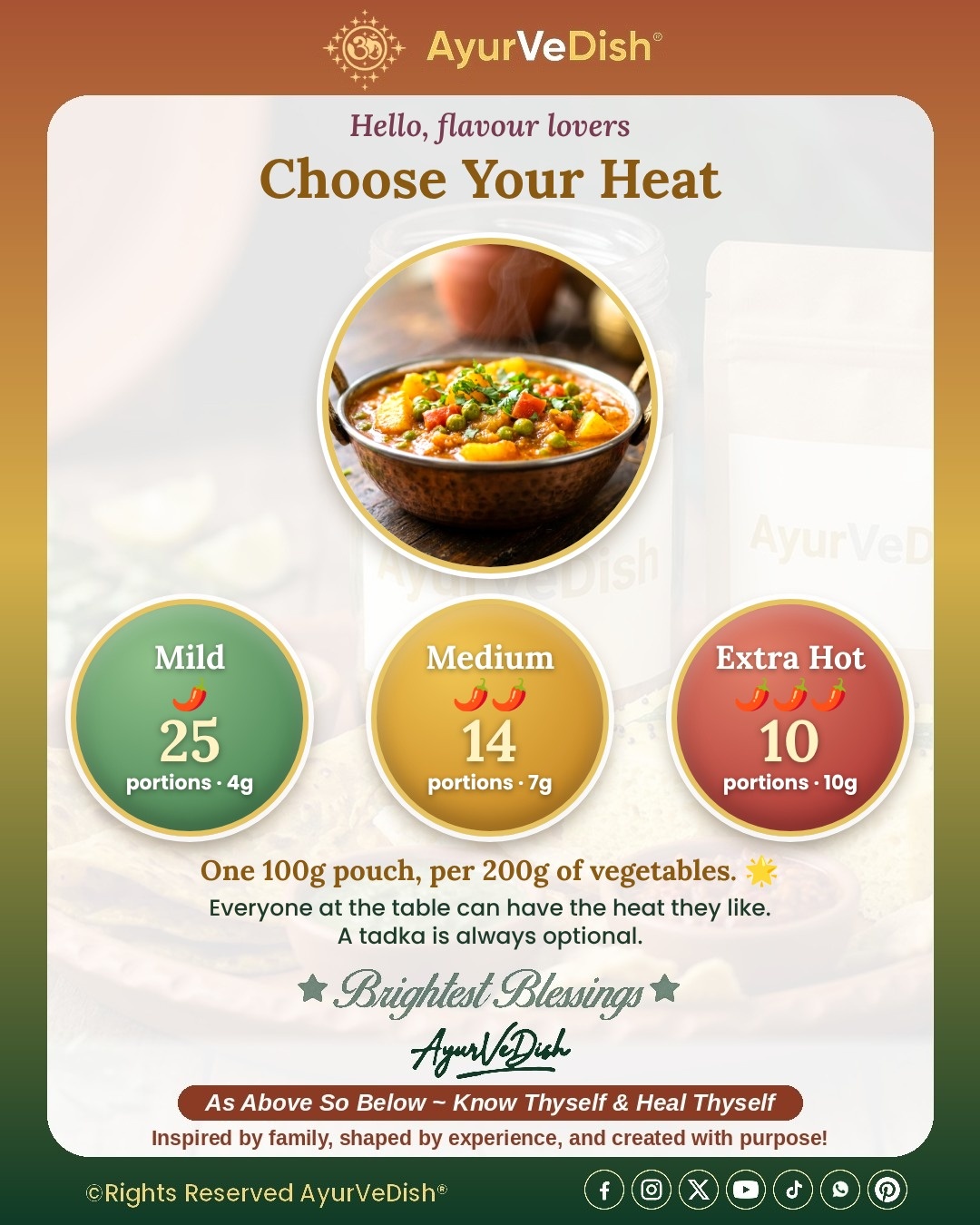
Choose your heat. Our curry and dal blends come in Mild, Medium and Extra Hot. One 100g pouch makes about 25 portions at Mild (4g), 14 at Medium (7g) or 10 at Extra Hot (10g), per 200g of vegetables, so everyone at the table can have the heat they like.
Explore optional tadkas. A tadka is always optional, and our blends offer three different styles, each giving the same dal a different character.
Sip to suit. Our Vata, Pitta and Kapha Balance herbal teas are each caffeine free and plant-based, so you can explore a little more.
Add variety. Our grain free premixes, flours and bakes, chutneys and finishing spices keep every meal interesting, and our grain free cupcake, banana bread, muffin and pancake premixes and srikand dessert are made without cane sugar, egg or dairy.
Let curiosity guide you, enjoy your food, and remember that no single way of eating suits everyone.
Let Food Be Thy Medicine Before Medicine Becomes Thy Food.
As Above, So Below, Know Thyself and Heal Thyself.
Inspired by family, shaped by experience, and created with purpose!
Brightest Blessings

This page is for information only. For medical advice, please speak to a qualified professional.
Evidence and Sources
- Charaka Samhita, Vimanasthana 1, verses 19, 20, 22 and 25 carakasamhitaonline.com/index.php/Rasa_Vimana
- Berry SE et al., Human postprandial responses to food and potential for precision nutrition. Nature Medicine 2020 pmc.ncbi.nlm.nih.gov/articles/PMC8265154
- Zeevi D et al., Personalized nutrition by prediction of glycemic responses. Cell 2015 pubmed.ncbi.nlm.nih.gov/26590418
- Charak Samhita Research, Training and Skill Development Centre. Charaka Samhita, Sutrasthana 7, Naveganadharaniya Adhyaya (giving up habits by quarter steps). Charak Samhita Online, 2020. carakasamhitaonline.com
- Charak Samhita Research, Training and Skill Development Centre. Charaka Samhita, Sutrasthana 26, Atreyabhadrakapyiya Adhyaya (incompatibility of habit). Charak Samhita Online, 2020. carakasamhitaonline.com
- Charak Samhita Research, Training and Skill Development Centre. Charaka Samhita, Vimanasthana 1, Rasa Vimana (salt and gradual withdrawal; the eater and habituation; rules of eating). Charak Samhita Online, 2020. carakasamhitaonline.com
- Charak Samhita Research, Training and Skill Development Centre. Charaka Samhita, Vimanasthana 2, Trividhakukshiya Vimana (signs of the right quantity; the mind and digestion). Charak Samhita Online, 2020. carakasamhitaonline.com
- Charak Samhita Research, Training and Skill Development Centre. Charaka Samhita, Vimanasthana 8, Rogabhishagjitiya Vimana (satmya). Charak Samhita Online, 2020. carakasamhitaonline.com