 AyurVeDish®
About us
Why AyurVeDish ExistsAyurveda at Our HeartOur Free-From PromiseWhole Food, Plant-Based LivingWhy Grain FreeWhy Oil FreeWhy Dairy FreeWhy Yeast FreeWhy Cane Sugar FreeWhy Soy FreeWhy Thoughtful IngredientsFresh and SeasonalHerbs and SpicesFood from Around the WorldGood Food for EveryoneA Recipe Should Inspire YouEat to LiveSalt, Spice and BalanceAyurveda
Ayurveda Made SimpleThe Five ElementsThe Three DoshasVataPittaKaphaPrakritiYour Dosha CombinationEating for Your ConstitutionChoosing Foods ThoughtfullyThe Six TastesSix Tastes on One PlateFood QualitiesAgni (Fire)Herbs and Spices in the Ayurvedic KitchenEating With the SeasonsAyurveda and the Body ClockFasting: The Ancient PauseBuilding a Plant-Based Ayurvedic MealAyurveda and Modern NutritionFood Combinations and Meal PlanningShop
Speciality All-in-One BlendsGrain Free Rice-Style BlendsSnack & Savoury PremixesGrain Free FloursBakes & DessertsChutneys, Dips & PicklesTadkas & Finishing SpicesDetox & Ayurvedic TeasHot & Cold Drinks




Your Dosha Combination
Your Dosha Combination: You Are a Blend
Look in a spice box and you will not find one flavour. You find many, in different amounts, and a good cook knows that the balance matters more than any one jar. People are much the same. Ayurveda does not ask you to be one dosha. It describes how all three come together in you.
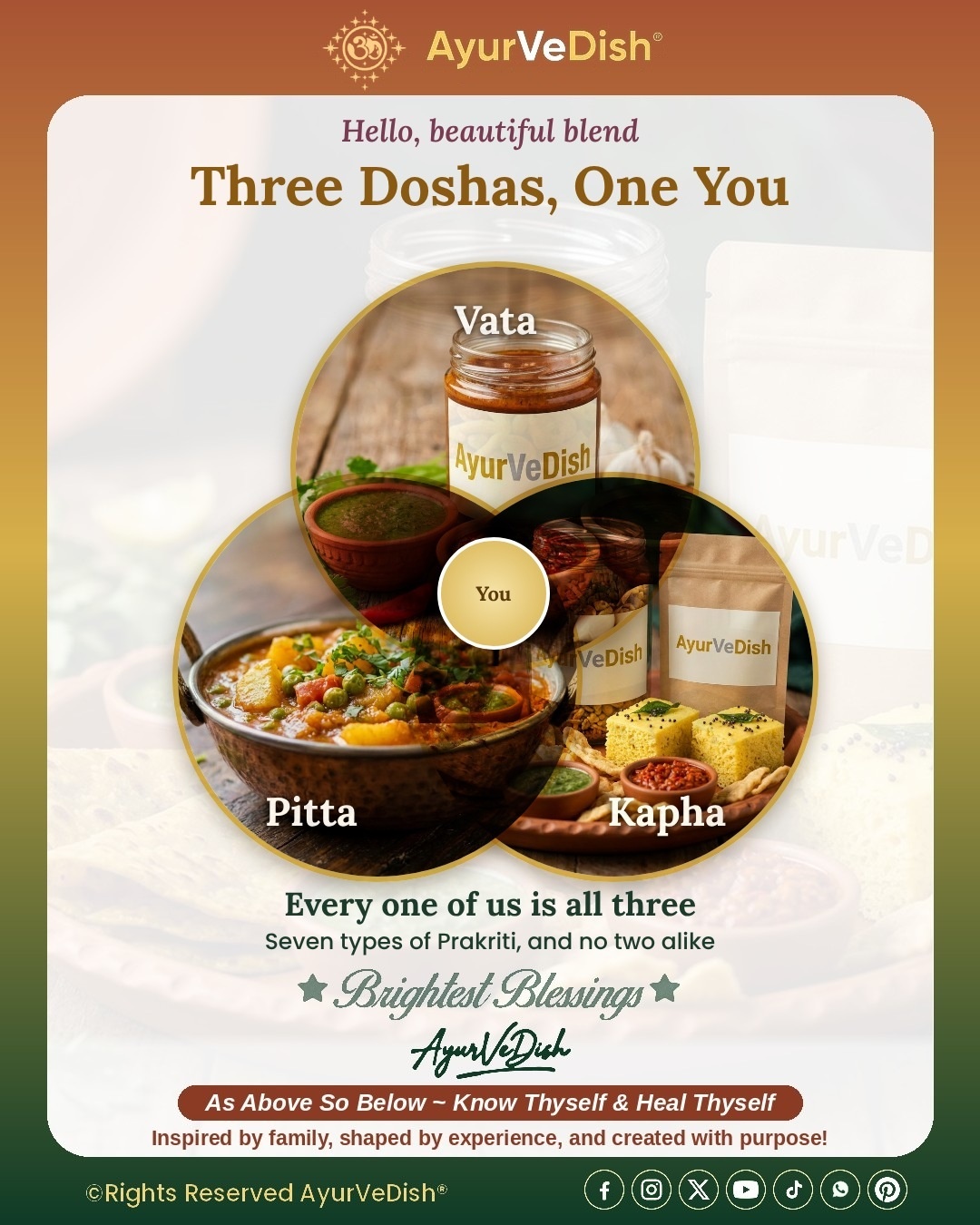
Every person has Vata, Pitta and Kapha. What differs is the combination. One may stand out, two may share the lead, or all three may be in similar proportion. Nobody is just a single word.
More Than One Dosha
Perhaps you recognise yourself in more than one description. You may have the quick thinking of Vata and the strong appetite of Pitta. You may be steady like Kapha but also enjoy variety. That is not confusion. It is exactly what the tradition describes.
What the Ancient Texts Say
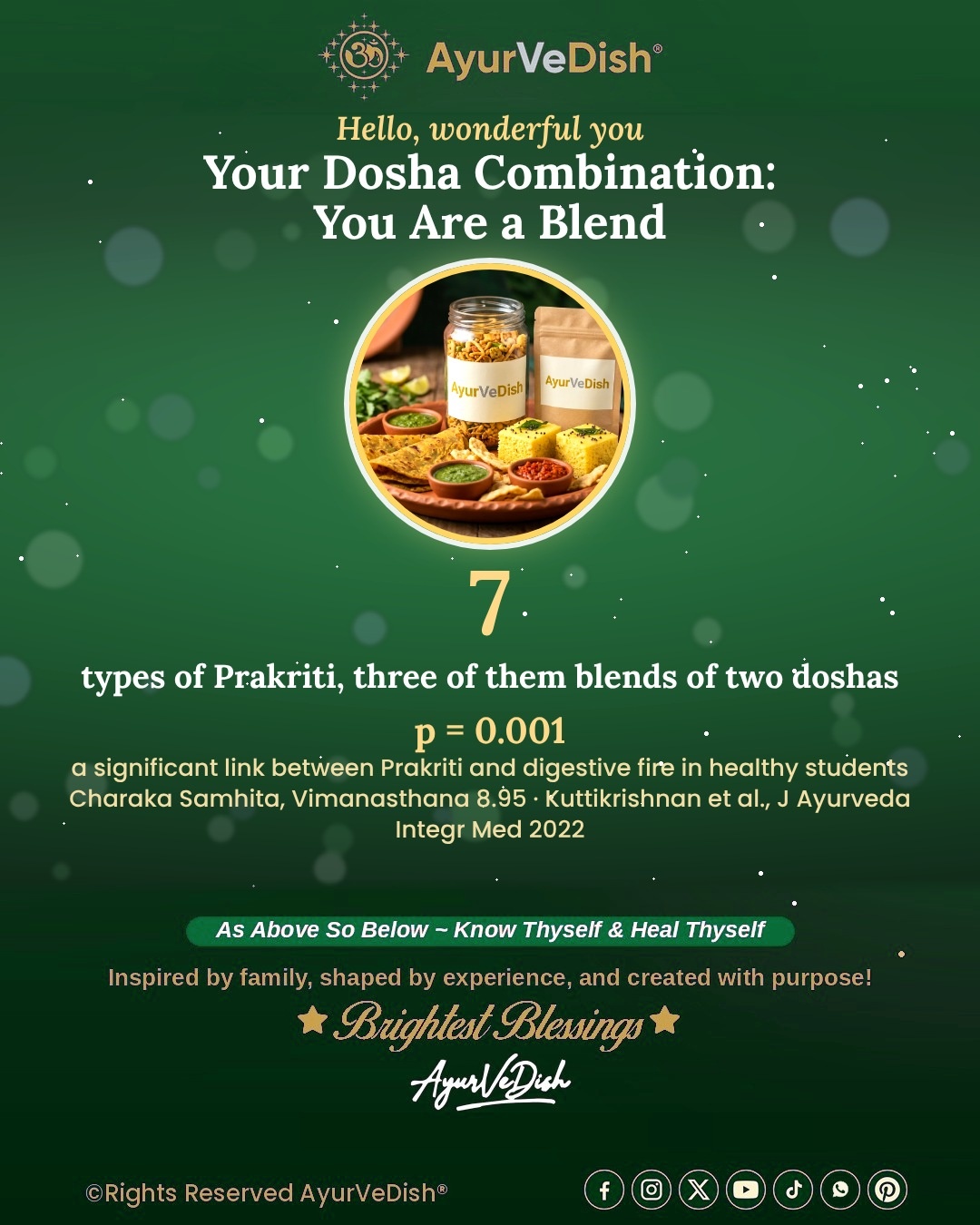
Of the seven types of Prakriti counted in the Sushruta Samhita, three are blends of two doshas: Vata-Pitta, Vata-Kapha and Pitta-Kapha. Vagbhata’s Ashtanga Hridaya (Sutrasthana 1, verse 12) has a word for two doshas together, samsarga, and another for all three together, sannipata. Having two doshas in the lead is common, and it simply means two sets of tendencies to look after, as the guide below explains.
Today’s Mood
If you are rushed, cold and irregular with meals this week, you may feel very Vata, even if that is not your underlying nature. If it is a hot summer, you may feel very Pitta. The patterns are a way to notice what is happening, not a way to pin yourself down.
Living With a Dual Constitution
The classical texts are candid about blended constitutions, and we think you deserve the same candour. Charaka says some people are balanced from conception while others lean towards vata, pitta or kapha, and he describes the leaning types as more prone to illness; where two doshas lead, he says simply that the person shows the features of both. Vagbhata’s Ashtanga Hridaya goes further, calling the balanced constitution the finest and the two-dosha constitutions the least favourable of all, while modern commentators note that dual constitutions are among the most common they meet. We read that as a description of tendency rather than a judgement of worth: it means two doshas to keep an eye on instead of one, and two seasons of the year that ask a little more of you. The answer the texts give for any leaning constitution is steady habit built on opposite qualities, adjusted as the year turns, and that is what the guidance below sets out.
Vata-Pitta
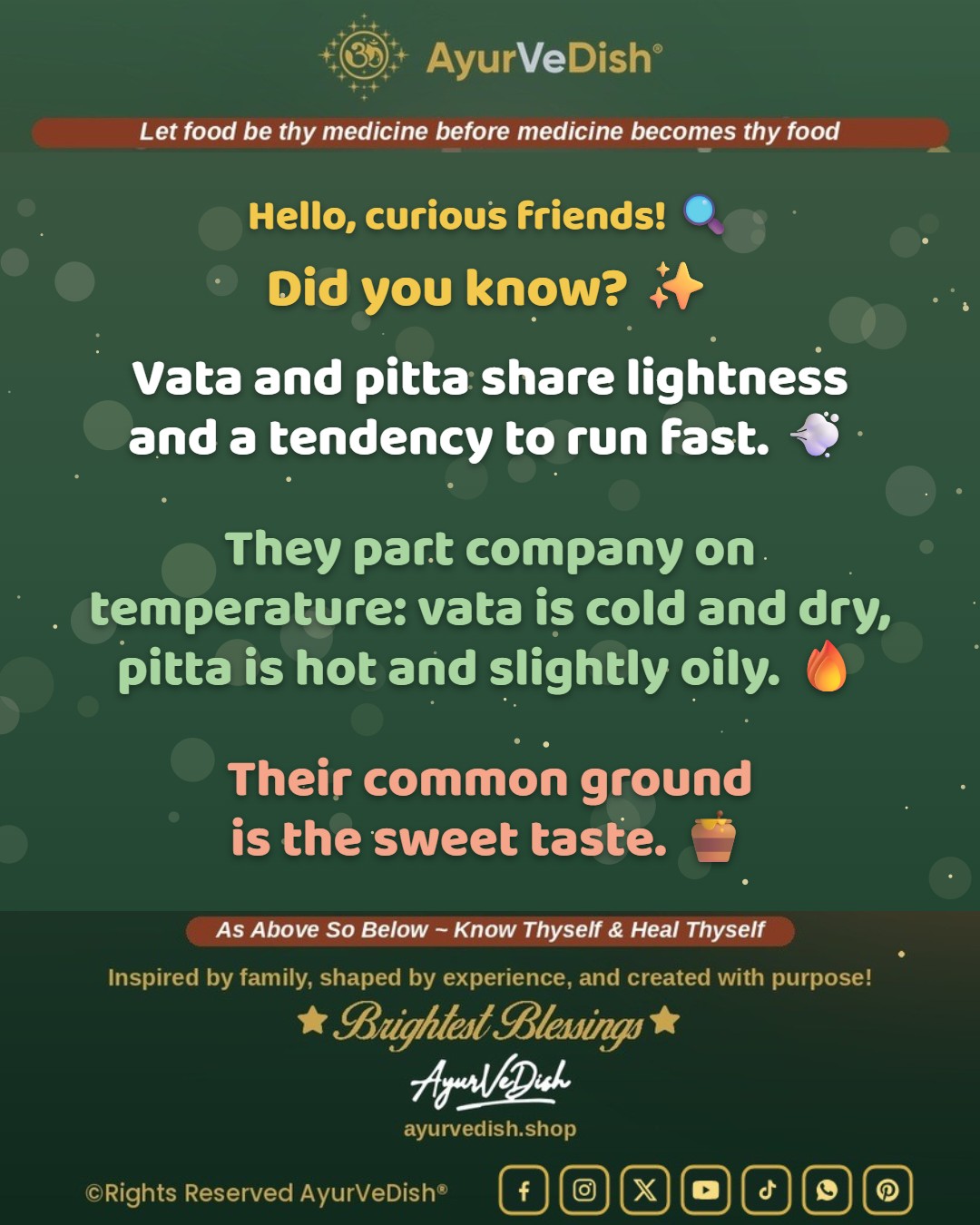
Vata and pitta share lightness and a tendency to run fast, but they part company on temperature, since vata is cold and dry and pitta is hot and slightly oily. Their common ground is the sweet taste, which Charaka lists as settling both, so a vata-pitta plate is built on sweet, moist, nourishing food such as mung, gourds, roots, ripe fruit, sweet grapes and coconut, served warm rather than hot. Salt and sour help vata but heat pitta, while bitter and astringent cool pitta but dry vata, so each is used in moderation rather than cut out. Regular meals matter doubly here, because one dosha brings an irregular appetite and the other a sharp one that dislikes being kept waiting.
- Autumn and winter, our UK reading of vata’s season: warmer, moister meals, such as Gujarati moong dal with kokum and date paste, baked roots and a soft quinoa rice-type pilau, with a little more lemon and rock salt.
- Late spring and summer: tilt towards pitta with lauki and chana dal with coriander, cucumber and mint raita made with coconut yoghurt, coconut water, sweet grapes and melon.
- All year: gentle spices such as fennel, coriander seed, cardamom and cumin, with chilli, raw garlic and very sour chutneys kept light.
Vata-Kapha
Vata and kapha are both cold, which gives them one clear shared need: warmth, in food, in drink and in the way we cook. Beyond that they pull apart, since vata is dry and light while kapha is oily and heavy, and Charaka’s lists of settling tastes for the two do not overlap at all. The bridge is heat and moderation: warm, freshly cooked food that is moist but not heavy, spiced with ginger, cumin, black pepper and pure hing, and brightened with lemon, which Charaka says eases both kapha and vata. Fresh ginger and horse gram, both described in Charaka as settling vata and kapha, earn a regular place in this kitchen.
- Cold, damp months from November to February: hot brothy soups and dals, horse gram rasam-style broth, moong dal with ginger and lemon, and root and leek stews in stock.
- Spring: tilt towards kapha with lighter, drier meals, such as dry-cooked cabbage sambharo, buckwheat roti, watercress and radish, and a little more pungent spice.
- Windy autumn: tilt towards vata with more moisture, such as soupier dals, stewed apples and pears, and a little coconut milk.
- All year: avoid both cold, raw meals and heavy, creamy ones; hot water and fresh ginger tea suit both doshas.
Pitta-Kapha
Pitta and kapha share some oiliness and moisture, and they share two settling tastes, bitter and astringent, which gives this pairing the widest common ground of the three. Charaka makes the menu easy: he recommends mung, lentils and chickpeas for pitta and kapha, and groups aubergine, bitter gourd and pointed gourd as bitter, cooling vegetables that regulate both. The difference is temperature, since pitta is hot and kapha cold, so food is warm and gently spiced rather than fiery or chilled. Sweet soothes pitta but feeds kapha, and salt and sour raise both, so ripe fruit, salt and souring agents are used lightly.
- Spring: tilt towards kapha with warmer, drier, more pungent food, such as masoor dal with ginger and black pepper, steamed greens with a mustard seed tempering, and buckwheat chilla.
- Summer and early autumn: tilt towards pitta with cooler, gently sweet and bitter food, such as lauki and moong dal, karela or methi shaak, and coriander and fennel seed water.
- All year: a pulse and a bitter green every day, modest portions, and warmth from ginger, cumin, coriander and turmeric rather than chilli.
Sama (balanced, or tridoshic)
When all three doshas are in balance from conception, Charaka describes the person as free from illness and the Ashtanga Hridaya calls this constitution the finest, though commentators add that it is rare. Charaka’s food advice for this person is the simplest in the texts: habitually eat all six tastes in balance. Balance still has to be kept, so the guidance becomes seasonal rather than constitutional, following the year so that no one dosha is left to build up. Digestion is the daily check: eat once the last meal has gone through, in the right amount, and with attention.
- Winter: warm and nourishing, with sweet, sour and salty tastes within our range, such as dals, roots, stewed fruit and ginger.
- Spring: lighter and drier, with more pungent, bitter and astringent, such as spring greens, radish and moong dal.
- Summer: cooling, moist and sweet, such as cucumber, courgette, berries and coconut water.
- Autumn: sweet, light and cool with a little bitter early on, turning warmer and more nourishing as November arrives.
- Every day: a sweet base, a pulse, a bitter green, and a sour and pungent finish together cover all six tastes on one plate.
Whatever your blend, what suits you will always depend on you as a person, your digestion, the season and how the food is prepared.
What Researchers Have Found
Blended types are now being studied in their own right, and the early results are striking. In 2022, in the Journal of Ayurveda and Integrative Medicine, Kuttikrishnan and colleagues in India surveyed healthy students aged 18 to 30 about their Prakriti and their digestive fire (Jatharagni). They found a significant link between the two (p = 0.001). People with a Vata-Pitta blend tended to have a sharp digestive fire (teekshnagni), people with Vata-Kapha a slow one (mandagni), and people with Pitta-Kapha an irregular one (vishamagni). They found a second significant link, between Prakriti and digestive capacity (Jarana Shakti, p = 0.001). The authors call the findings promising and look forward to larger studies.
What Does This Mean for Your Meals?
You do not need to fit neatly into one category to explore Ayurveda’s food traditions. You can learn about the principles associated with Vata, Pitta and Kapha, then take what feels right from each and leave the rest. Your own tastes, lifestyle and nutritional needs always come first.
At AyurVeDish, we make this welcoming and practical. Our plant-based cooking encourages variety, flavour and thoughtful ingredients rather than rigid rules. A single 100g pouch of our curry or dal blend gives about 25 portions at Mild (4g), 14 at Medium (7g) or 10 at Extra Hot (10g), per 200g of vegetables, so one pouch suits a whole table of different tastes. A tadka is always optional. Our Vata, Pitta and Kapha Balance herbal teas are each caffeine free, and our chutney premixes let you add a little more of what you enjoy. For something sweet, our grain free cupcake, banana bread, muffin and pancake premixes and srikand dessert are made without cane sugar, egg or dairy.
You are an individual, not a label. Let these ancient ideas inspire your choices and add to your enjoyment of food.
Let Food Be Thy Medicine Before Medicine Becomes Thy Food.
As Above, So Below, Know Thyself and Heal Thyself.
Inspired by family, shaped by experience, and created with purpose!
Brightest Blessings

This page is for information only. For medical advice, please speak to a qualified professional.
Evidence and Sources
- Charaka Samhita, Vimanasthana 8, verse 95 carakasamhitaonline.com/index.php/Rogabhishagjitiya_Vimana
- Ashtanga Hridaya, Sutrasthana 1, verse 12 satyori.com/source-texts/ashtanga-hridayam/sutrasthana/1/12/
- Kuttikrishnan M, Sridhar R, Varghese E. Jatharagni and Prakriti of young Indian adult population. Journal of Ayurveda and Integrative Medicine 2022 pubmed.ncbi.nlm.nih.gov/35101333/
- Charaka Samhita, Sutrasthana 7 (Naveganadharaniya Adhyaya), verses 36 to 40: balanced and dosha-dominant constitutions. siva.sh
- Charak Samhita Online. Charaka Samhita, Sutrasthana 7, Naveganadharaniya Adhyaya (verse 41: all six tastes in balance for the balanced constitution). carakasamhitaonline.com
- Charaka Samhita, Vimanasthana 8 (Rogabhishagjitiya Vimana), verses 96 to 100: kapha, pitta, vata, mixed and balanced constitutions. siva.sh
- Satyori. Ashtanga Hridayam, Sutrasthana 1, verse 10: the constitutions, with the balanced type ranked finest and the two-dosha types least favourable. satyori.com
- Charaka Samhita, Vimanasthana 1 (Rasa Vimana), verses 6 to 10: the tastes that increase and settle each dosha. siva.sh
- Charaka Samhita, Sutrasthana 27 (Annapanavidhi Adhyaya), verses 21 to 25: mung, urad and black-eyed beans. siva.sh
- Charaka Samhita, Sutrasthana 27 (Annapanavidhi Adhyaya), verses 26 to 30: horse gram, moth beans, chickpeas, lentils, peas and sesame. siva.sh
- Charaka Samhita, Sutrasthana 27 (Annapanavidhi Adhyaya), verses 96 to 100: pointed gourd, aubergine, bitter gourd and other bitter vegetables. siva.sh
- Charaka Samhita, Sutrasthana 27 (Annapanavidhi Adhyaya), verses 166 to 170: ginger, lemon, radish, holy basil and ajwain. siva.sh
- Satyori. Ashtanga Hridayam, Sutrasthana 1, verse 8: the doshas across life, day, night and digestion, and the four digestive fires. satyori.com
- Ashtanga Hridaya, Sutrasthana 12 (Doshabhediya Adhyaya), verses 21 to 25: the seasonal build-up, flare and settling of each dosha. siva.sh
- Charak Samhita Online. Charaka Samhita, Vimanasthana 1, Rasa Vimana (verse 16 on long pepper; verses 24 to 25 on the rules of eating). carakasamhitaonline.com