 AyurVeDish®
About us
Why AyurVeDish ExistsAyurveda at Our HeartOur Free-From PromiseWhole Food, Plant-Based LivingWhy Grain FreeWhy Oil FreeWhy Dairy FreeWhy Yeast FreeWhy Cane Sugar FreeWhy Soy FreeWhy Thoughtful IngredientsFresh and SeasonalHerbs and SpicesFood from Around the WorldGood Food for EveryoneA Recipe Should Inspire YouEat to LiveSalt, Spice and BalanceAyurveda
Ayurveda Made SimpleThe Five ElementsThe Three DoshasVataPittaKaphaPrakritiYour Dosha CombinationEating for Your ConstitutionChoosing Foods ThoughtfullyThe Six TastesSix Tastes on One PlateFood QualitiesAgni (Fire)Herbs and Spices in the Ayurvedic KitchenEating With the SeasonsAyurveda and the Body ClockFasting: The Ancient PauseBuilding a Plant-Based Ayurvedic MealAyurveda and Modern NutritionFood Combinations and Meal PlanningShop
Speciality All-in-One BlendsGrain Free Rice-Style BlendsSnack & Savoury PremixesGrain Free FloursBakes & DessertsChutneys, Dips & PicklesTadkas & Finishing SpicesDetox & Ayurvedic TeasHot & Cold Drinks




Prakriti
Prakriti: Your Natural Constitution
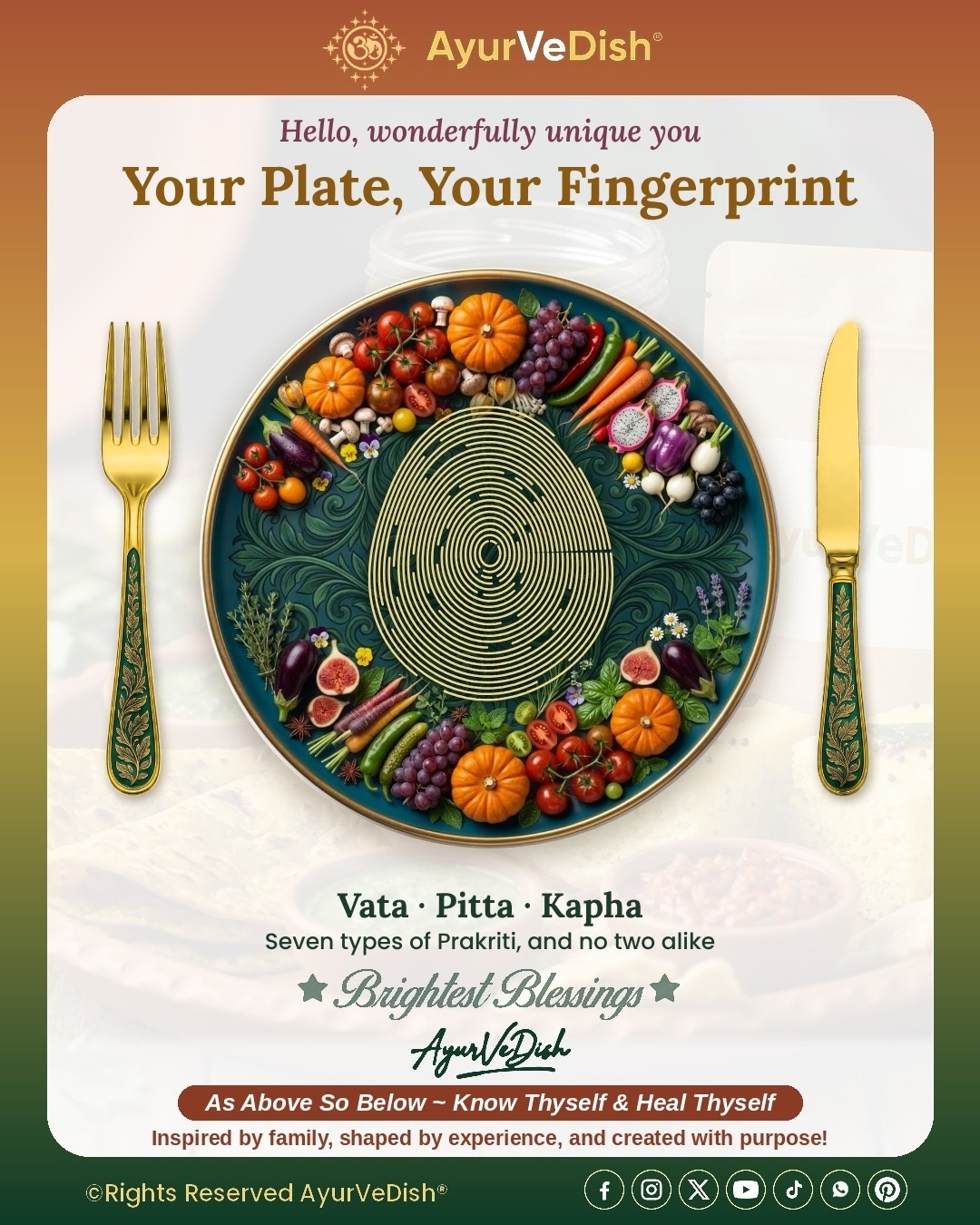
Think of a fingerprint. Everyone has one, no two are the same, and yours has been with you since before you could walk. In Ayurveda, your Prakriti is something like that: your own natural pattern, the particular balance of Vata, Pitta and Kapha that makes you who you are.
This is one of the most important ideas in Ayurveda, because it explains why the tradition never assumes that one way of eating, living or resting suits everyone equally. That is one of its most human ideas.
What Is Prakriti?
Prakriti means “natural tendency”. In Ayurveda, it is your underlying constitution, traditionally understood as the unique combination of Vata, Pitta and Kapha present from birth. It describes your tendencies, such as how you tend to digest, to rest and to respond to the world.
What the Ancient Texts Say
The Charaka Samhita (Vimanasthana 8, verse 95) describes Prakriti as formed by the dominance of the doshas at conception. It is shaped by the make-up of the sperm and egg, the time of conception, the health of the womb, the mother’s diet and lifestyle during pregnancy, and the interaction of the five elements. The ancients saw a person as the result of many influences coming together, including the food a mother ate. That was an early understanding that food begins to shape us before we are born.
The Sushruta Samhita counts seven types of Prakriti. Three are led by a single dosha: Vata, Pitta or Kapha. Three are led by two doshas together: Vata and Pitta, Vata and Kapha, or Pitta and Kapha. The seventh is the balanced type, where all three are in proportion.
Prakriti and Vikriti
Ayurveda makes a very helpful distinction. Prakriti is your underlying constitution. Vikriti is your current state of change or imbalance, which may move with the seasons, your circumstances and your lifestyle. The Charaka Samhita lists both among the ten things a physician examines (Vimanasthana 8). Think of Prakriti as who you are, and Vikriti as how you are today. This is why a person’s needs can change from one season, or one week, to the next.
How the Classics Assess Constitution
In Charaka, prakriti is never assessed on its own or from a list of questions. It is the first item in a ten-part examination that a trained physician carries out in person. Seeing the whole examination explains why constitution is a matter for a personal reading and why we will never reduce it to an online quiz.
| Part of the examination | What is being judged |
|---|---|
| Prakriti | The constitution set at conception |
| Vikriti | The present disturbance, judged by its cause, the doshas and tissues involved, place, time and signs |
| Sara | The quality and excellence of the tissues |
| Samhanana | Compactness of build: well-set bones, firm joints, well-formed muscle |
| Pramana | Body measurements and proportion |
| Satmya | What has become suitable to the person through steady use |
| Sattva | Strength of mind |
| Ahara shakti | Capacity to take in and digest food |
| Vyayama shakti | Capacity for exertion |
| Vaya | Age, and the stage of life the body has reached |
Why one look is never enough
Charaka warns physicians against judging strength by appearance alone, noting that some people who are slight in build are strong, and that a large frame can sit with little capacity to bear discomfort. That is why he asks for the tissues, build, mind, appetite and stamina to be examined before strength is decided. A questionnaire cannot feel a pulse, see the skin, eyes and tongue, or weigh how a person carries a symptom.
What this means for your kitchen
- Use the dosha pages as a description of tendencies, not a verdict on you.
- Notice your present state: appetite, sleep, bowel habit, energy, and how you handle heat and cold this month.
- Let the season and your digestion steer daily choices, and keep constitution as the longer view.
- If you want an accurate reading, seek a one-to-one consultation with someone trained, never an online test.
What suits you will always depend on you as a person, your digestion, the season and how the food is prepared.
What Researchers Have Found
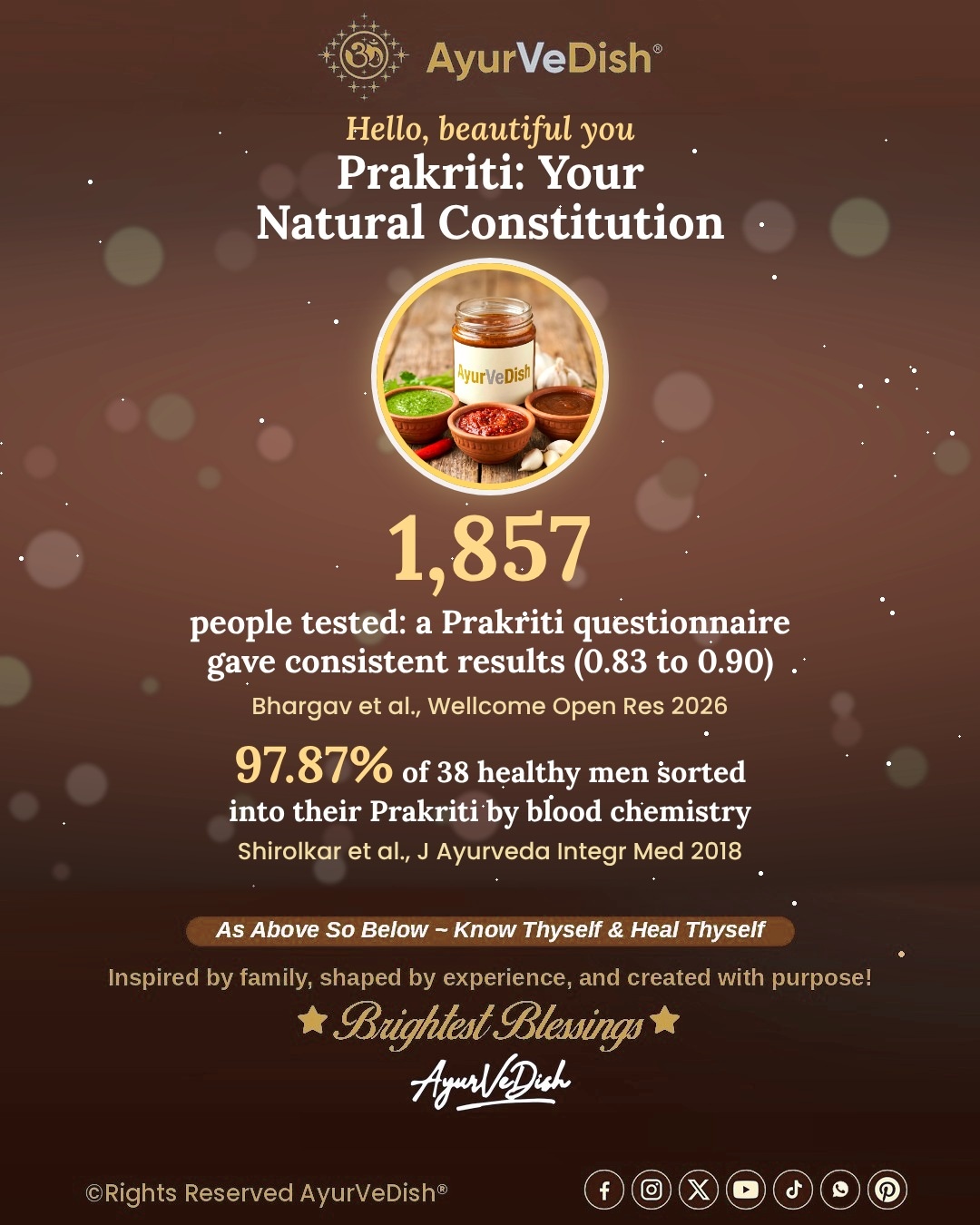
Researchers have begun to put Prakriti to the test, and the results are encouraging. In 2026, in Wellcome Open Research, Bhargav and colleagues in India tested a new 21-question Prakriti questionnaire on 1,857 people. It gave consistent results when repeated (correlations of 0.83 to 0.90) and agreed closely with traditional assessments (correlations of 0.78 to 0.84), while correlating only minimally with Western personality traits. In other words, it measures something distinct.
In 2018, in the Journal of Ayurveda and Integrative Medicine, Shirolkar and colleagues analysed blood plasma from 38 healthy men. A statistical model recognised their Prakriti types with 97.87% accuracy, and 76 blood chemicals differed between the types. Pathways for steroid hormones, amino acids and arachidonic acid varied most.
Two studies, two different methods, and both point the same way.
How Can This Guide Your Food Choices?
Prakriti introduces you to traditional ideas about the qualities of food, how it is prepared, its flavours and your daily routine. You do not need to work out your constitution to enjoy a varied plant-based diet, and your own needs and preferences always come first.
That is why we make choice easy. Our Vata, Pitta and Kapha Balance herbal teas are each caffeine free and blended for one dosha. A single 100g pouch of our curry or dal blend gives about 25 portions at Mild (4g), 14 at Medium (7g) or 10 at Extra Hot (10g), per 200g of vegetables, so everyone at the table can have the heat they like. A tadka is always optional. Our grain free premixes, flours and bakes, chutneys, finishing spices and plant-based hot drinks add plenty of variety, and our grain free cupcake, banana bread, muffin and pancake premixes and srikand dessert are made without cane sugar, egg or dairy.
Your constitution is a starting point for curiosity, not a set of rules.
Let Food Be Thy Medicine Before Medicine Becomes Thy Food.
As Above, So Below, Know Thyself and Heal Thyself.
Inspired by family, shaped by experience, and created with purpose!
Brightest Blessings

This page is for information only. For medical advice, please speak to a qualified professional.
Evidence and Sources
- Charaka Samhita, Vimanasthana 8, verse 95: Prakriti. carakasamhitaonline.com/index.php/Prakriti
- Charaka Samhita, Vimanasthana 8, verse 95: Deha prakriti. carakasamhitaonline.com/index.php/Deha_prakriti
- Charaka Samhita, Vimanasthana 8: Rogabhishagjitiya Vimana. carakasamhitaonline.com/index.php/Rogabhishagjitiya_Vimana
- Bhargav H et al. The Brief Prakriti Inventory. Wellcome Open Research 2026. pubmed.ncbi.nlm.nih.gov/41523163/
- Shirolkar A et al. Plasma metabolomics and Prakriti. Journal of Ayurveda and Integrative Medicine 2018. pubmed.ncbi.nlm.nih.gov/29183656/
- Charak Samhita Research, Training and Skill Development Centre. Charaka Samhita, Vimanasthana 8, Rogabhishagjitiya Vimana (the ten-fold examination; prakriti at conception; sara and strength; samhanana; vikriti; satmya, digestive capacity, exertion and age). Charak Samhita Online, 2020. carakasamhitaonline.com