 AyurVeDish®
About us
Why AyurVeDish ExistsAyurveda at Our HeartOur Free-From PromiseWhole Food, Plant-Based LivingWhy Grain FreeWhy Oil FreeWhy Dairy FreeWhy Yeast FreeWhy Cane Sugar FreeWhy Soy FreeWhy Thoughtful IngredientsFresh and SeasonalHerbs and SpicesFood from Around the WorldGood Food for EveryoneA Recipe Should Inspire YouEat to LiveSalt, Spice and BalanceAyurveda
Ayurveda Made SimpleThe Five ElementsThe Three DoshasVataPittaKaphaPrakritiYour Dosha CombinationEating for Your ConstitutionChoosing Foods ThoughtfullyThe Six TastesSix Tastes on One PlateFood QualitiesAgni (Fire)Herbs and Spices in the Ayurvedic KitchenEating With the SeasonsAyurveda and the Body ClockFasting: The Ancient PauseBuilding a Plant-Based Ayurvedic MealAyurveda and Modern NutritionFood Combinations and Meal PlanningShop
Speciality All-in-One BlendsGrain Free Rice-Style BlendsSnack & Savoury PremixesGrain Free FloursBakes & DessertsChutneys, Dips & PicklesTadkas & Finishing SpicesDetox & Ayurvedic TeasHot & Cold Drinks





Vata
Vata: Air and Space, the Dosha of Movement
Think of the wind. It cannot be held, it is never quite still, and it changes direction without warning. That is the picture the ancients used for Vata, the dosha of movement, communication and change.
In Ayurveda, Vata is made of air and space. Air gives it motion, and space gives it room to move. Because it is the dosha of movement, Vata is traditionally described as the one that sets the others in motion.
The Qualities of Vata
Vata is traditionally described through the qualities of lightness, dryness, coolness, roughness and mobility. In everyday life you can recognise these qualities as quick thoughts, a lively imagination, a love of variety and an appetite that comes and goes. When these qualities are in balance, traditional teaching describes them as creativity, enthusiasm and flexibility. The beauty of Ayurveda is that every quality has its gift.
What the Ancient Texts Say
The Charaka Samhita lists the qualities of Vata as dry, cold, light, subtle, mobile, non-slimy and rough (Sutrasthana 1, verse 59). Vagbhata’s Ashtanga Hridaya describes it the same way (Sutrasthana 1, verse 11).
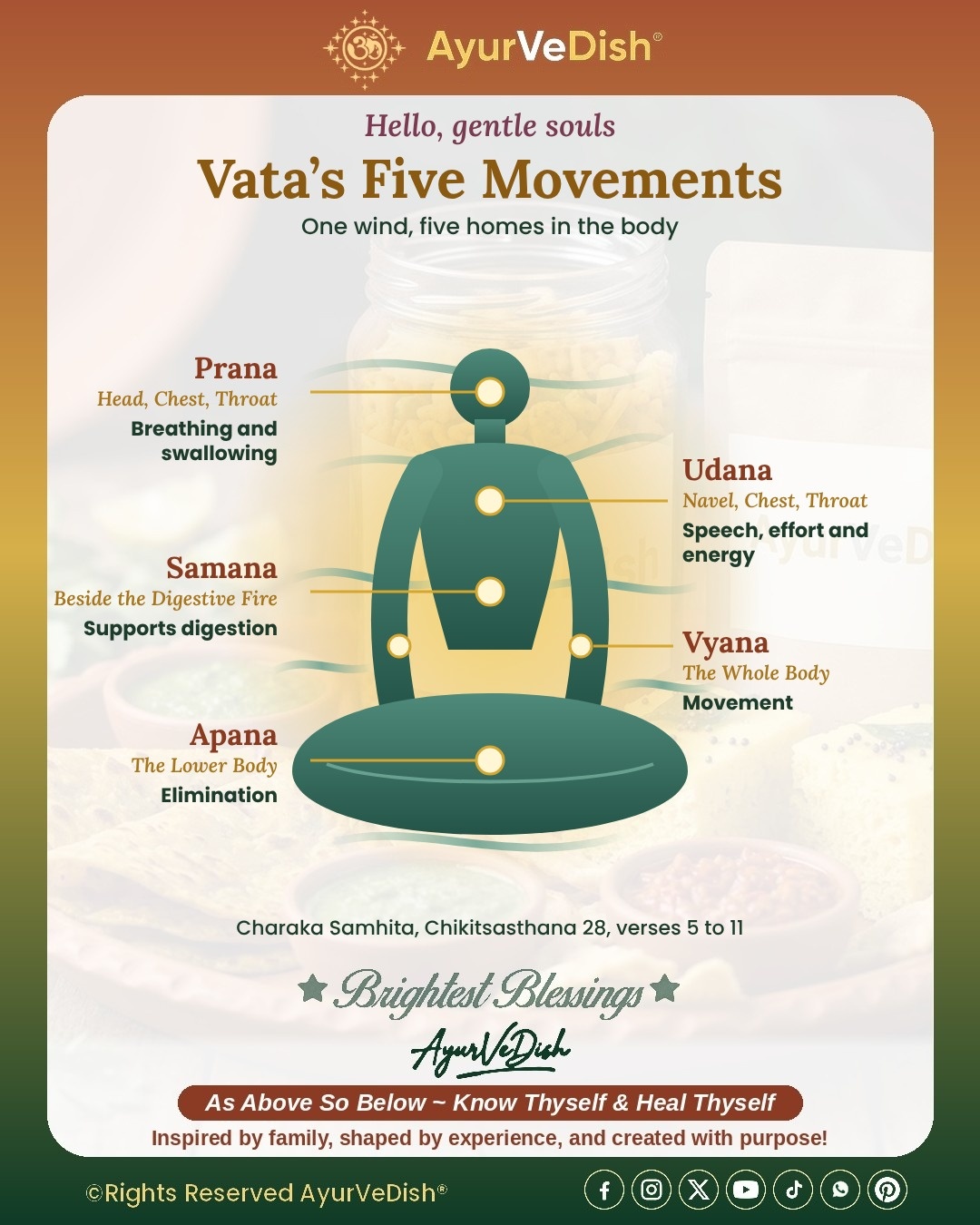
The texts also describe Vata as a family of five movements. The Charaka Samhita names them and gives each a home in the body (Chikitsasthana 28, verses 5 to 11). Prana, in the head, chest and throat, governs breathing and swallowing. Udana, in the navel, chest and throat, governs speech, effort and energy. Samana, beside the digestive fire, supports digestion. Vyana spreads through the whole body and governs movement. Apana, in the lower body, governs elimination. The Sushruta Samhita likewise describes vayu as five kinds that support the body (Sutrasthana 15). The ancients did not describe one wind. They described a whole family of movements, each with its own place in the body.
Vata and Food
Traditional Ayurvedic teaching suggests that the qualities of food can be used to balance the qualities of a dosha. For Vata, which is light, dry and cool, the traditional suggestion is warm, freshly prepared meals eaten at regular times. The Charaka Samhita lists sweet, sour and salty tastes as those that balance Vata (Sutrasthana 1, verse 66), and the same passage lists pungent, bitter and astringent tastes as those that increase it when taken in excess.
In a plant-based kitchen, that points naturally to cooked vegetables, nourishing lentil dishes, soups and gently spiced meals. Ginger (Adrak or Sunth), cumin (Jeera), coriander (Dhania) and fennel (Saunf) add warmth and flavour. These are general traditional suggestions, not rules that everyone who feels like Vata must follow.
What We Make for Vata
Our Caffeine Free Vata Balance Herbal Tea is the Vata idea in a cup: warm and sweet-spiced, with dried ginger (Sunth), fennel (Saunf), Ceylon cinnamon (Dalchini), green cardamom (Elaichi), tulsi, rose (Gulab), amla, vanilla, black pepper (Kali mirch) and clove (Laung). One level teaspoon (2g) in 200ml of boiling water, steeped for 5 to 7 minutes, makes a cup, so one 100g pouch makes 50 cups.
For warm, grounding meals, our all-in-one dal and curry blends do the seasoning for you. One 100g pouch seasons about 25 portions at Mild (4g), 14 at Medium (7g) or 10 at Extra Hot (10g), each portion being 200g of vegetables. Our Gujarati Toor Dal Blend is sweet, sour and spicy, with coconut sugar (Nariyal gur), tamarind (Ambli) and dried ginger (Sunth), the very tastes the Charaka Samhita names for Vata. Our Gujarati Kadhi Blend, with gram flour (Besan), ginger (Adrak), cumin (Jeera), fenugreek (Methi) and asafoetida (Hing), is stirred into plant-based yoghurt and water for a soothing, warm soup: one 100g pouch makes 13 bowls. Our Punjabi Dal Makhani Blend, with cardamom (Elaichi), cinnamon (Dalchini), clove (Laung) and nutmeg (Jaiphal), gives black urad dal and kidney beans a rich, creamy, warming finish.
For a complete one-pot meal, our grain free Gujarati Vegetable Kitchadi Premix is made with split moong dal, buckwheat (Kuttu) groats and sabudana, with ginger (Sunth), cumin (Jeera), turmeric (Haldi) and asafoetida (Hing). Just add water: 50g makes one bowl, so one 1kg pouch makes 20 bowls. Our optional tadka blends and our Agni Spark finishing spice, a no-cook sprinkle of cumin, dried ginger, black pepper and long pepper (Pippali), add warmth at the table. And for a warming cup between meals, our Plant-Based Gujarati Karak Chai, with cardamom, dried ginger and cinnamon, is ready with boiling water in 15 to 20 seconds.
Eating for Vata: A Practical Guide
Because vata is dry, cold, light and restless, the kitchen answers with the opposite: food that is warm, moist, soft and a little more substantial, eaten at steady times. Below we turn that principle into a grain free, oil free basket and a full day of Gujarati, Punjabi and everyday UK cooking.
| Food group | Leans towards settling | Use more lightly |
|---|---|---|
| Vegetables | Carrots, beetroot, parsnips, swede, sweet potato and squash, courgettes, bottle gourd (lauki), fennel bulb, asparagus, young mooli cooked into a dal, and onions and leeks cooked until soft | Raw salads and crudités, cabbage, cauliflower, broccoli and Brussels sprouts, kale and bitter leaves such as chicory, aubergine and karela, and mustard greens (sarson), which Charaka says unsettle all three doshas |
| Fruit | Sweet grapes and soaked raisins, dates, figs, ripe mango, ripe bananas, stewed ripe pears and sweet apples, lemons and limes, fresh coconut, with tamarind or kokum for souring | Hard raw apples, cranberries, quince, green (unripe) banana, and dried fruit eaten dry and unsoaked |
| Pulses | Split mung (moong dal) and whole mung cooked soft and soupy, split urad dal, horse gram (kulthi), and chickpea tofu and red lentil tofu in a sauce | Chickpeas and kala chana, red and green lentils, split peas and black-eyed beans: soak them well, cook them long with ginger and pure hing, and serve them wet rather than dry |
| Herbs and spices | Fresh and dry ginger, cumin, fennel seed, green cardamom, cinnamon, ajwain, pure hing, curry leaves, fresh coriander, garlic, holy basil (tulsi) and pink Himalayan salt | Chilli, heavy amounts of black pepper or long pepper, fenugreek seed, and large quantities of turmeric or other bitter seasonings |
| Seeds and grain free staples | Sesame seeds and sesame paste, ground flax, soaked chia, ground pumpkin and sunflower seeds, coconut milk and coconut cream, avocado, and quinoa, amaranth or sabudana (cassava pearls) cooked soft as porridge or pilau | Buckwheat (modern practice regards it as drying), dry crackers, puffed amaranth, crisp flatbreads eaten without a wet dish, and dry-roasted seeds eaten on their own |
| Drinks | Warm or hot water sipped through the day, fresh ginger tea, fennel and cardamom tea, cumin, coriander and fennel seed tea, and warm coconut milk drink spiced with cardamom and sweetened with a little date | Iced water and chilled drinks, fizzy drinks, cold juices and smoothies, and strong coffee or black tea on an empty stomach |
Tastes, qualities and temperature
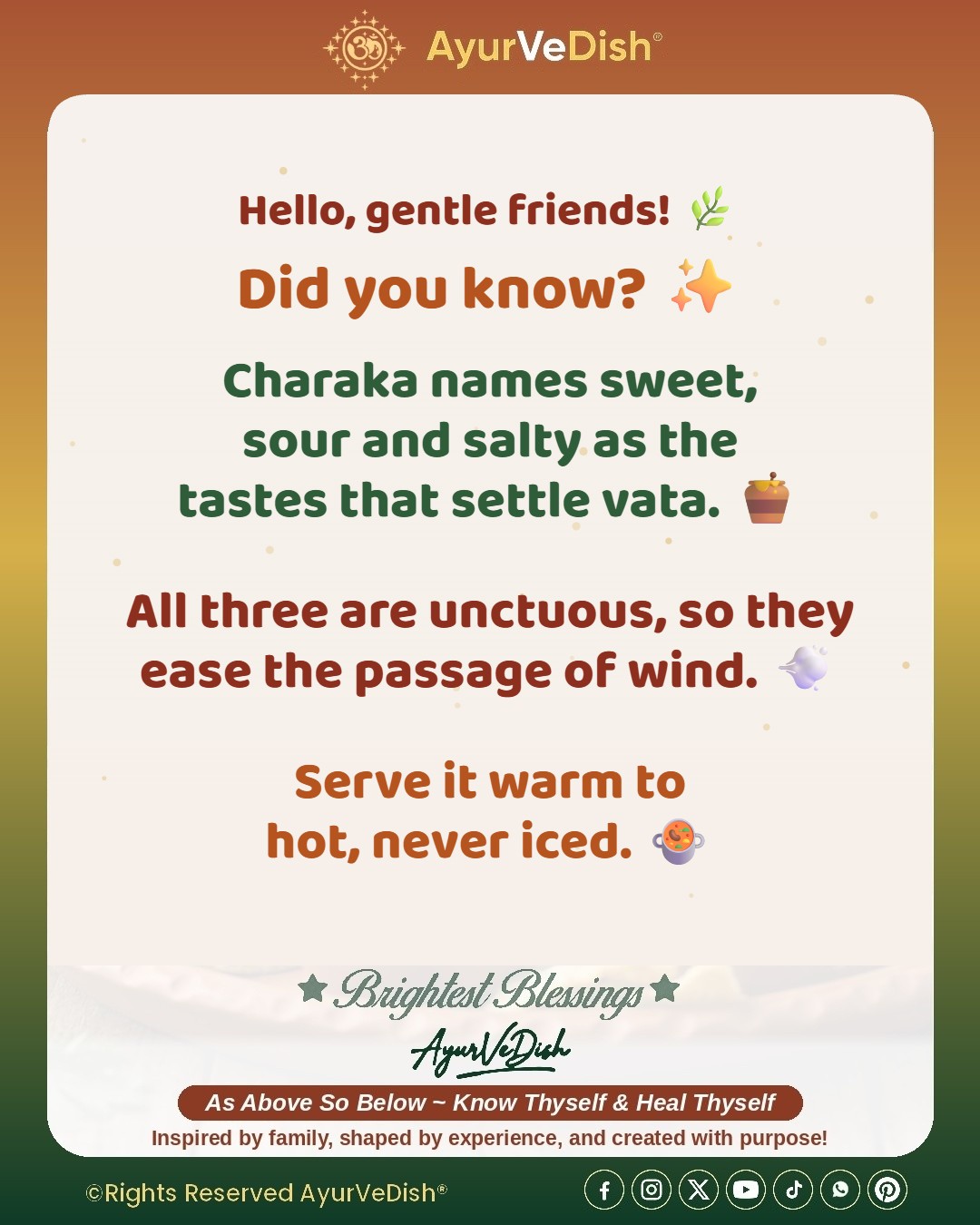
Charaka names sweet, sour and salty as the tastes that settle vata, and he points out what links them: all three are unctuous, so they ease the passage of wind, urine and stool, while pungent, bitter and astringent are drying and tend to hold these back. He also spells out the qualities that calm vata in the body: unctuousness, heaviness, warmth, smoothness, softness, a little slipperiness and compactness. In the kitchen that means food served warm to hot, never iced; soft, moist textures such as soupy dals, purées, stews and porridges; and enough substance on the plate to feel grounded. The texts assume ghee or oil supplies the unctuousness; in our oil free kitchen we take it from whole foods instead (seeds, coconut, avocado, slow-cooked pulses and juicy vegetables), and that is our adaptation rather than a classical instruction. Sesame is the seed Charaka singles out as settling vata, though he adds that it raises kapha and pitta, and rock salt, which he calls the best of salts and not heating, is the natural choice for the salty taste, used with a measured hand. Sweet potato and squash have no classical taste assignment, so their place here is modern practice.
Cooking methods
- Slow simmering: dals, khichdi-style pots and soups cooked until soft and loose, so moisture is built into the meal.
- Steaming roots and gourds until tender, then finishing them in a spiced coconut milk or tamarind gravy.
- Water-sauté: soften onions, ginger and garlic in splashes of hot stock, rather than letting them crisp.
- Baking in a covered dish with a little stock, so roots come out tender rather than leathery.
- Dry-roasting for whole spices only: toast cumin, fennel or ajwain and tip them straight into a wet dish.
- Soaking: pulses overnight, raisins and figs in warm water, and chia and flax before use.
A day of eating
- Breakfast: quinoa or amaranth porridge cooked in coconut milk drink with stewed pear, soaked raisins, cardamom and cinnamon; on a savoury morning, moong dal chilla with coconut yoghurt and fresh coriander.
- Lunch, the main meal: Gujarati khatti-meethi toor dal soured with kokum and sweetened with date paste, dudhi nu shaak (lauki), a soft quinoa jeera rice-type pilau and a spoon of fresh coconut chutney.
- Dinner, earlier and lighter: a khichdi-style pot of split moong and quinoa with carrot, ginger and pure hing, or a UK-style carrot, parsnip and ginger soup with a warm cassava flatbread.
- Snack: two or three dates or soaked figs, a baked sweet potato with lemon and a pinch of rock salt, or warm stewed apple with cinnamon.
- Drinks: hot water through the day, fresh ginger tea mid-morning, fennel and cardamom tea after meals, and a small cup of warm spiced coconut milk drink in the evening.
Through the UK year
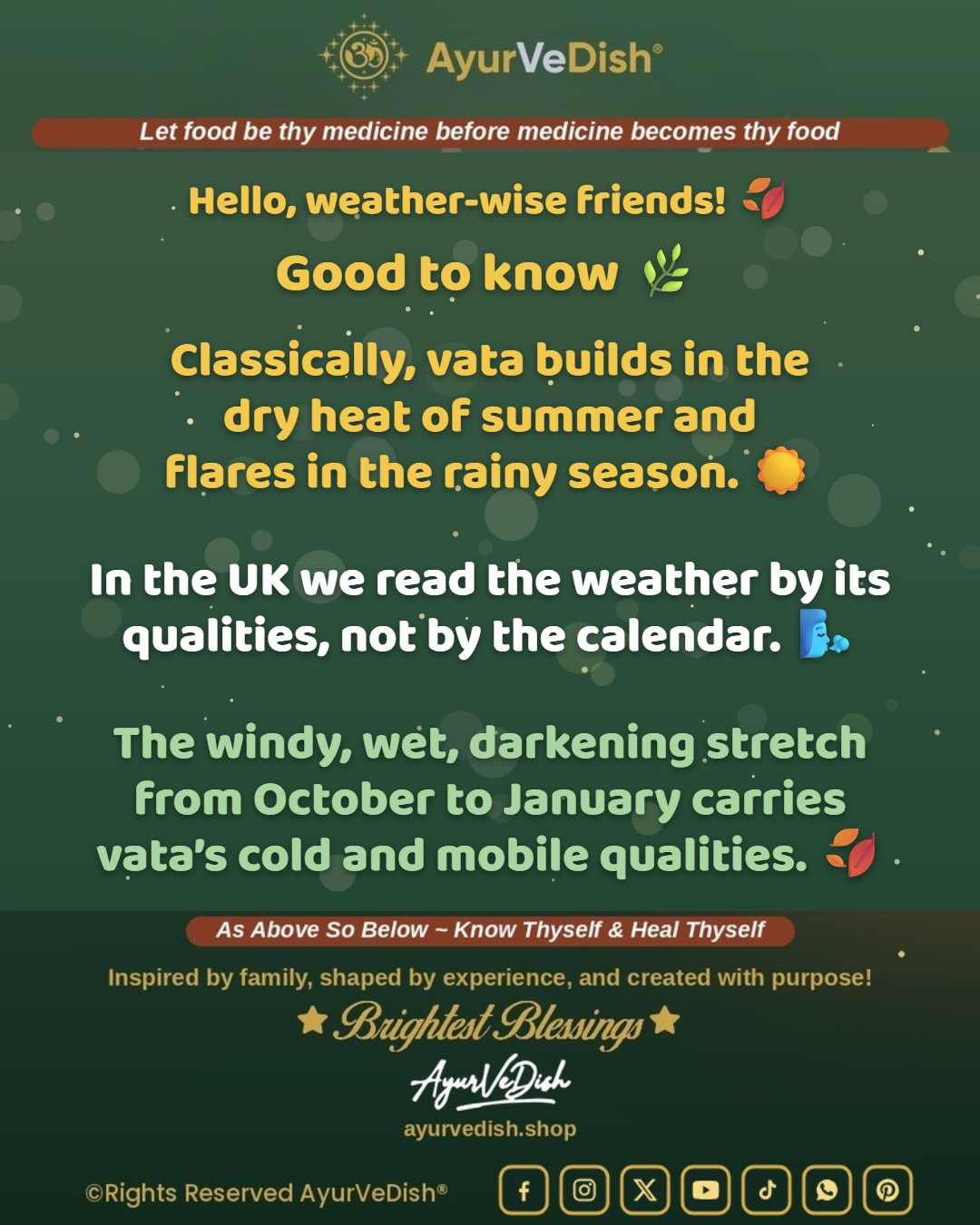
In the classical cycle, vata builds up in the dry heat of summer, flares in the rainy season and settles in autumn, and Charaka also warns against cold, dry, light food in late winter. Britain has no monsoon after its summer, so we do not copy that calendar. As our adaptation, we read UK weather by its qualities: the windy, wet, darkening stretch from October into January carries the cold and mobile qualities vata shares, and long dry, bright spells in late spring can add dryness. Those are the weeks to lean harder on warm, moist, regular meals, and to ease into each change of season over about a fortnight, as the texts advise for the junction between seasons.
Build a list with our Ready-Made Lists on the Shopping List Builder.
What suits you will always depend on you as a person, your digestion, the season and how the food is prepared.
What Researchers Have Found
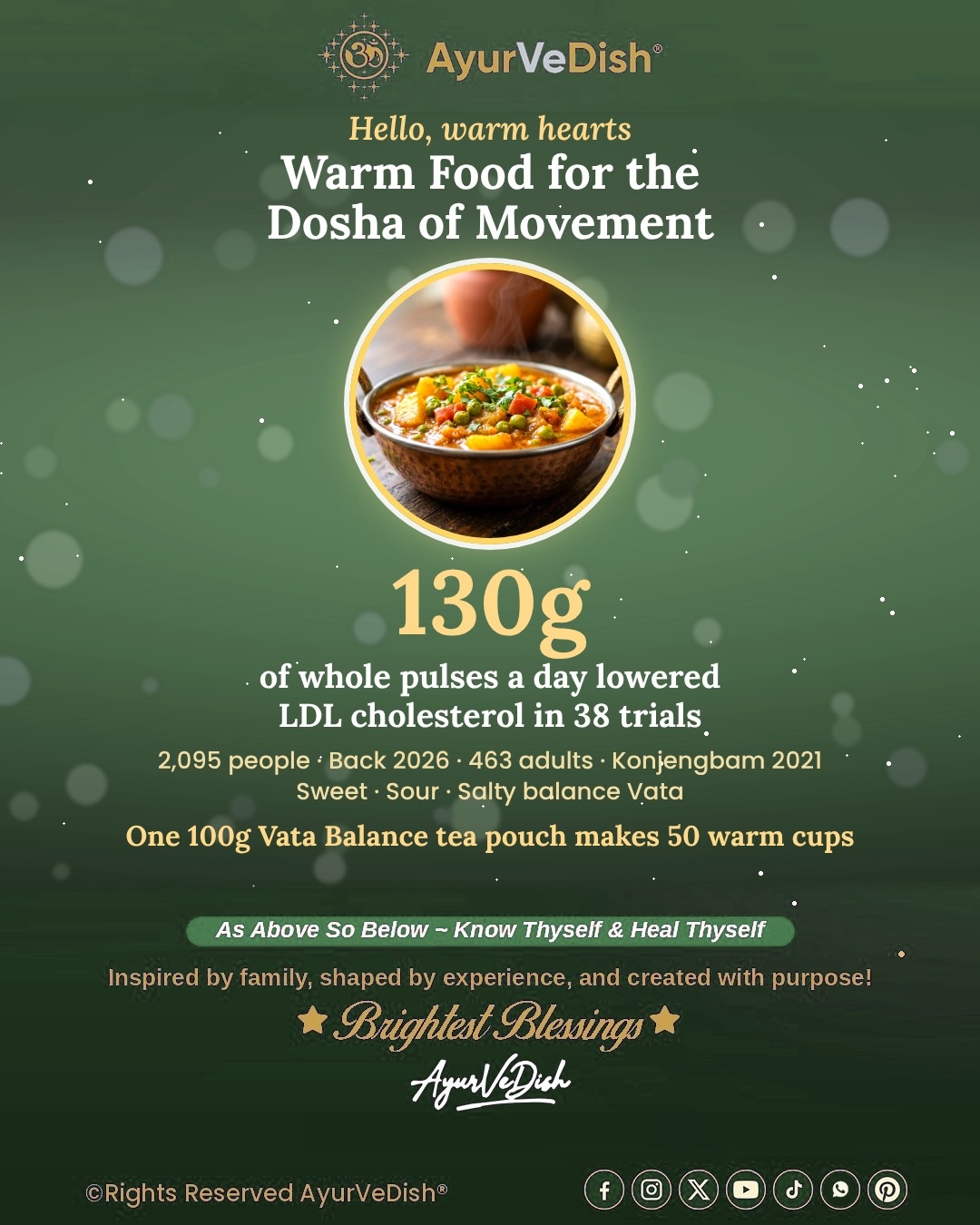
Lentil, bean and pea dishes have good modern support. In 2026, in the Journal of the American Heart Association, Back and colleagues combined 38 randomised trials with 2,095 people. About 130g a day of whole pulses (roughly half to two-thirds of a cup) lowered LDL cholesterol by 0.14 mmol/L, non-HDL cholesterol by 0.22 mmol/L, and apolipoprotein B (apoB, a marker of cholesterol-carrying particles) by 0.08 g/L. For beans, the benefit grew with the amount eaten, up to a cup a day.
Body measurements also follow the old descriptions. In 2021, in Annals of Human Biology, Konjengbam and colleagues measured 463 adults of the Meitei community in Manipur, India, and compared them with their Prakriti type. People assessed as Vata had the lowest body weight, body mass index and body fat, Pitta fell in the middle and Kapha had the highest. Types matched Western body-type categories only fairly well.
The pulse authors note that chickpeas, dried peas and lentils need further study, and the Manipur study covers one community, so these show tendencies in a group, not a prediction for any one person.
Begin Where You Are
You do not need to decide whether you are Vata. Simply notice. Do you feel better with warm food, regular meals and a calm routine? Do cold or dry things leave you feeling unsettled? That noticing is the beginning of the practice.
Vata is an Ayurvedic concept, not a medical diagnosis. Food choices should reflect your own needs, preferences and health circumstances.
Let Food Be Thy Medicine Before Medicine Becomes Thy Food.
As Above, So Below, Know Thyself and Heal Thyself.
Inspired by family, shaped by experience, and created with purpose!
Brightest Blessings

This page is for information only. For medical advice, please speak to a qualified professional.
Evidence and Sources
- Charaka Samhita, Sutrasthana 1, Deerghanjiviteeya Adhyaya, verse 59. carakasamhitaonline.com/index.php/Deerghanjiviteeya_Adhyaya
- Charaka Samhita, Sutrasthana 1, verse 66. siva.sh/caraka-samhita/sutra-sthana/1/66-70
- Charaka Samhita, Chikitsasthana 28, Vatavyadhi Chikitsa, verses 5 to 11. carakasamhitaonline.com/index.php/Vatavyadhi_Chikitsa_Adhyaya
- Ashtanga Hridaya, Sutrasthana 1, verse 11. satyori.com/source-texts/ashtanga-hridayam/sutrasthana/1/11/
- Sushruta Samhita, Sutrasthana 15. wisdomlib.org/hinduism/book/sushruta-samhita-volume-1-sutrasthana/d/doc122907.html
- Back S et al. Whole dietary pulses and lipid targets. Journal of the American Heart Association 2026. pubmed.ncbi.nlm.nih.gov/42132198/
- Konjengbam H et al. Body composition and Prakriti, Meitei adults of Manipur. Annals of Human Biology 2021. pubmed.ncbi.nlm.nih.gov/34097545/
- Charaka Samhita, Sutrasthana 1 (Deerghanjiviteeya Adhyaya), verses 56 to 60: the three bodily doshas and the qualities of vata and pitta. siva.sh
- Charaka Samhita, Vimanasthana 1 (Rasa Vimana), verses 6 to 10: the tastes that increase and settle each dosha. siva.sh
- Charaka Samhita, Sutrasthana 12 (Vatakalakaliya Adhyaya), verses 6 to 10: what aggravates and settles vata, and its functions. siva.sh
- Charaka Samhita, Sutrasthana 26 (Atreyabhadrakapyiya Adhyaya), verses 56 to 60: lightness of the tastes, vipaka, and the unctuous and dry tastes. siva.sh
- Charaka Samhita, Sutrasthana 27 (Annapanavidhi Adhyaya), verses 21 to 25: mung, urad and black-eyed beans. siva.sh
- Charaka Samhita, Sutrasthana 27 (Annapanavidhi Adhyaya), verses 26 to 30: horse gram, moth beans, chickpeas, lentils, peas and sesame. siva.sh
- Charaka Samhita, Sutrasthana 27 (Annapanavidhi Adhyaya), verses 121 to 125: mustard greens, mushrooms and grapes. siva.sh
- Charaka Samhita, Sutrasthana 27 (Annapanavidhi Adhyaya), verses 166 to 170: ginger, lemon, radish, holy basil and ajwain. siva.sh
- Charaka Samhita, Sutrasthana 6 (Tasyashiteeya Adhyaya), verses 21 to 25: late winter and spring regimen. siva.sh
- Ashtanga Hridaya, Sutrasthana 12 (Doshabhediya Adhyaya), verses 21 to 25: the seasonal build-up, flare and settling of each dosha. siva.sh
- Charak Samhita Online (Charak Samhita Research, Training and Development Centre, Jamnagar). Charaka Samhita, Sutrasthana 26, Atreyabhadrakapyiya Adhyaya (verses 43, 49 and 53: actions of the tastes, rock salt and amalaka as non-heating, salt as the most heating taste). carakasamhitaonline.com
- Charak Samhita Online. Charaka Samhita, Sutrasthana 27, Annapanavidhi Adhyaya (verse 300: rock salt as the best of salts). carakasamhitaonline.com
- Charak Samhita Online. Charaka Samhita, Vimanasthana 1, Rasa Vimana (verse 16 on long pepper; verses 24 to 25 on the rules of eating). carakasamhitaonline.com
- Charak Samhita Online. Ritucharya (topic page; Ashtanga Hridaya Sutrasthana 3, verse 58 on the junction between seasons). carakasamhitaonline.com