 AyurVeDish®
About us
Why AyurVeDish ExistsAyurveda at Our HeartOur Free-From PromiseWhole Food, Plant-Based LivingWhy Grain FreeWhy Oil FreeWhy Dairy FreeWhy Yeast FreeWhy Cane Sugar FreeWhy Soy FreeWhy Thoughtful IngredientsFresh and SeasonalHerbs and SpicesFood from Around the WorldGood Food for EveryoneA Recipe Should Inspire YouEat to LiveSalt, Spice and BalanceAyurveda
Ayurveda Made SimpleThe Five ElementsThe Three DoshasVataPittaKaphaPrakritiYour Dosha CombinationEating for Your ConstitutionChoosing Foods ThoughtfullyThe Six TastesSix Tastes on One PlateFood QualitiesAgni (Fire)Herbs and Spices in the Ayurvedic KitchenEating With the SeasonsAyurveda and the Body ClockFasting: The Ancient PauseBuilding a Plant-Based Ayurvedic MealAyurveda and Modern NutritionFood Combinations and Meal PlanningShop
Speciality All-in-One BlendsGrain Free Rice-Style BlendsSnack & Savoury PremixesGrain Free FloursBakes & DessertsChutneys, Dips & PicklesTadkas & Finishing SpicesDetox & Ayurvedic TeasHot & Cold Drinks





The Three Doshas
The Three Doshas: A Map, Not a Label
If the five elements are the alphabet of Ayurveda, the three doshas are its first words. Vata, Pitta and Kapha are the way Ayurveda describes the different qualities we meet in food, in the seasons and in ourselves.
They are often misunderstood. They are not boxes to be sorted into, and they are not a diagnosis. The best way to think of them is as a map: a traditional way of finding your bearings, with room for you to be exactly who you are.
What the Three Doshas Are
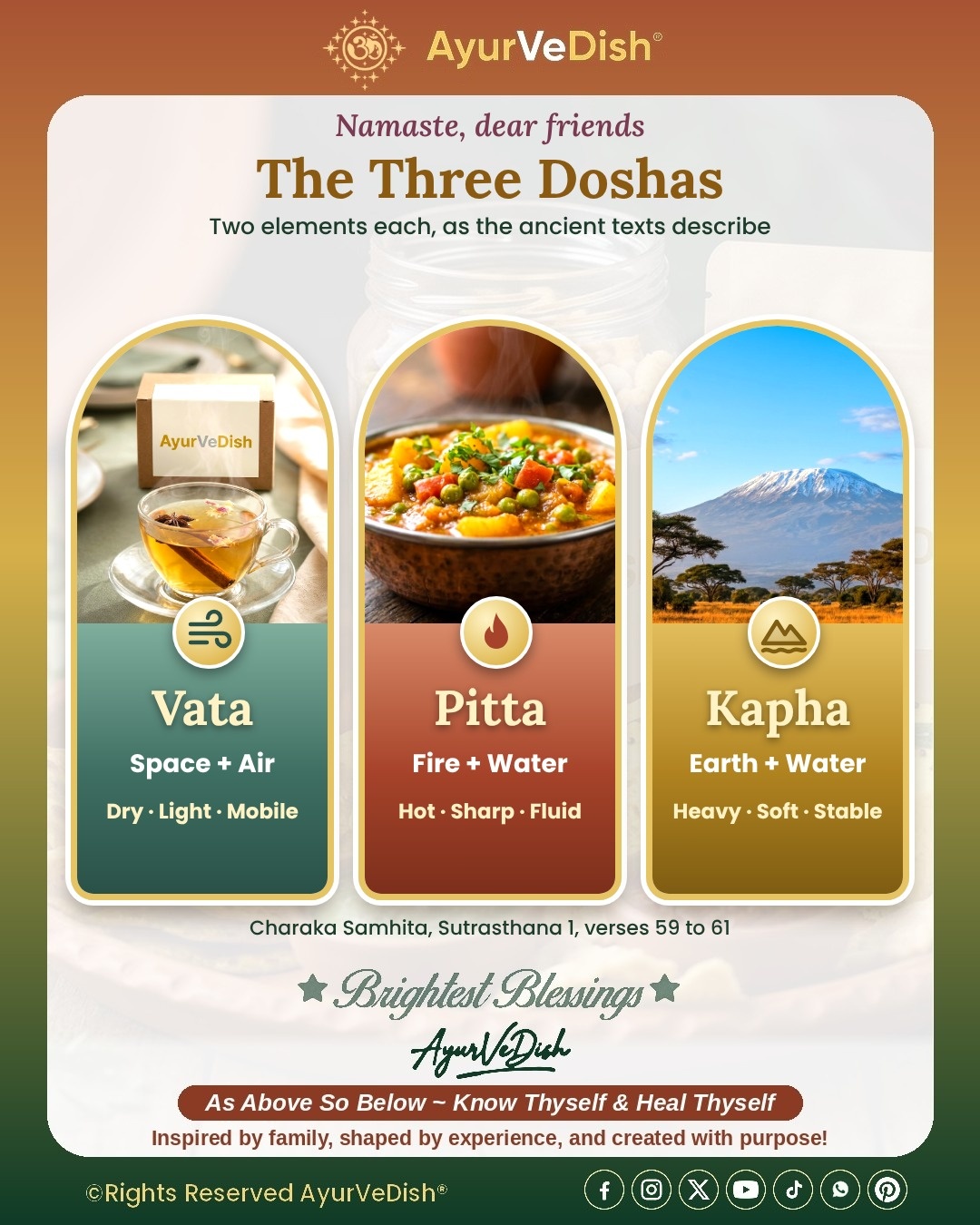
The word dosha is Sanskrit. The Charaka Samhita names vata, pitta and kapha as the three bodily doshas (Sutrasthana 1, verse 57). Each one is a pairing of two of the five elements from our previous page, and each is known by its qualities. Meet them one at a time.
Vata: Space and Air
Vata combines space and air. The Charaka Samhita describes it as dry, cold, light, subtle, mobile and rough (Sutrasthana 1, verse 59). It calls Vata the initiator of all activity in the body (Sutrasthana 12, verse 8). Think of movement, lightness and change.
Pitta: Fire and Water
Pitta combines fire and water. It is described as mildly oily, hot, sharp, fluid, sour and pungent (Sutrasthana 1, verse 60). The Charaka Samhita calls Pitta the body’s fire, behind digestion, vision, warmth and complexion, and says that in balance it brings courage and joy (Sutrasthana 12, verse 11). Think of warmth, transformation and intensity.
Kapha: Earth and Water
Kapha combines earth and water. It is described as heavy, dense, cold, soft, oily, sweet and stable (Sutrasthana 1, verse 61). The Charaka Samhita says that in balance it brings firm, well-nourished tissues, enthusiasm and vigour (Sutrasthana 12, verse 12). Think of structure, steadiness and nourishment.
Do You Have Just One Dosha?
No. All three are present in everyone. One may be more prominent, or two may be prominent together. Your underlying constitution is called Prakriti, and we explore it on its own page. Ayurveda also recognises that how you feel today may differ from your underlying constitution, which is why a dosha is something to notice, not something to be stuck with.
What the Ancient Texts Say
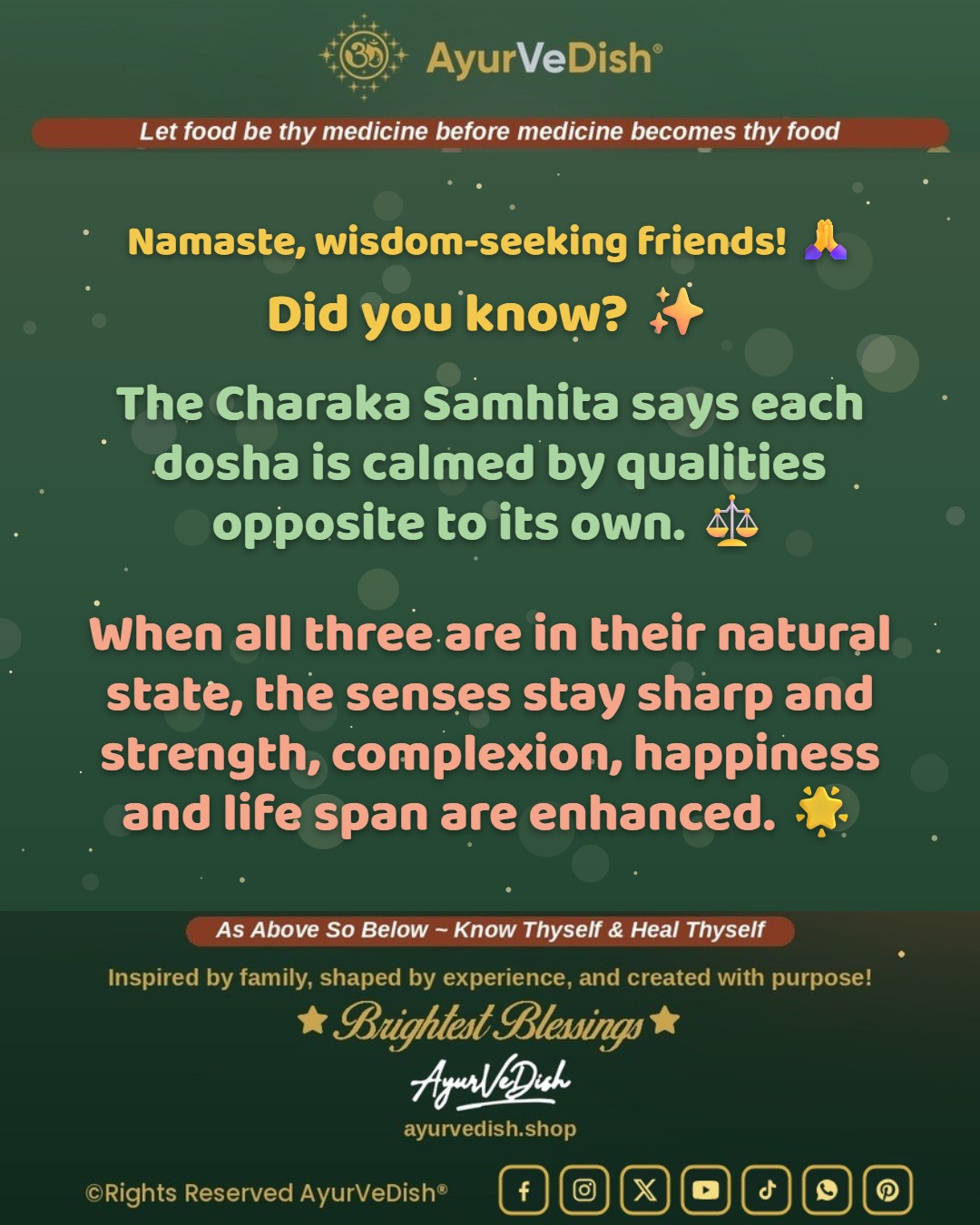
The Charaka Samhita says that each dosha is calmed by qualities opposite to its own (Sutrasthana 1, verses 59 to 61). It also says that when vata, pitta and kapha are all in their natural state they keep the senses sharp and enhance strength, complexion, happiness and life span (Sutrasthana 12, verse 13).
Notice what the ancients did here. They did not give us a list of rules. They gave us a language of qualities, so that every person could look at their own life and see what they needed more of, and what they needed less of.
The Three Doshas Side by Side
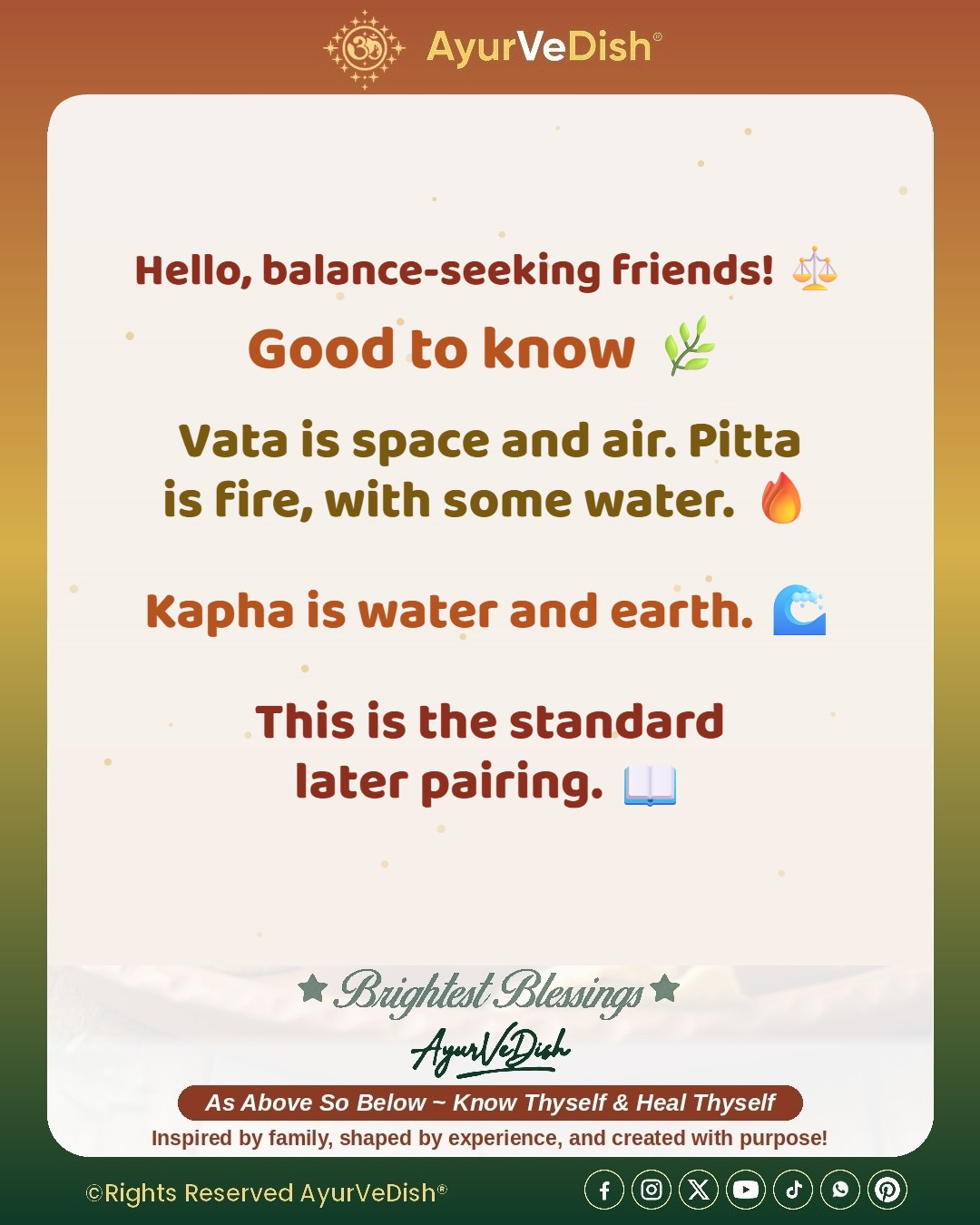
Here are the three as the classical texts describe them, set out in one place so the contrasts are easy to see.
| Vata | Pitta | Kapha | |
|---|---|---|---|
| Elements (the standard later pairing) | Space and air | Fire, with some water | Water and earth |
| Qualities given by Charaka | Dry, cold, light, subtle, mobile, clear (non-slimy) and rough | Slightly oily, hot, sharp, liquid, flowing, sour and pungent | Heavy, cold, soft, oily, sweet, stable and slimy |
| Main seat (Ashtanga Hridaya) | Below the navel, above all the large intestine; also the hips, thighs, ears, bones and skin | Between the navel and the heart, above all the navel region; also the stomach and small intestine, sweat, lymph, blood, plasma, eyes and skin | Above the heart, above all the chest; also the throat, head, joints, stomach, plasma, fat, nose and tongue |
| Main work in the body (Charaka) | Starts every movement, steers the mind and senses, prompts speech, fans the digestive fire and moves wastes out | Digestion, sight, body heat and complexion; courage and cheerfulness when balanced | Firmness, nourishment and strength; enthusiasm, vigour and understanding when balanced |
| Digestive fire when it dominates | Irregular (vishama) | Sharp (tikshna) | Slow (manda) |
| Tastes that settle it | Sweet, sour, salty | Sweet, bitter, astringent | Pungent, bitter, astringent |
| Tastes that increase it | Pungent, bitter, astringent | Pungent, sour, salty | Sweet, sour, salty |
| Time of day, life and digestion (Ashtanga Hridaya) | The closing part of the day and of the night, later life, and the end of digestion | The middle of the day and of the night, the middle years, and the middle of digestion | The opening part of the day and of the night, childhood and youth, and the time just after eating |
| Clock hours often given today (modern convention) | About 2 to 6, afternoon and before dawn | About 10 to 2, midday and midnight | About 6 to 10, morning and evening |
| Season in the classical cycle | Builds in summer, flares in the rains, settles in autumn | Builds in the rains, flares in autumn, settles in early winter | Builds in late winter, flares in spring, settles in summer |
| Our UK reading (AyurVeDish® adaptation) | Windy, wet autumn into early winter | Hot spells and bright late summer into September | Cold, damp late winter into spring |
Charaka is careful here: he argues that people in whom one dosha dominates are more accurately called vata-prone, pitta-prone or kapha-prone than given a fixed nature, because the natural state he has in mind is balance. And as the rows on time and season show, every one of us passes through the hours, meals, seasons and decades of all three, so the chart describes the weather we travel through rather than a box we live in.
What Researchers Have Found
Researchers in India have begun to test these old descriptions, and the results are encouraging.
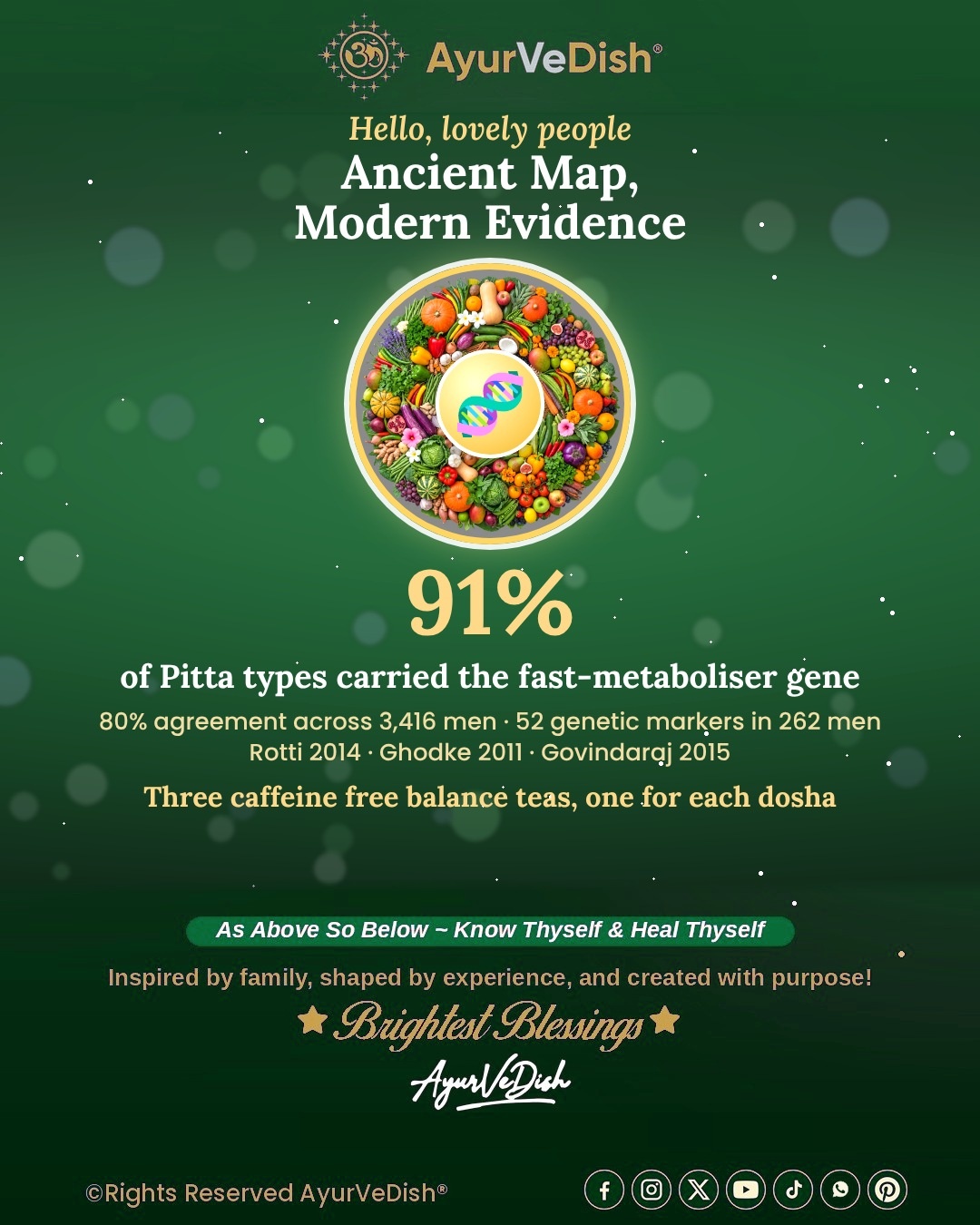
In 2014, in the Journal of Ayurveda and Integrative Medicine, Rotti and colleagues assessed 3,416 healthy men aged 20 to 30. An Ayurvedic physician and a computer tool each assessed every man’s constitution, and they reached the same answer 80% of the time, which the authors describe as moderate agreement (kappa 0.77). The dominant type was also significantly linked to body mass index and to place of birth (both P below 0.01).
In 2011, in Evidence-Based Complementary and Alternative Medicine, Ghodke, Joshi and Patwardhan tested a claim in the Ayurvedic texts: that Pitta people are fast metabolisers and Kapha people slow ones. In 132 healthy people, 91% of those with a Pitta constitution carried the fast-metaboliser version of the CYP2C19 gene, which helps the body process many medicines. The slow-metaboliser version was most common in Kapha (31%) compared with Vata (12%) and Pitta (9%). The ancient description and the modern measurement pointed the same way.
In 2015, in Scientific Reports, Govindaraj and colleagues went further and looked at the genes themselves. They studied 262 men, chosen from the 3,416 screened, and found 52 genetic markers that differed significantly between the three constitution types. The markers sorted people into their types regardless of ancestry, and the finding held in a second group of 297 people from India. One gene, PGM1, was linked to the Pitta type described in the Charaka Samhita.
These studies were in healthy adults, two of them in men only, and none tested a food or a treatment, so further research is needed.
Why This Matters at the Table
Traditional Ayurvedic guidance looks at the qualities of food, how it is prepared, the season, and the person eating. Because the Charaka Samhita calms each dosha with the opposite qualities, the doshas give us words for choosing: warming or cooling, light or grounding, moist or dry. The same dish may suit one person on one day and a different person on another. That is why our range lets you choose.
Our three caffeine free herbal teas follow the idea one dosha at a time. The Kapha Balance Herbal Tea is warming, with ginger (Adrak), cinnamon (Dalchini), tulsi and black pepper (Kali mirch). The Pitta Balance Herbal Tea is cooling, with fennel (Saunf), coriander (Dhania), mint (Pudina) and rose (Gulab). The Vata Balance Herbal Tea is warm and sweet-spiced, with ginger (Adrak), cinnamon (Dalchini), fennel (Saunf) and cardamom (Elaichi). Each is simply boiling water and a steep.
At the table, you set the warmth yourself. One 100g pouch of any of our all-in-one curry and dal blends makes about 25 portions at Mild (4g), 14 at Medium (7g) or 10 at Extra Hot (10g) per 200g of vegetables. Our optional tadka blends and our Agni Spark finishing spice, a no-cook sprinkle, add warmth at the table, while our Saunf, Pudina & Gulab Sharbat is a cooling fennel, mint and rose drink, sweetened with coconut sugar and dates and stirred into cold water. For something sweet, our grain free banana bread and blueberry muffin premixes are made without cane sugar, eggs or dairy.
Think of the doshas as a framework for exploration, not as labels that define you or a diagnosis of your health. Ayurvedic dosha theory belongs to a traditional system of knowledge and is not a substitute for evidence-based medical advice.
Where to Next
The next three pages take Vata, Pitta and Kapha one at a time, so you can read about each in depth.
Let Food Be Thy Medicine Before Medicine Becomes Thy Food.
As Above, So Below, Know Thyself and Heal Thyself.
Inspired by family, shaped by experience, and created with purpose!
Brightest Blessings

This page is for information only. For medical advice, please speak to a qualified professional.
Evidence and Sources
- Charaka Samhita, Sharirasthana 1, Katidhapurusha Sharira, verses 16 and 27. carakasamhitaonline.com/Katidhapurusha_Sharira
- Charaka Samhita, Sutrasthana 26, Atreyabhadrakapyiya Adhyaya, verses 10 and 40. carakasamhitaonline.com/Atreyabhadrakapyiya_Adhyaya
- Charaka Samhita online: Shunthi (dry ginger). carakasamhitaonline.com/Shunthi
- Charaka Samhita online: Maricha (black pepper). carakasamhitaonline.com/Maricha
- McDonald D, et al. American Gut: an Open Platform for Citizen Science Microbiome Research. mSystems 2018. PubMed 29795809
- Charaka Samhita, Sutrasthana 1 (Deerghanjiviteeya Adhyaya), verses 56 to 60: the three bodily doshas and the qualities of vata and pitta. siva.sh
- Charaka Samhita, Sutrasthana 1 (Deerghanjiviteeya Adhyaya), verses 61 to 65: the qualities of kapha. siva.sh
- Satyori. Ashtanga Hridayam, Sutrasthana 1, verse 7: the seats of the three doshas. satyori.com
- Satyori. Ashtanga Hridayam, Sutrasthana 1, verse 8: the doshas across life, day, night and digestion, and the four digestive fires. satyori.com
- Ashtanga Hridaya, Sutrasthana 12 (Doshabhediya Adhyaya), verses 1 to 5: the seats of vata, pitta and kapha. siva.sh
- Charaka Samhita, Sutrasthana 12 (Vatakalakaliya Adhyaya), verses 6 to 10: what aggravates and settles vata, and its functions. siva.sh
- Charaka Samhita, Sutrasthana 12 (Vatakalakaliya Adhyaya), verses 11 to 15: the functions of pitta and kapha. siva.sh
- Charaka Samhita, Vimanasthana 1 (Rasa Vimana), verses 6 to 10: the tastes that increase and settle each dosha. siva.sh
- Ashtanga Hridaya, Sutrasthana 12 (Doshabhediya Adhyaya), verses 21 to 25: the seasonal build-up, flare and settling of each dosha. siva.sh
- Charaka Samhita, Vimanasthana 6 (Roganika Vimana), verses 11 to 15: the four states of digestive fire and the naming of dosha-dominant people. siva.sh