 AyurVeDish®
About us
Why AyurVeDish ExistsAyurveda at Our HeartOur Free-From PromiseWhole Food, Plant-Based LivingWhy Grain FreeWhy Oil FreeWhy Dairy FreeWhy Yeast FreeWhy Cane Sugar FreeWhy Soy FreeWhy Thoughtful IngredientsFresh and SeasonalHerbs and SpicesFood from Around the WorldGood Food for EveryoneA Recipe Should Inspire YouEat to LiveSalt, Spice and BalanceAyurveda
Ayurveda Made SimpleThe Five ElementsThe Three DoshasVataPittaKaphaPrakritiYour Dosha CombinationEating for Your ConstitutionChoosing Foods ThoughtfullyThe Six TastesSix Tastes on One PlateFood QualitiesAgni (Fire)Herbs and Spices in the Ayurvedic KitchenEating With the SeasonsAyurveda and the Body ClockFasting: The Ancient PauseBuilding a Plant-Based Ayurvedic MealAyurveda and Modern NutritionFood Combinations and Meal PlanningShop
Speciality All-in-One BlendsGrain Free Rice-Style BlendsSnack & Savoury PremixesGrain Free FloursBakes & DessertsChutneys, Dips & PicklesTadkas & Finishing SpicesDetox & Ayurvedic TeasHot & Cold Drinks





The Five Elements
The Five Elements: The Pattern Behind Everything
Before the doshas, before the six tastes, before any talk of food, Ayurveda begins with something much older and simpler: the five elements. They are the ancient answer to a very old question. What is the world made of, and what are we made of?
The answer, in the Ayurvedic tradition, is the same thing. Nature and the human body are built from the same five elements. That is a beautiful idea to carry into the kitchen. When we cook with plants, we are working with the same patterns that make up us.
The Five Elements
The elements are known in Sanskrit as the Pancha Mahabhuta, “the five great elements”. Each is described by its quality and by the sense through which we meet it.
Aakash, Space. The element of openness, the room in which things exist. Its quality is free flow, and we meet it through hearing.
Vayu, Air. The element of movement and lightness. Its quality is motion, and we meet it through touch.
Teja, Fire. The element of heat and transformation. Its quality is warmth, and we meet it through sight.
Jala, Water. The element of fluidity and moisture. Its quality is flow and cohesion, and we meet it through taste.
Prithvi, Earth. The element of solidity and structure. Its quality is firmness, and we meet it through smell.
What the Ancient Texts Say
The Charaka Samhita says a human being (purusha) is made of six parts: the five great elements and consciousness (Sharirasthana 1, verse 16). It pairs the elements with the senses in order, from space to earth: sound, touch, vision, taste and smell (Sharirasthana 1, verse 27). It describes every substance used as medicine as made of the five great elements (Sutrasthana 26, verse 10). The ancients did not set the body apart from nature. They placed us inside it.
How the Elements Become the Doshas
The five elements gather in pairs to form the three doshas, which you will meet in the next pages. Vata combines space and air. Pitta combines fire and water. Kapha combines earth and water.

How the Elements Reach Your Plate
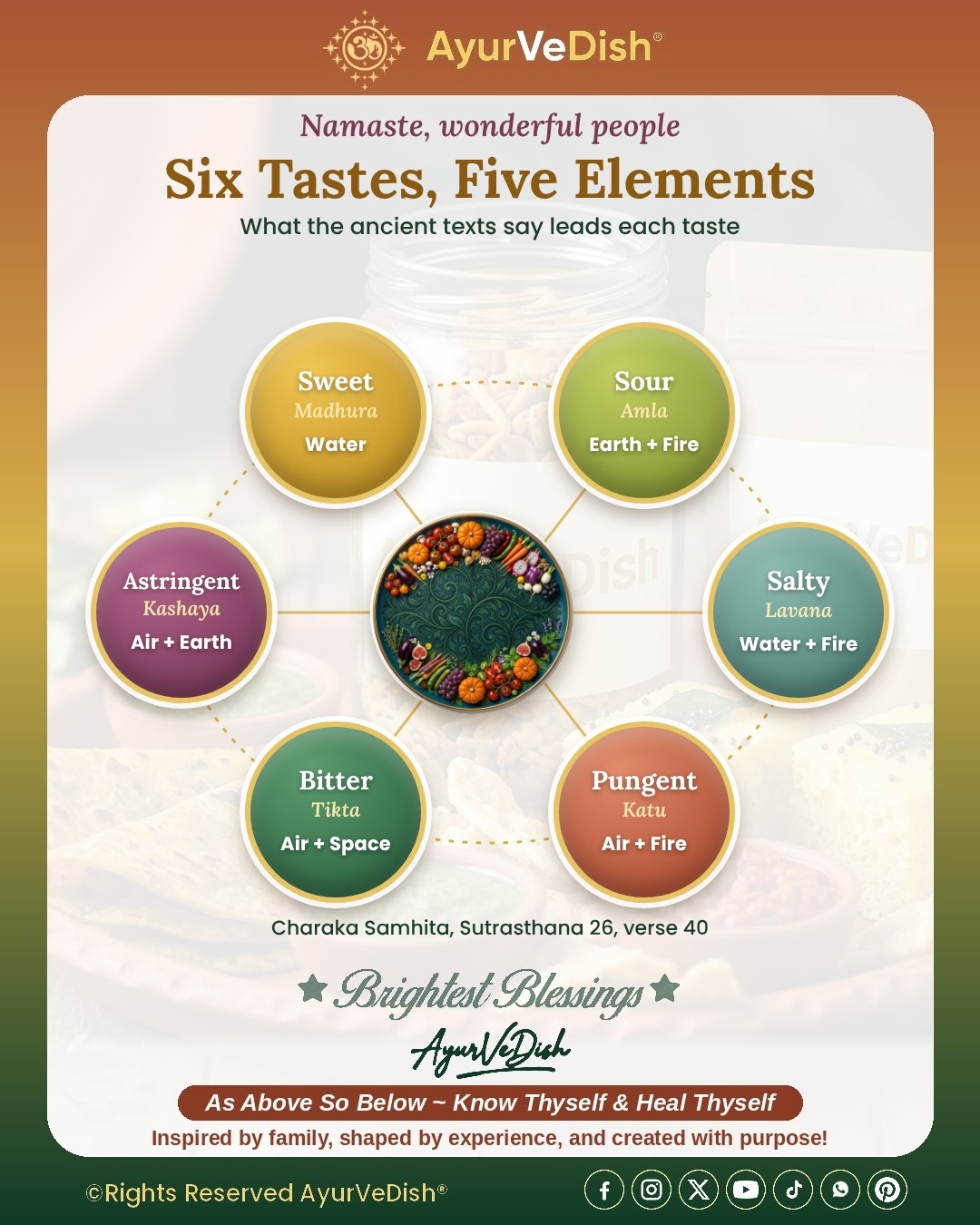
The same elements shape the food we eat. In the same chapter (Sutrasthana 26, verse 40), the Charaka Samhita ties each of the six tastes to the elements that lead it. Sweet is led by water. Sour by earth and fire. Salty by water and fire. Pungent by air and fire. Bitter by air and space. Astringent by air and earth.
So when you choose what to cook, the elements are already in the pot. Pungent is air and fire, and it is the taste behind our Agni Spark finishing spice, a no-cook sprinkle for the table: dry ginger (Sunth), black pepper (Kali mirch), long pepper (Pippali), cumin (Jeera), carom (Ajwain), asafoetida (Hing) and Himalayan pink salt (Sendha namak). Dry ginger and black pepper are both listed as pungent in the Charaka Samhita reference. Our optional tadka blends (Plain Gujarati Vaghar, Punjabi Masala and South Indian) bring the same wake-up note for anyone who likes a finishing tempering. Each carries ginger (Adrak), with mustard seed (Rai), curry leaf, chilli and, in the Punjabi blend, garlic (Lasan).
The Five Elements at a Glance
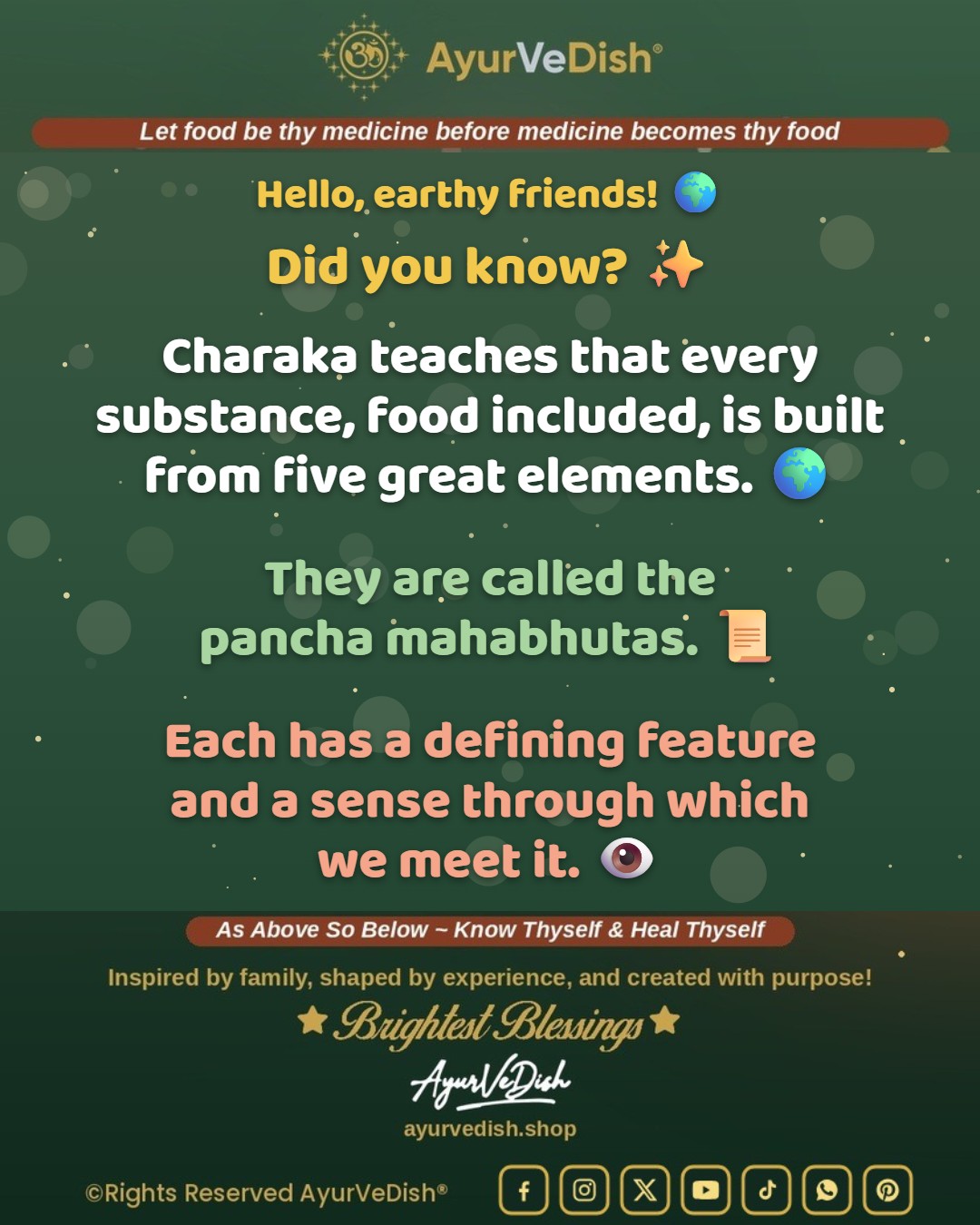
Charaka teaches that every substance, food included, is built from the five great elements, the pancha mahabhutas. Each has a defining feature and a sense through which we meet it, and Charaka lists the qualities and actions of foods in which each element dominates. The table brings these together.
| Element | Defining feature and sense | Qualities (Charaka) | What it does in the body (Charaka) |
|---|---|---|---|
| Earth (prithvi) | Solidity; smell | Heavy, coarse, hard, slow, stable, non-slimy, dense and gross | Builds bulk, compactness, weight and firmness |
| Water (jala, ap) | Liquidity; taste | Liquid, unctuous, cold, slow, soft and slimy | Moistens, lubricates, binds, softens and refreshes |
| Fire (agni, tejas) | Heat; sight | Hot, sharp, subtle, light, dry and non-slimy | Gives burning, digestion, lustre, brightness and complexion |
| Air (vayu) | Movement; touch | Light, cold, dry, coarse, non-slimy and subtle | Brings dryness, lightness, movement and a clean, non-sticky quality, and in excess fatigue |
| Space (akasha) | Openness; sound | Soft, light, subtle and smooth | Creates softness, porousness and lightness |
Each element also carries the qualities of those before it in the sequence, so air can be both heard and felt, and earth holds all five sense qualities.
Elements, Doshas and the Grain Free Kitchen
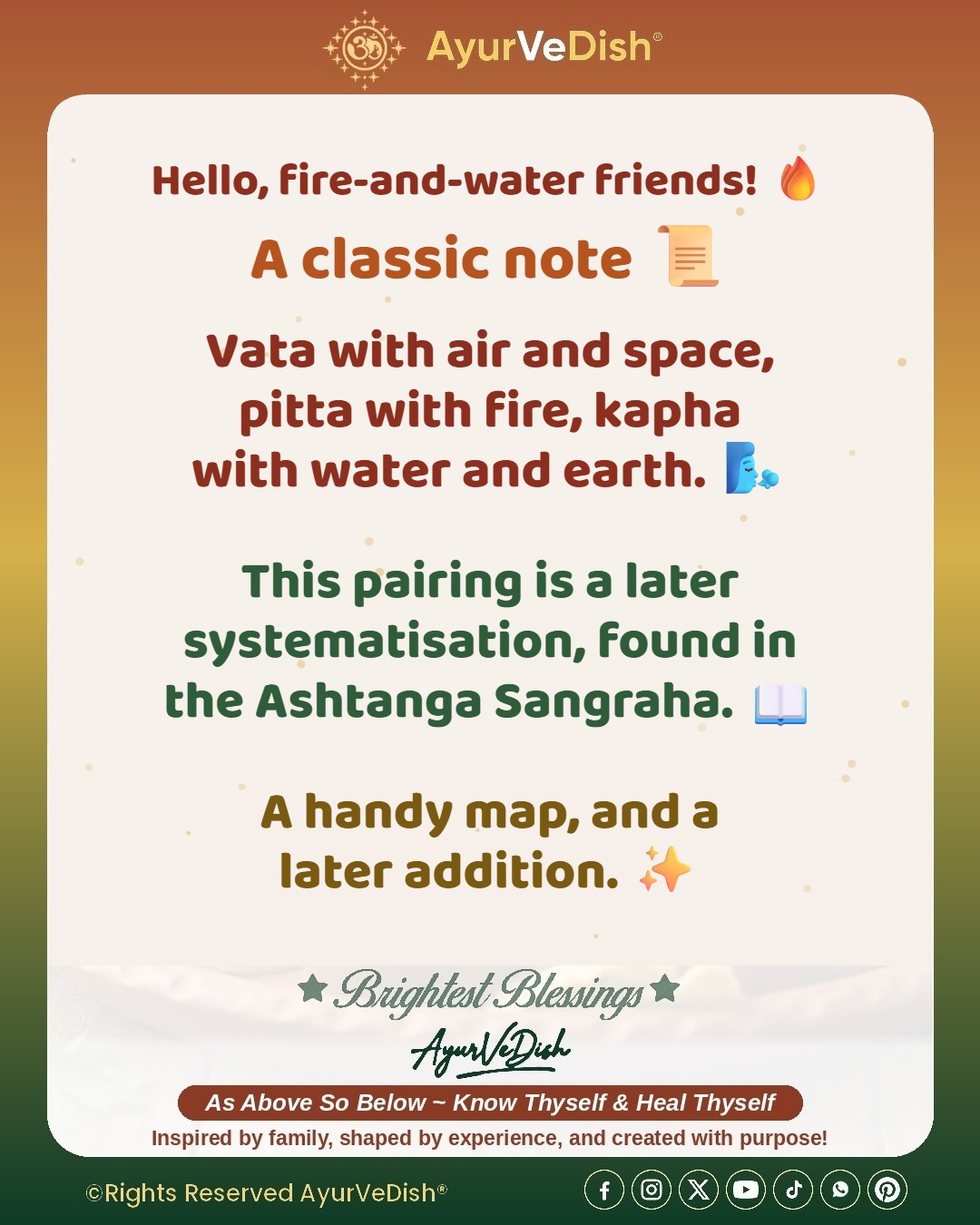
The pairing of the doshas with elements, vata with air and space, pitta with fire, and kapha with water and earth, is a later systematisation found in the Ashtanga Sangraha rather than a line of Charaka. The foods in the last column are our own kitchen reading, chosen by taste and quality, not a classical list.
| Element | Dosha it is usually paired with | Where we notice it in an AyurVeDish® kitchen (our reading) |
|---|---|---|
| Earth | Kapha | Dense, firm, filling food: beetroot, swede and other roots, chickpeas, chickpea tofu, buckwheat groats and the astringent pulses |
| Water | Kapha | Juicy, sweet, cooling food: cucumber, courgette, melon, sweet grapes, dates, coconut water and soft-cooked gourds |
| Fire | Pitta | Heat and sharpness: fresh and dry ginger, black pepper, mustard seed, garlic, lemon, tamarind and salt |
| Air | Vata | Light, dry, rough food: raw leaves, radish, rocket, puffed amaranth and dry-roasted pulses |
| Space | Vata | Light, open, porous food: bitter leaves such as chicory and fenugreek leaf, clear broths and airy, puffed textures |
Using the elements when you cook
- Cooking moves the balance. Charaka counts processing among the eight factors that shape a food: water softens and lends moisture, heat lends lightness and sharpness, and grinding or soaking change texture. A dry-roasted chickpea and a slow-simmered one are not the same food.
- Balance the plate, not just the ingredient. Pair an earthy, heavy base such as mashed swede with a little fire (ginger, black pepper) and some lightness (bitter leaves), and a watery, cooling dish such as cucumber and mung with warming cumin.
- Read the weather. Damp, cold spells already lean towards water and earth, so meals with more fire and lightness tend to sit better; hot, dry spells call for more water.
- Respect your own digestion. A lot of air and space suits a slow, heavy digestion better than an irregular one, which usually prefers warmth and moisture.
What suits you will always depend on you as a person, your digestion, the season and how the food is prepared.
What Researchers Have Found
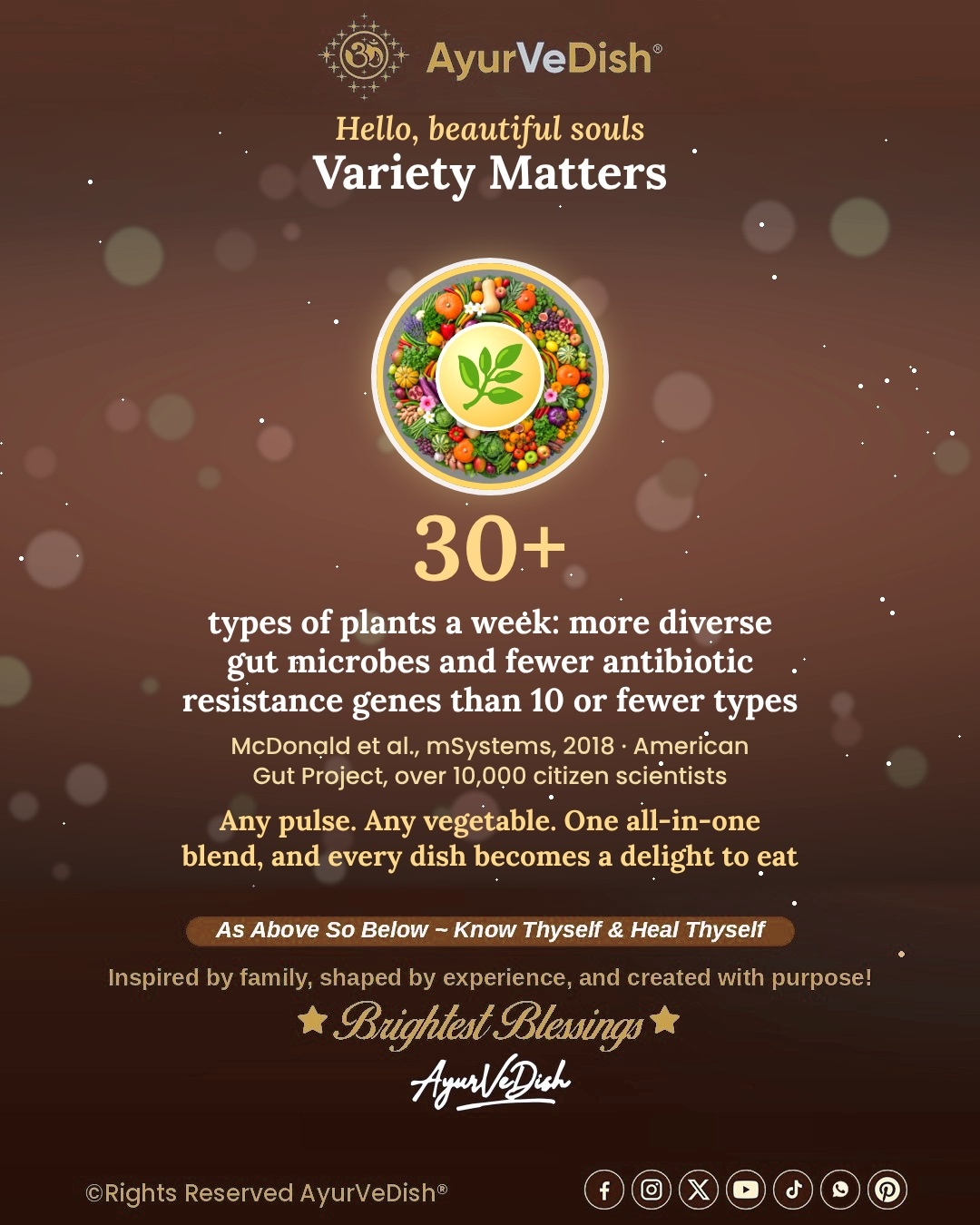
In 2018, in mSystems, McDonald and colleagues reported the American Gut Project, with samples from over 10,000 citizen scientists, mainly in the United States, United Kingdom and Australia. The authors found that the diversity of plants people ate was linked to their gut microbes, while a label such as veganism had little or no explanatory power. People who ate more than 30 types of plants a week had more diverse gut microbes and fewer antibiotic resistance genes than those who ate 10 or fewer. Eating widely is an easy way to meet all five elements on your plate.
The five elements are a way of seeing rather than something science classifies, and the American Gut data are self-reported, so further research is needed.
Begin With the Elements
You do not need to memorise them. Start by noticing. Notice how a warm bowl of food feels different from a cold salad, how a light meal feels different from a heavy one. That noticing is the first step, and the rest of these pages will build on it.
The five elements are part of traditional Ayurvedic philosophy, not a medical or scientific classification, and this page is not medical advice.
Let Food Be Thy Medicine Before Medicine Becomes Thy Food.
As Above, So Below, Know Thyself and Heal Thyself.
Inspired by family, shaped by experience, and created with purpose!
Brightest Blessings

This page is for information only. For medical advice, please speak to a qualified professional.
Evidence and Sources
- Charaka Samhita, Sharirasthana 1, Katidhapurusha Sharira, verses 16 and 27. carakasamhitaonline.com/Katidhapurusha_Sharira
- Charaka Samhita, Sutrasthana 26, Atreyabhadrakapyiya Adhyaya, verses 10 and 40. carakasamhitaonline.com/Atreyabhadrakapyiya_Adhyaya
- Charaka Samhita online: Shunthi (dry ginger). carakasamhitaonline.com/Shunthi
- Charaka Samhita online: Maricha (black pepper). carakasamhitaonline.com/Maricha
- McDonald D, et al. American Gut: an Open Platform for Citizen Science Microbiome Research. mSystems 2018. PubMed 29795809
- Charak Samhita Research, Training and Development Centre (Jamnagar), Charak Samhita Online, Atreyabhadrakapyiya Adhyaya (Charaka, Sutra Sthana 26). carakasamhitaonline.com
- Charak Samhita Research, Training and Development Centre (Jamnagar), Charak Samhita Online, Pancha mahabhuta (topic page). carakasamhitaonline.com
- siva.sh, Caraka Samhita, Sutra Sthana 26. siva.sh
- Charak Samhita Research, Training and Development Centre (Jamnagar), Charak Samhita Online, Rasa Vimana (Charaka, Vimana Sthana 1). carakasamhitaonline.com
- Bhishagratna K.K. (trans.), Sushruta Samhita, Sutrasthana 42, 1907, via Wisdom Library. wisdomlib.org