 AyurVeDish®
About us
Why AyurVeDish ExistsAyurveda at Our HeartOur Free-From PromiseWhole Food, Plant-Based LivingWhy Grain FreeWhy Oil FreeWhy Dairy FreeWhy Yeast FreeWhy Cane Sugar FreeWhy Soy FreeWhy Thoughtful IngredientsFresh and SeasonalHerbs and SpicesFood from Around the WorldGood Food for EveryoneA Recipe Should Inspire YouEat to LiveSalt, Spice and BalanceAyurveda
Ayurveda Made SimpleThe Five ElementsThe Three DoshasVataPittaKaphaPrakritiYour Dosha CombinationEating for Your ConstitutionChoosing Foods ThoughtfullyThe Six TastesSix Tastes on One PlateFood QualitiesAgni (Fire)Herbs and Spices in the Ayurvedic KitchenEating With the SeasonsAyurveda and the Body ClockFasting: The Ancient PauseBuilding a Plant-Based Ayurvedic MealAyurveda and Modern NutritionFood Combinations and Meal PlanningShop
Speciality All-in-One BlendsGrain Free Rice-Style BlendsSnack & Savoury PremixesGrain Free FloursBakes & DessertsChutneys, Dips & PicklesTadkas & Finishing SpicesDetox & Ayurvedic TeasHot & Cold Drinks





Ayurveda Made Simple
Ayurveda Made Simple: Begin Where You Are
Ayurveda can sound like a big subject with a long list of unfamiliar words. It doesn’t have to be. At its heart, it is a way of paying attention to your body, your mind, your daily habits and the food on your plate, and noticing how they work together.
You do not need to know your dosha to begin. You do not need special equipment or a new vocabulary. You only need a little curiosity about how you feel, and a willingness to notice what suits you.
What Ayurveda Is
The word Ayurveda means “the knowledge of life”. The Charaka Samhita, one of its oldest texts, describes life (ayu) as the union of body, senses, mind and soul (Sutrasthana 1.42). It then states the purpose of this knowledge: to preserve the health of the healthy, and to cure the disease of the unwell (Sutrasthana 30.26). Protecting health comes first. Ayurveda begins with how we live and eat every day, long before anything goes wrong. In my view, that is its most practical gift.
Three Ideas to Hold On To
Everything is made of five elements. Earth, water, fire, air and space. The ancients used them to describe the natural world and ourselves.
The elements gather into three doshas. Vata, Pitta and Kapha are three patterns of qualities, such as light or heavy, warm or cool, dry or moist. Everyone carries all three, in their own proportions.
You are one of a kind. Your constitution, your appetite, your energy and your preferences are not the same as anyone else’s. Food that feels wonderful to one person may sit heavily with another, and Ayurveda treats that as normal, not as a problem to correct.
Where Our Ingredients Come In
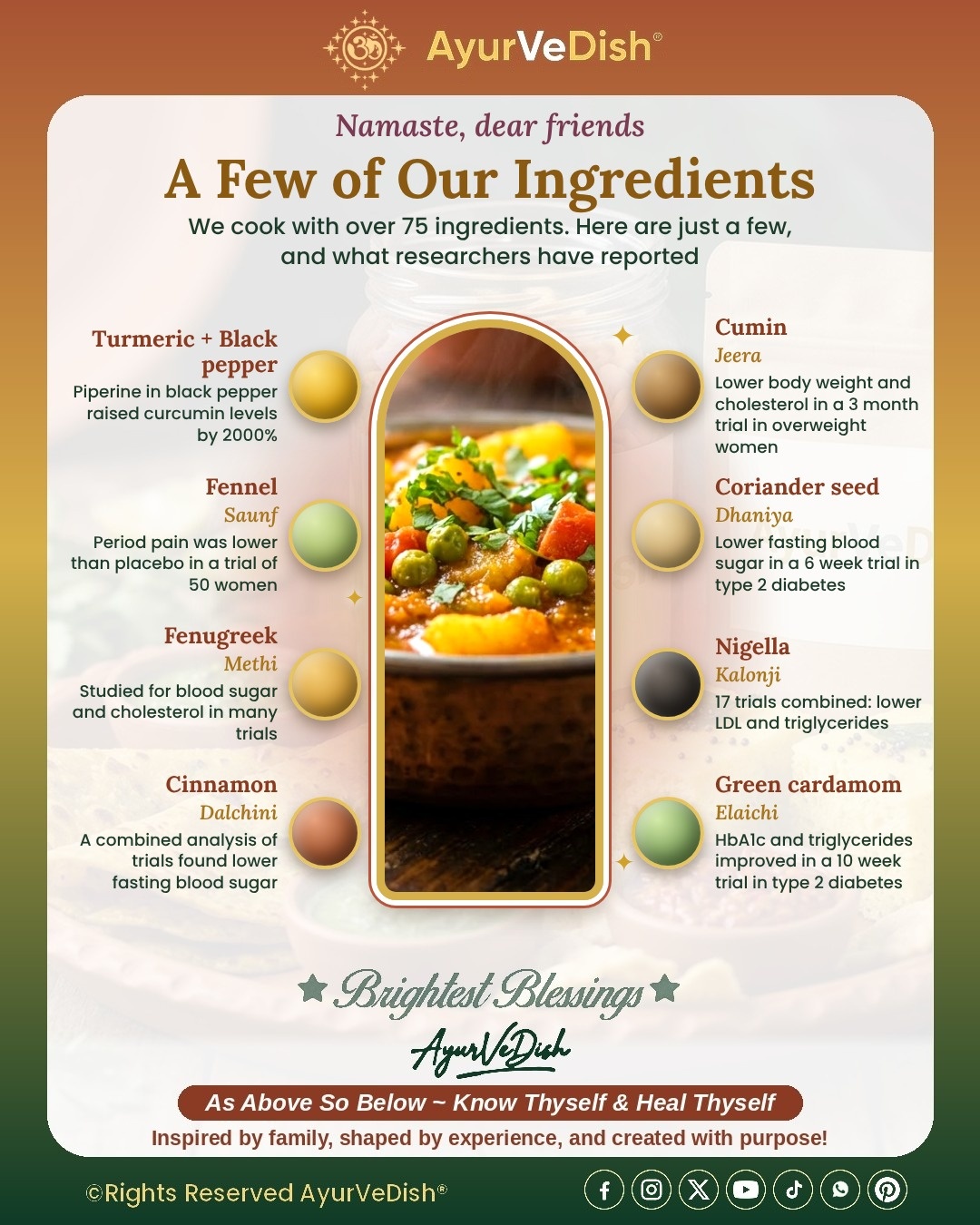
Our recipes use over 75 ingredients, and many come straight from the Ayurvedic kitchen. Turmeric with black pepper, cumin, coriander seed, fennel, dry ginger, mustard seed and hing bring warmth. Amchur (raw mango), tamarind and lemon bring tang. Moong, toor, urad and chana dal, besan, buckwheat and amaranth bring plant protein and fibre and keep our flours grain free. Coconut sugar and dates sweeten, and Himalayan pink salt seasons. Everything is grain free, oil free, cane sugar free and 100% plant-based.

Eight Questions to Ask of Any Food
If you remember one list from Charaka, make it this one. It tells you what to ask about any food before you eat it.
Charaka lists eight factors that decide whether a food helps or harms. Turned into plain questions, they make a reliable kitchen checklist.
| Factor | The question | An example |
|---|---|---|
| Nature (prakriti) | Is this food heavy or light by nature? | Urad is heavy; mung is light |
| Preparation (karana) | How has it been soaked, cooked, stored? | Soaking and slow cooking make chickpeas easier to digest |
| Combination (samyoga) | What is it eaten with? | Two foods together can act in ways neither does alone |
| Quantity (rashi) | How much, of the whole meal and of each part? | A spoon of chutney, not a bowl |
| Place (desha) | Where does it come from, and where am I? | A British winter is not a Gujarati summer |
| Time (kala) | What season and hour is it, and what state am I in? | A lighter supper, eaten earlier |
| Rules of eating | Am I eating in the right way? | Warm food, after the last meal has digested, not rushed |
| The eater | Does this suit me, and am I used to it? | A new food is best introduced gradually |
Charaka adds that these eight depend on one another, so no single answer settles the matter. A light food eaten in excess can still sit heavily, and a heavy food can suit a strong appetite in midwinter.
A note on warm, unctuous food
Charaka’s rules of eating begin with food that is warm and unctuous, and he explains that warm food tastes better, kindles digestion and digests quickly. Without ghee or oil, richness in our pans comes from sesame, coconut, avocado and soft, slow-cooked pulses, which is our adaptation and we would rather say so than pretend it is classical.
What suits you will always depend on you as a person, your digestion, the season and how the food is prepared.
What Researchers Have Found
Modern researchers have been curious about these old ideas too. In a 2015 study in Scientific Reports, scientists in India screened 3,416 men and chose 262 whose Ayurvedic constitution type (Prakriti) was clearly assessed by experienced Ayurvedic physicians. When they compared genetic markers, they found 52 that differed between the Vata, Pitta and Kapha groups.
Other spices we cook with have been studied too, among them cumin, fennel, coriander seed, fenugreek, nigella, cinnamon and green cardamom, for their reported effects on blood sugar, cholesterol and more.
Six Tastes
Ayurveda describes six tastes in food: sweet, sour, salty, pungent, bitter and astringent. A meal that includes all six is considered balanced. We will explore them page by page, and you will find they are already on your plate more often than you think. In our kitchen, sweet comes from coconut sugar and dates, sour from tamarind, raw mango and lemon, salty from Himalayan pink salt, and pungent from chilli, black pepper and dry ginger. Fenugreek brings bitter, and pulses such as moong and chana dal are traditionally counted as astringent.
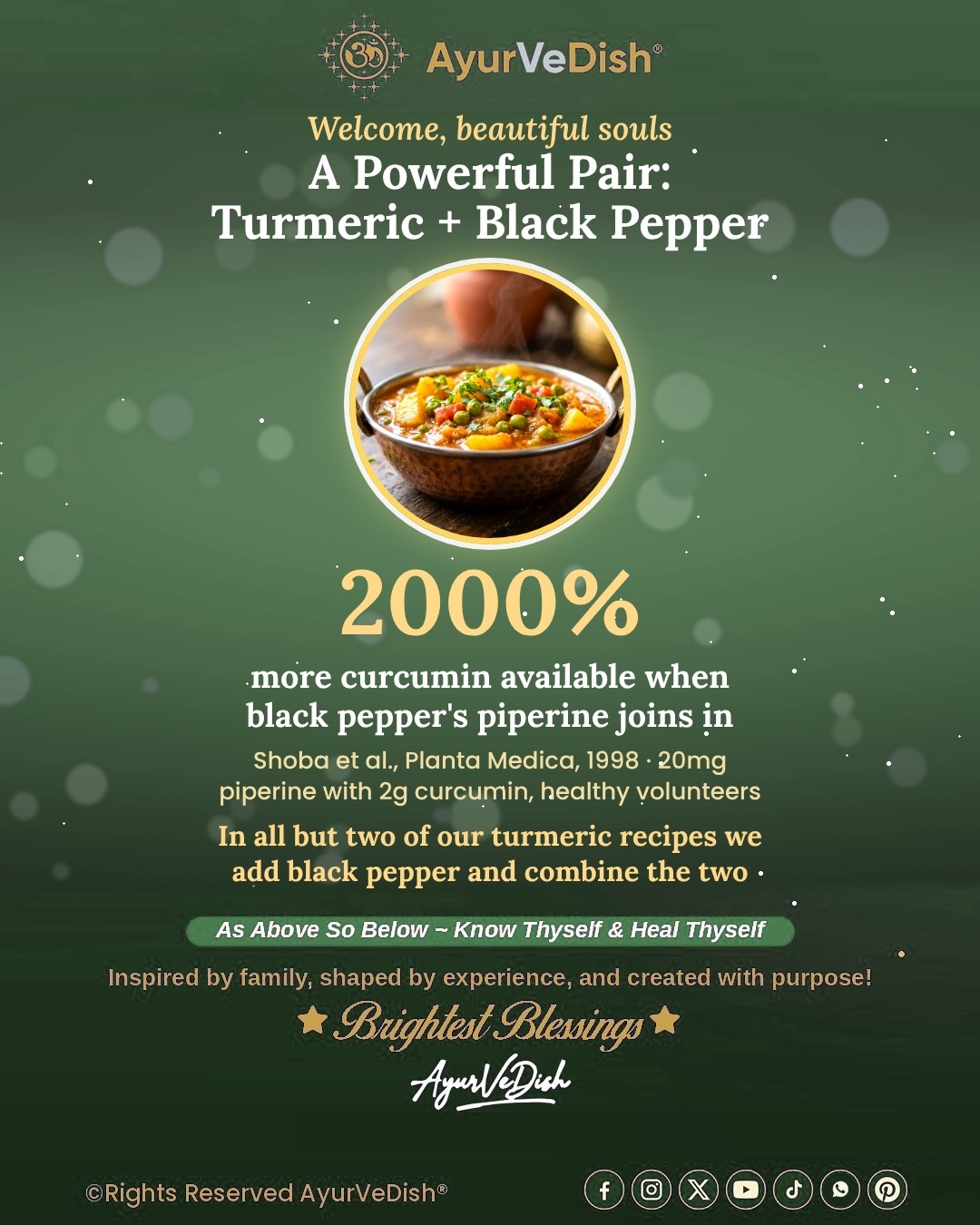
A powerful pair. Researchers have looked closely at the spices on our shelves too. In 1998, healthy volunteers took 2g of curcumin, once alone and once with 20mg of piperine, the compound in black pepper. With piperine, curcumin levels in the blood were about 2000% higher. That was a high dose of curcumin, not a meal, so we cannot promise the same effect at the table, but it is a big reason why, in all but two of our turmeric recipes, we add black pepper and combine the two. Black pepper’s piperine is the reason the two belong together on the plate.
How Far a Blend Goes
A 100g blend cooks up to 25 portions at the Mild 4g rate, about 14 at Medium 7g and about 10 at Extra Hot 10g, each for 200g of vegetables.
Ayurveda in Under a Minute
See how the ideas on this page come together on your plate: Ayurveda as the knowledge of life, five elements and three doshas, six tastes in every meal, and the spices we cook with.
Begin With Curiosity
Start small. Notice how you feel after meals. Notice which foods leave you light and which leave you heavy. Notice how the seasons change your appetite. There is no test to pass and nothing to get right.
Everything else on these pages will help you understand what you notice. Ayurveda is a traditional system of knowledge, not a substitute for medical advice, diagnosis or treatment.
Let Food Be Thy Medicine Before Medicine Becomes Thy Food.
As Above, So Below, Know Thyself and Heal Thyself.
Inspired by family, shaped by experience, and created with purpose!
Brightest Blessings

This page is for information only. For medical advice, please speak to a qualified professional.
Evidence and Sources
- Govindaraj P, et al. Genome-wide analysis correlates Ayurveda Prakriti. Sci Rep 2015;5:15786. nature.com/articles/srep15786
- Shoba G, et al. Influence of piperine on the pharmacokinetics of curcumin in animals and human volunteers. Planta Med 1998;64(4):353-356. PubMed 9619120
- Zare R, et al. Effect of cumin powder on body composition and lipid profile in overweight and obese women. Complement Ther Clin Pract 2014;20(4):297-301.
- Omidvar S, et al. Effect of fennel on pain intensity in dysmenorrhoea: placebo-controlled trial. Ayu 2012;33(2):311-313. PubMed 23559811
- Zamany S, et al. Coriander seed powder in type 2 diabetes: RCT. Prev Nutr Food Sci 2025;30(6):529-538. PMC12765609
- Pickering E, et al. Exploratory RCT of a fenugreek seed extract in early glucose dysregulation. Pharmaceutics 2022;14(11):2453. PMC9698270
- Sahebkar A, et al. Nigella sativa effects on plasma lipids: systematic review and meta-analysis of RCTs. Pharmacol Res 2016;106:37-50.
- Allen RW, et al. Cinnamon use in type 2 diabetes: a systematic review and meta-analysis. Ann Fam Med 2013;11(5):452-459. annfammed.org
- Aghasi M, et al. Green cardamom in overweight adults with type 2 diabetes. J Sci Food Agric 2019;99(8):3933-3940. PubMed 30701554
- Charaka Samhita, Sutrasthana 1.42 and 30.26.
- Charak Samhita Research, Training and Skill Development Centre. Charaka Samhita, Vimanasthana 1, Rasa Vimana (the eight factors of diet; the rules of eating). Charak Samhita Online, 2020. carakasamhitaonline.com