 AyurVeDish®
About us
Why AyurVeDish ExistsAyurveda at Our HeartOur Free-From PromiseWhole Food, Plant-Based LivingWhy Grain FreeWhy Oil FreeWhy Dairy FreeWhy Yeast FreeWhy Cane Sugar FreeWhy Soy FreeWhy Thoughtful IngredientsFresh and SeasonalHerbs and SpicesFood from Around the WorldGood Food for EveryoneA Recipe Should Inspire YouEat to LiveSalt, Spice and BalanceAyurveda
Ayurveda Made SimpleThe Five ElementsThe Three DoshasVataPittaKaphaPrakritiYour Dosha CombinationEating for Your ConstitutionChoosing Foods ThoughtfullyThe Six TastesSix Tastes on One PlateFood QualitiesAgni (Fire)Herbs and Spices in the Ayurvedic KitchenEating With the SeasonsAyurveda and the Body ClockFasting: The Ancient PauseBuilding a Plant-Based Ayurvedic MealAyurveda and Modern NutritionFood Combinations and Meal PlanningShop
Speciality All-in-One BlendsGrain Free Rice-Style BlendsSnack & Savoury PremixesGrain Free FloursBakes & DessertsChutneys, Dips & PicklesTadkas & Finishing SpicesDetox & Ayurvedic TeasHot & Cold Drinks



Ancient Fasting Days
Ancient Fasting Days
Ekadashi, Purnima and Amavasya
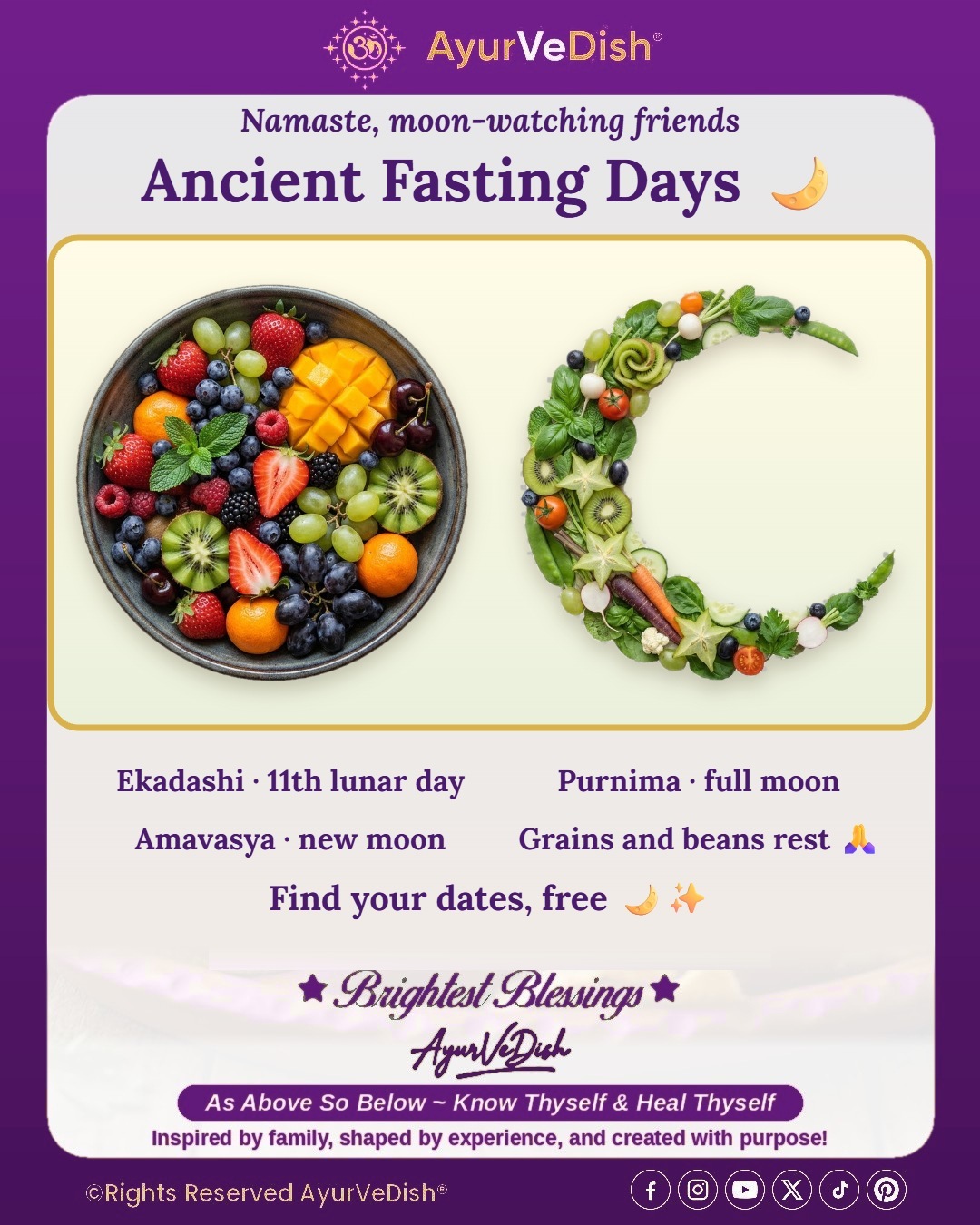
Namaste. The ancients set certain days of the lunar cycle aside for a pause from food. We call them fasting days, and our free tool shows you when they fall wherever you are.
Find Your Fasting Days 🌙
Choose your place and tap a day to see when it falls. 👇

Three Days, One Rhythm
A tithi is a lunar day, the time it takes the Moon to move 12° ahead of the Sun. There are 30 in every lunar month, 15 in each fortnight.
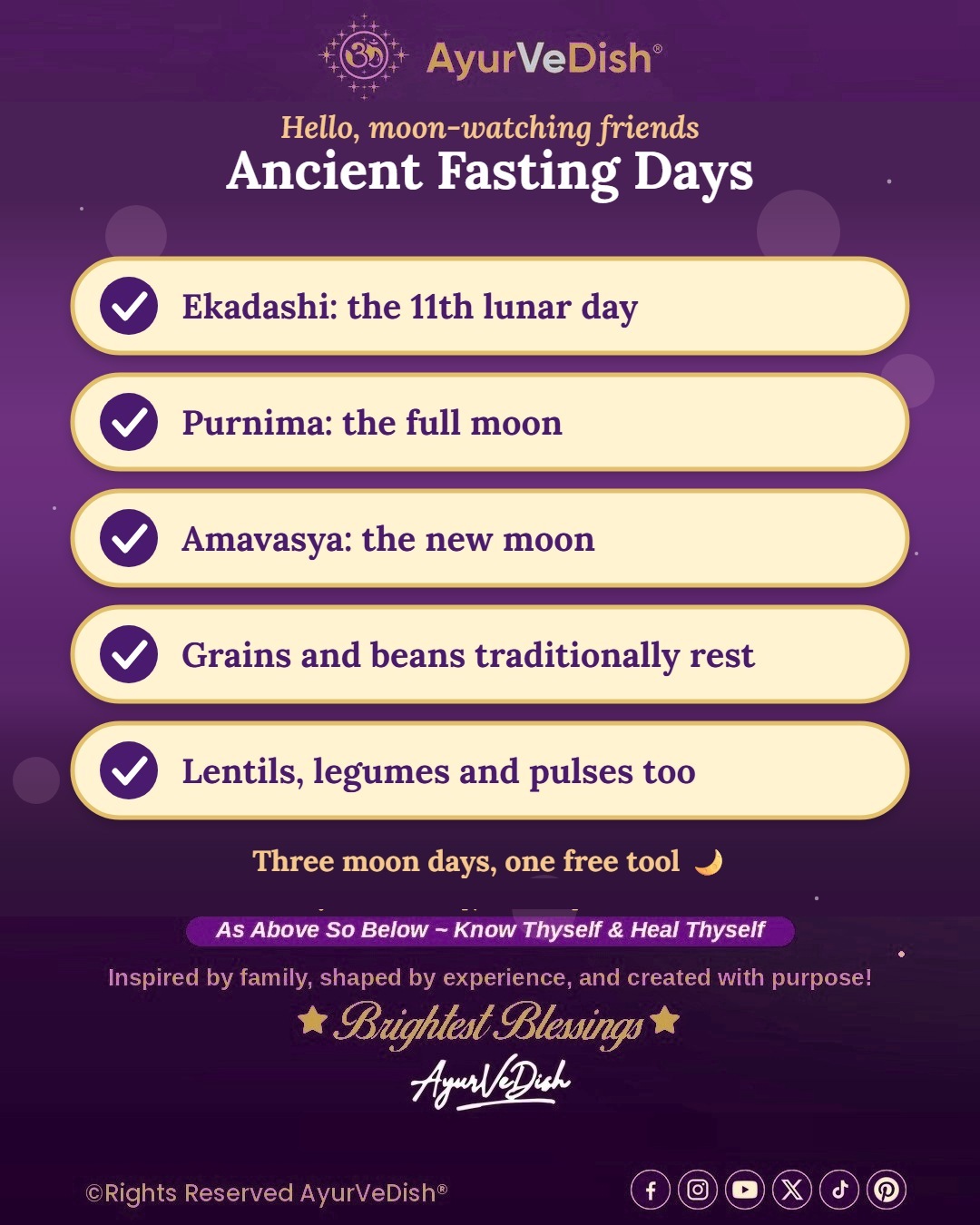
Ekadashi is the 11th tithi of each fortnight, so it comes twice a month. Known as Agyaras in Gujarati, it is the traditional fasting day. Grains and beans are traditionally avoided. Grains, beans, lentils, legumes, pulses.
Purnima is the full moon, the 15th tithi of the bright fortnight.
Amavasya is the new moon, the 15th tithi of the dark fortnight.
The Pause and Your Cells
Every cell clears out and recycles itself. This is called autophagy. Yoshinori Ohsumi identified the genes behind it, and in 2016 he won the Nobel Prize in Physiology or Medicine for his discoveries of mechanisms for autophagy.
In 2019, de Cabo and Mattson reviewed the research in the New England Journal of Medicine. In people, intermittent fasting improved glucose regulation and reduced risk factors for diabetes, cardiovascular disease and stroke.
In 2021, Patikorn and colleagues pooled 11 meta-analyses covering 130 randomised trials and found significant benefits on 28 measures, including body weight, cholesterol, blood sugar and blood pressure. The authors rated only part of that evidence as high quality.
Most of the protective effects in the 2019 review come from animal studies, and human research is still growing.
The Moon, The Waters And The Body
The Moon moves the oceans, and up to 60% of an adult body is water. Scientists are asking whether the Moon touches us too, and two studies are worth knowing.
In a 2013 study in Current Biology, researchers looked back at sleep-lab records from 33 volunteers. Around the full moon they took about 5 minutes longer to fall asleep, slept about 20 minutes less, had 30% less deep-sleep brain activity and lower melatonin. A larger 2014 study of more than 1,200 people did not find the same pattern, so the question is still open.
In 2021, a study in Science Advances followed women’s cycle diaries over many years. Women whose cycles were longer than 27 days sometimes fell in step with the Moon. The effect was weak, faded with age and with artificial light at night, and was stronger in long winter nights.
The word menses shares its root with month, and month comes from Moon. These are early findings, shared as findings, not promises. 🌙
Bringing the Pause Home
You do not need a dramatic fast. An earlier supper or a lighter day is a gentle way to begin. Read more in Fasting: The Ancient Pause.
Fasting is not for everyone. Please speak to a qualified professional before you try it.
Know someone who would love to keep the fasting days? Send them Ancient Fasting Days. 🙏
Let Food Be Thy Medicine Before Medicine Becomes Thy Food.
As Above, So Below, Know Thyself and Heal Thyself.
Inspired by family, shaped by experience, and created with purpose!
Brightest Blessings
This page is for information only. For medical advice, please speak to a qualified professional.
Evidence and Sources
- The 2016 Nobel Prize in Physiology or Medicine (NobelPrize.org): nobelprize.org/prizes/medicine/2016/press-release/
- de Cabo R, Mattson MP. Effects of intermittent fasting on health, aging, and disease. N Engl J Med 2019;381:2541-2551: pubmed.ncbi.nlm.nih.gov/31881139/
- Patikorn C et al. Intermittent fasting and obesity-related health outcomes: an umbrella review of meta-analyses of randomized clinical trials. JAMA Netw Open 2021;4(12):e2139558: pubmed.ncbi.nlm.nih.gov/34919135/
- Tithi (Wikipedia): en.wikipedia.org/wiki/Tithi
- Body water (USGS Water Science School): usgs.gov/water-science-school/science/water-you-water-and-human-body
- Cajochen C, Altanay-Ekici S, Münch M, Frey S, Knoblauch V, Wirz-Justice A. Evidence that the lunar cycle influences human sleep. Current Biology 2013;23(15):1485-1488: doi.org/10.1016/j.cub.2013.06.029
- Cordi M, et al. Lunar cycle effects on sleep and the file drawer problem. Current Biology 2014;24(12):R549-R550: doi.org/10.1016/j.cub.2014.05.017
- Helfrich-Förster C, Monecke S, Spiousas I, Hovestadt T, Mitesser O, Wehr TA. Women temporarily synchronize their menstrual cycles with the luminance and gravimetric cycles of the Moon. Science Advances 2021;7(5):eabe1358: doi.org/10.1126/sciadv.abe1358