 AyurVeDish®
About us
Why AyurVeDish ExistsAyurveda at Our HeartOur Free-From PromiseWhole Food, Plant-Based LivingWhy Grain FreeWhy Oil FreeWhy Dairy FreeWhy Yeast FreeWhy Cane Sugar FreeWhy Soy FreeWhy Thoughtful IngredientsFresh and SeasonalHerbs and SpicesFood from Around the WorldGood Food for EveryoneA Recipe Should Inspire YouEat to LiveSalt, Spice and BalanceAyurveda
Ayurveda Made SimpleThe Five ElementsThe Three DoshasVataPittaKaphaPrakritiYour Dosha CombinationEating for Your ConstitutionChoosing Foods ThoughtfullyThe Six TastesSix Tastes on One PlateFood QualitiesAgni (Fire)Herbs and Spices in the Ayurvedic KitchenEating With the SeasonsAyurveda and the Body ClockFasting: The Ancient PauseBuilding a Plant-Based Ayurvedic MealAyurveda and Modern NutritionFood Combinations and Meal PlanningShop
Speciality All-in-One BlendsGrain Free Rice-Style BlendsSnack & Savoury PremixesGrain Free FloursBakes & DessertsChutneys, Dips & PicklesTadkas & Finishing SpicesDetox & Ayurvedic TeasHot & Cold Drinks





Salt, Spice and Balance
Flavour First, Salt in Its Place
Namaste, and welcome.
Salt has been part of cooking for as long as there has been cooking. It brings out flavour, and the body needs a little of it. The art, as our ancestors knew, is balance. At AyurVeDish, flavour comes from the herbs and spices, with salt in its supporting role.
The Salt We Never See
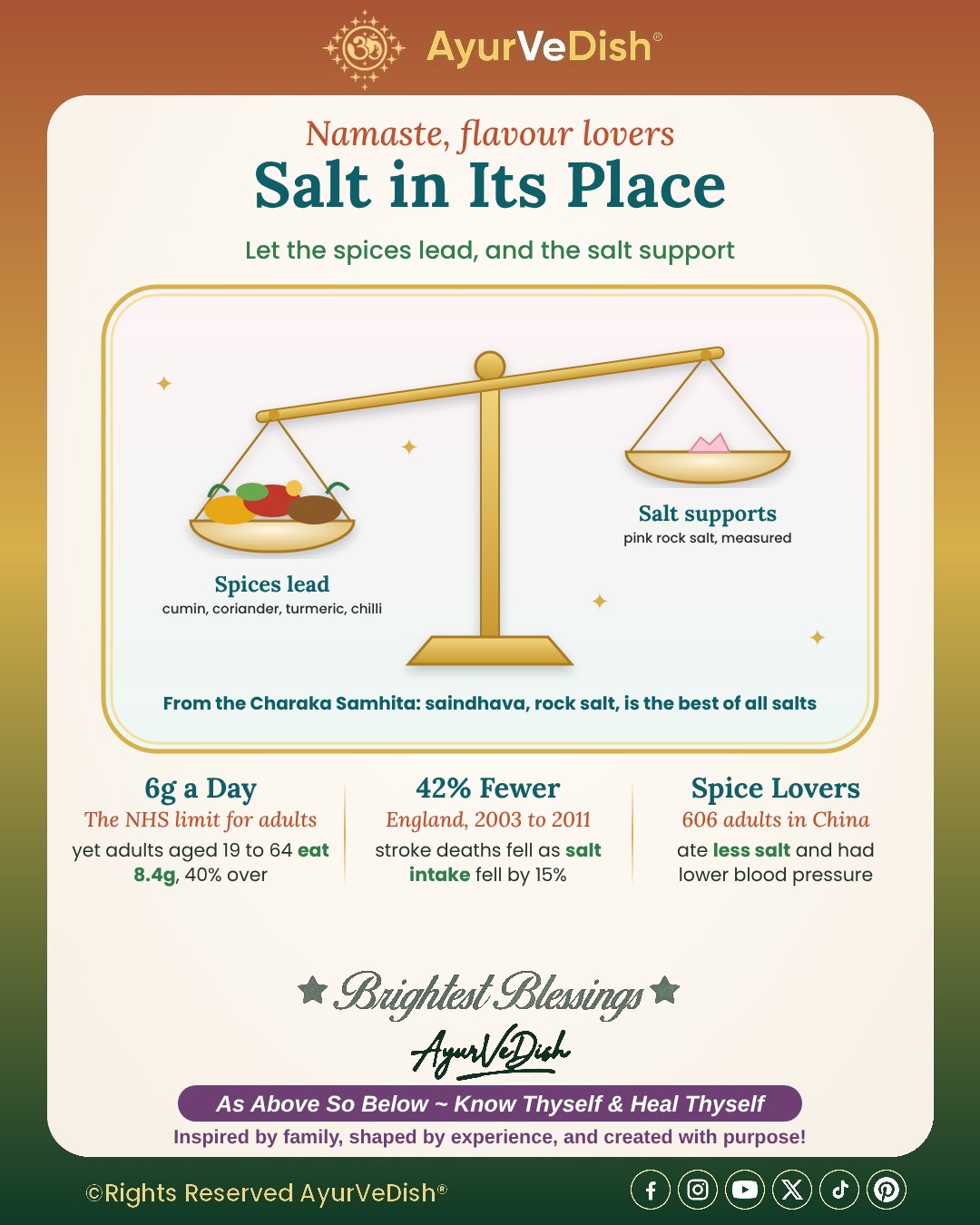
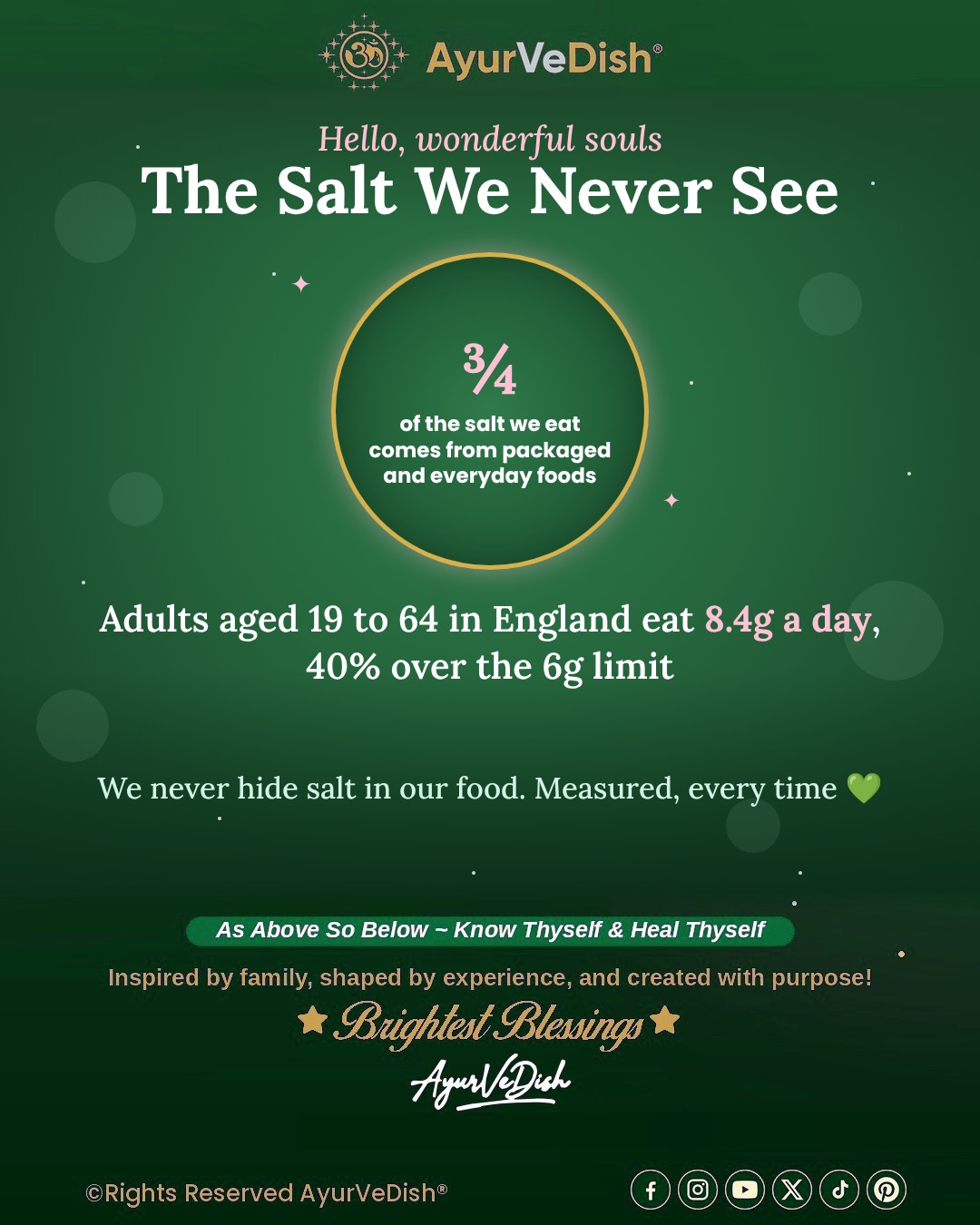
Most of the salt we eat is not the salt we add. The NHS says that around three quarters of it comes from packaged and everyday foods we buy, and that adults should have no more than 6g a day, about one level teaspoon. Yet the latest national survey found that adults aged 19 to 64 in England eat an average of 8.4g a day, 40 per cent over the limit, with men at 9.2g. White bread, bacon and ham are among the biggest sources. That is why we will never hide salt in our food.
What the Ancient Texts Say
The Charaka Samhita counts salt (lavana) among the six tastes, and it is honest about both sides. Salt, it says, is warming, sharp, moistening and relishing, and it names salt the foremost of all things that give food its relish (Sutra Sthana 25.40). But “its excessive usage causes malaise, laxity and debility in the body”, and people who use too much salt fall victim to early baldness, greying hair and wrinkles (Vimana Sthana 1.18).
The same text also ranks the salts. Saindhava, rock salt, is named the best of all salts, while salt from saline soil is named the worst (Sutra Sthana 25.38 to 39). Our ancestors valued salt, but they never believed more was better, and modern science says the same.
Our Salt: Pink Himalayan Rock Salt
We use pink Himalayan salt, a natural rock salt formed from ancient salt beds. Saindhava takes its name from Sindhu, the land of the Indus, and the pink rock salt we use is mined from the Salt Range of Pakistan, in those same Indus lands. Its soft pink colour comes from tiny traces of minerals such as iron.
Measured, Every Time
Balance is never left to chance. We measure the salt in every blend with care, so you never have to guess. Every product tells you exactly how much salt is in each spoonful and in each dose, so you can see precisely what you are getting and cook to suit your own table.
Our curry and dal blends do the seasoning for you: one 100g pouch makes about 25 portions at Mild (4g), 14 at Medium (7g) or 10 at Extra Hot (10g), each for 200g of vegetables. Our finishing spices and chutneys add flavour at the table, so the salt cellar can stay in the cupboard.
What Researchers Have Found
Less salt, lower blood pressure. In 2013, Professor Feng He and Professor Graham MacGregor of Queen Mary University of London pooled 34 trials with 3,230 people in the BMJ. Cutting salt by about 4.4g a day for at least four weeks lowered blood pressure by about 5.4/2.8 mm Hg in people with high blood pressure and by 2.4/1.0 mm Hg in people with normal blood pressure. The bigger the cut, the bigger the fall.
A whole country cuts back. Between 2003 and 2011, as food makers in England reduced the salt in their products, average salt intake fell by 15 per cent, from 9.5g to 8.1g a day. Over the same years, average blood pressure fell, deaths from stroke fell by 42 per cent and deaths from heart disease by 40 per cent. The same team found that the fall in salt is likely to have played an important part.
Spice in place of salt. In 2017, Professor Zhiming Zhu and colleagues at the Third Military Medical University in Chongqing, China, studied 606 adults. Those who most enjoyed spicy food ate less salt, and their blood pressure was about 8/5 mm Hg lower than those who enjoyed spice least. Brain scans showed why: spice boosted activity in the brain regions that sense salt, so food tasted saltier with less of it.
These are findings from studies, and results differ from person to person.
Pink Salt Is Still Salt
We want to be straightforward. Pink salt is mostly sodium chloride. In 2020, Dr Flavia Fayet-Moore and colleagues analysed 31 pink salts sold in Australia and found that you would need more than 30g a day, about six teaspoons, to get a meaningful amount of its other minerals, well above dietary guidelines. Pink salt still counts towards the 6g a day like any other salt, and it does not supply the iodine that iodised table salt does. We love it for its natural character and its gentle, rounded flavour, and we measure it carefully.
Flavour Before Salt
Spices bring warmth, colour and depth that salt alone can never give. Cumin, coriander, turmeric, ginger, cardamom and chilli each add their own character, so a dish can taste rich and satisfying without leaning on salt. That is how we cook: let the spices lead, and use salt to bring out the best in them.
Let Food Be Thy Medicine Before Medicine Becomes Thy Food.
As Above, So Below, Know Thyself and Heal Thyself.
Inspired by family, shaped by experience, and created with purpose!
Brightest Blessings

This page is for information only. For medical advice, please speak to a qualified professional.
Evidence and Sources
- Charaka Samhita, Vimana Sthana 1.18, Rasa Vimana (the qualities of salt and the harm of excess). carakasamhitaonline.com/index.php/Rasa_Vimana
- Charaka Samhita, Sutra Sthana 25.38 to 40, Yajjah Purushiya Adhyaya (the best and worst salts, and salt as the foremost relish). carakasamhitaonline.com/index.php/Yajjah_Purushiya_Adhyaya
- NHS. Salt: the facts. nhs.uk/live-well/eat-well/food-types/salt-nutrition
- Action on Salt. National Diet and Nutrition Survey: salt intake from urinary sodium in adults in England, 2018 to 2019. actiononsalt.org.uk/reformulation/salt-intake-in-the-uk/national-diet-and-nutrition-survey
- He FJ, Li J, MacGregor GA. Effect of longer term modest salt reduction on blood pressure: Cochrane systematic review and meta-analysis of randomised trials. BMJ 2013;346:f1325. doi.org/10.1136/bmj.f1325
- He FJ, Pombo-Rodrigues S, MacGregor GA. Salt reduction in England from 2003 to 2011: its relationship to blood pressure, stroke and ischaemic heart disease mortality. BMJ Open 2014;4:e004549. doi.org/10.1136/bmjopen-2013-004549
- Li Q, Cui Y, Jin R et al. Enjoyment of spicy flavor enhances central salty-taste perception and reduces salt intake and blood pressure. Hypertension 2017;70(6):1291-1299. doi.org/10.1161/HYPERTENSIONAHA.117.09950
- Fayet-Moore F, Wibisono C, Carr P et al. An analysis of the mineral composition of pink salt available in Australia. Foods 2020;9(10):1490. doi.org/10.3390/foods9101490