 AyurVeDish®
About us
Why AyurVeDish ExistsAyurveda at Our HeartOur Free-From PromiseWhole Food, Plant-Based LivingWhy Grain FreeWhy Oil FreeWhy Dairy FreeWhy Yeast FreeWhy Cane Sugar FreeWhy Soy FreeWhy Thoughtful IngredientsFresh and SeasonalHerbs and SpicesFood from Around the WorldGood Food for EveryoneA Recipe Should Inspire YouEat to LiveSalt, Spice and BalanceAyurveda
Ayurveda Made SimpleThe Five ElementsThe Three DoshasVataPittaKaphaPrakritiYour Dosha CombinationEating for Your ConstitutionChoosing Foods ThoughtfullyThe Six TastesSix Tastes on One PlateFood QualitiesAgni (Fire)Herbs and Spices in the Ayurvedic KitchenEating With the SeasonsAyurveda and the Body ClockFasting: The Ancient PauseBuilding a Plant-Based Ayurvedic MealAyurveda and Modern NutritionFood Combinations and Meal PlanningShop
Speciality All-in-One BlendsGrain Free Rice-Style BlendsSnack & Savoury PremixesGrain Free FloursBakes & DessertsChutneys, Dips & PicklesTadkas & Finishing SpicesDetox & Ayurvedic TeasHot & Cold Drinks





Why Thoughtful Ingredients
Every Ingredient Has a Purpose
Namaste, and welcome.
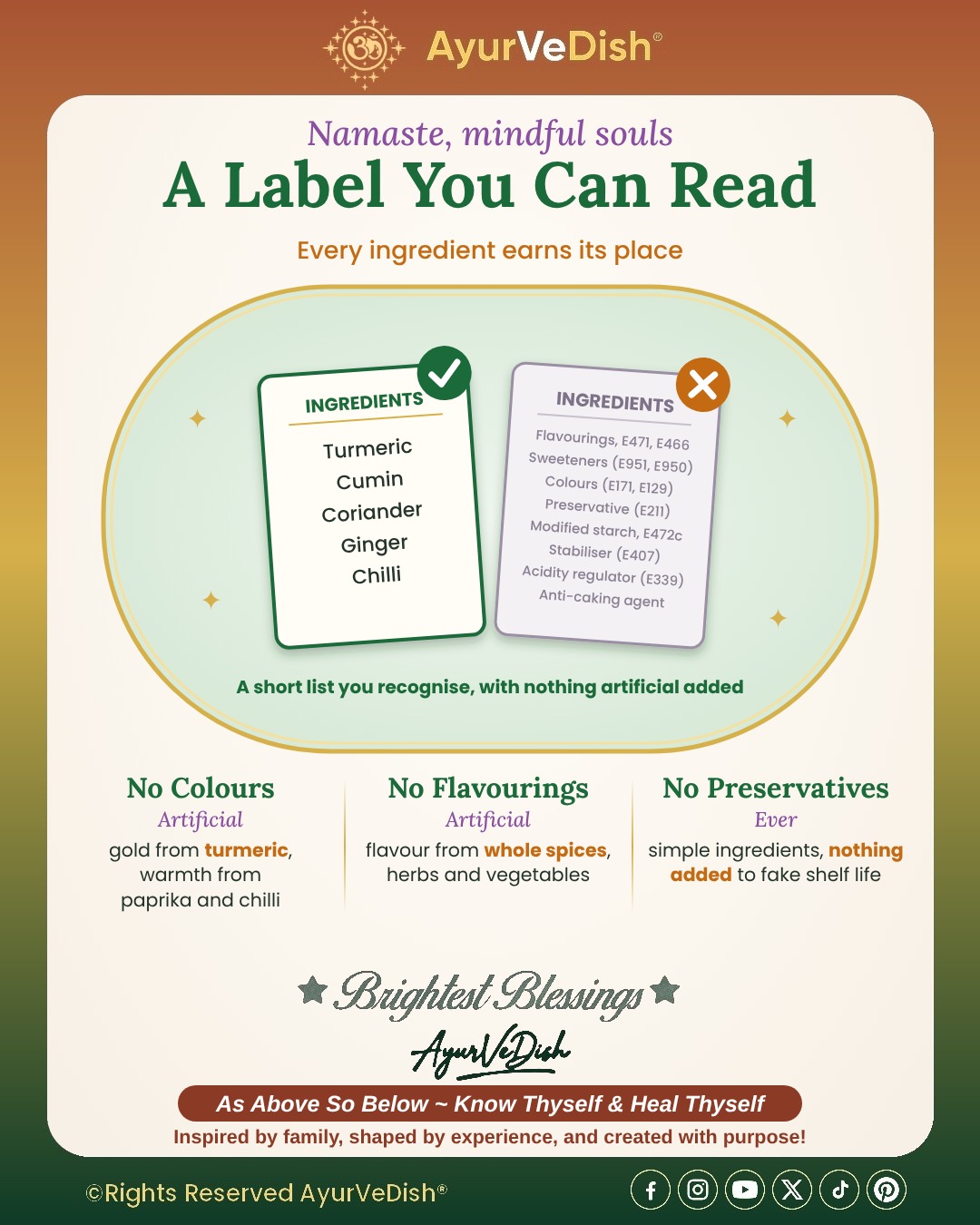
Every ingredient should earn its place. Across our whole range, from curry blends and premixes to instant chutneys, flours, finishing spices, herbal teas and plant-based hot drinks, you will find 100% plant-based recipes with no artificial flavours, no artificial colours and no preservatives.
Reading Between the Lines
A food label tells a story. The longer the list of ingredients you would never keep in your own kitchen, the further that food has travelled from nature. We value a short list you recognise, each ingredient there for a reason. No emulsifiers to hold things together, no sweeteners to fake sweetness, no colours to fake freshness.
Colour From Nature
Turmeric brings golden colour, paprika warmth, and herbs freshness, while cumin, cardamom and cinnamon give each dish its own character. Turmeric, haridra in Sanskrit, is named in the Charaka Samhita among its groups of herbs. Our ancestors coloured and flavoured their food with plants, and so do we.
What the Ancient Texts Say
The Bhagavad Gita is clear about food that has lost its life. It describes “food prepared more than three hours before being eaten, food that is tasteless, decomposed and putrid” as dear to those in the mode of darkness, tamas (Bhagavad Gita 17.10).
The ancients had no emulsifiers, no artificial sweeteners and no artificial preservatives. They had fresh food, cooked and eaten while it was still alive with flavour. Here Ayurveda and AyurVeDish stand together: food should be fresh, recognisable and whole, and nothing should be added simply to make it last longer on a shelf.
Made Easy, Made With Care
Our curry and dal blends are complete, all-in-one blends: everything is already in the pouch, so you just add your vegetables, pulses or beans and water, then cook. One 100g pouch makes about 25 portions at Mild (4g), 14 at Medium (7g) or 10 at Extra Hot (10g), each for 200g of vegetables. Our grain free premixes need only water or plant milk, then cooking. Whatever the category, the aim is the same: to make good food easier to prepare without reaching for artificial additions.

What Researchers Have Found
Emulsifiers and the heart. In a study of 95,442 French adults followed for an average of seven years, published in the BMJ in 2023, Dr Laury Sellem, Dr Bernard Srour, Dr Mathilde Touvier and colleagues in France found that higher intakes of common emulsifiers were linked to a higher risk of cardiovascular disease. They included celluloses (E460 to E468) and mono- and diglycerides of fatty acids (E471 and E472), used widely in processed foods.
Sweeteners and cancer. In the same NutriNet-Santé cohort, Dr Charlotte Debras and colleagues followed 102,865 adults and found that those who consumed the most artificial sweeteners, particularly aspartame and acesulfame-K, had a 13 per cent higher risk of cancer than those who consumed none. In 2023, the World Health Organization’s cancer agency classified aspartame as possibly carcinogenic to humans.
Banned Next Door
In 2021, the European Food Safety Authority concluded that the whitening agent titanium dioxide, E171, “could no longer be considered as safe for use as a food additive”, and the European Union banned it in food from August 2022. It remains permitted in Great Britain.
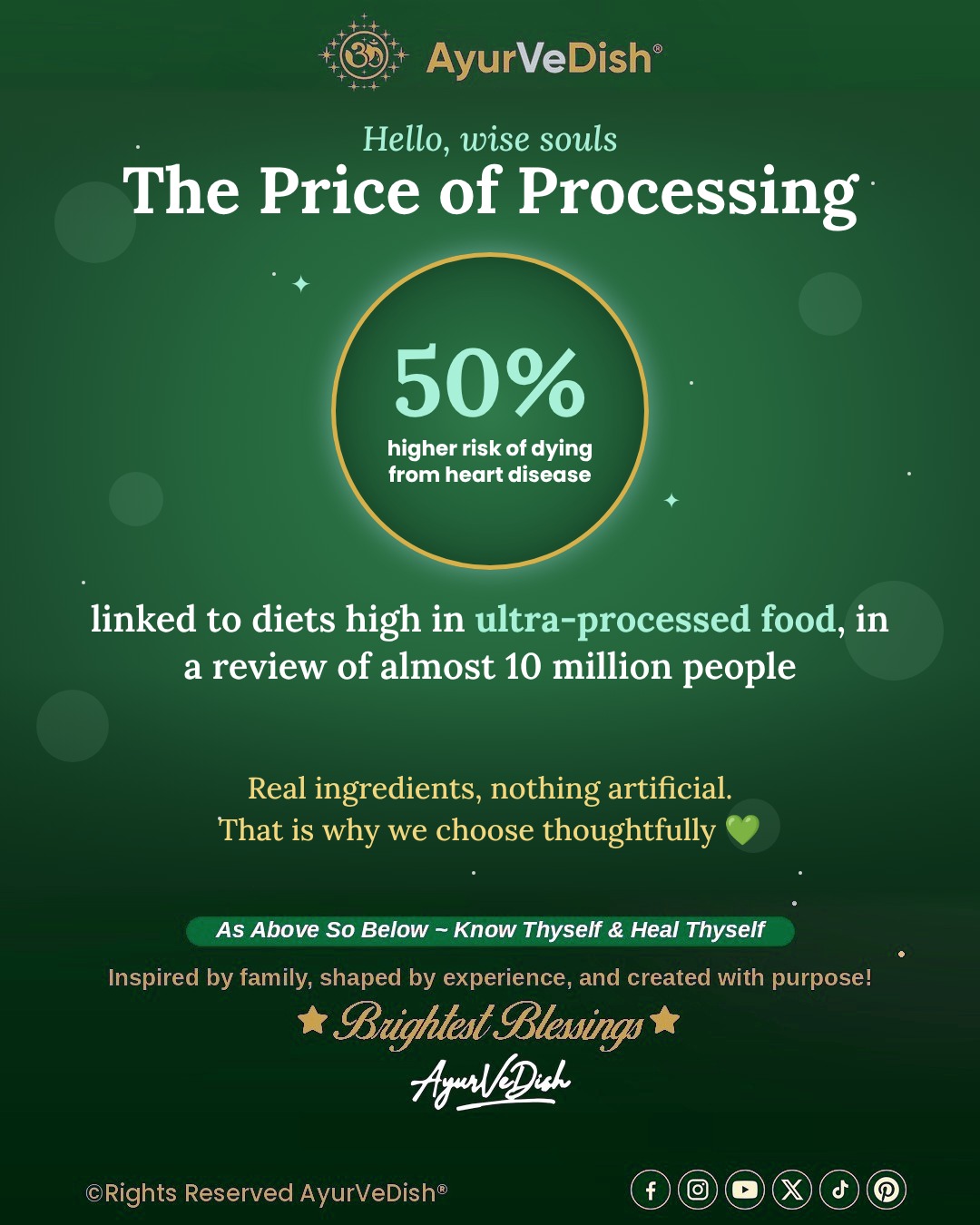
The bigger picture. In 2024, an umbrella review in the BMJ, covering 45 pooled analyses and almost 10 million people, found convincing evidence that diets high in ultra-processed food, which often contain colours, emulsifiers, flavourings and other additives, are linked to around a 50 per cent higher risk of dying from cardiovascular disease, a 48 to 53 per cent higher risk of anxiety and common mental disorders, and a 12 per cent higher risk of type 2 diabetes.
These are observational studies, but together they show why we keep additives out.
More Than a Recipe
Ingredients connect us to the people who grow them, the cultures that built the recipes and the natural world that makes our food possible. They also connect us to the animals and living creatures we share this world with, and choosing with kindness is part of how we cook.
Know your ingredients. Celebrate nature. Choose thoughtfully. Cook deliciously.
Let Food Be Thy Medicine Before Medicine Becomes Thy Food.
As Above, So Below, Know Thyself and Heal Thyself.
Inspired by family, shaped by experience, and created with purpose!
Brightest Blessings

This page is for information only. For medical advice, please speak to a qualified professional.
Evidence and Sources
- Bhagavad Gita 17.10, Bhagavad-gita As It Is. vedabase.io/en/library/bg/17/10
- Sellem L, Srour B, Javaux G et al. Food additive emulsifiers and risk of cardiovascular disease in the NutriNet-Santé cohort: prospective cohort study. BMJ 2023;382:e076058. doi.org/10.1136/bmj-2023-076058
- Inserm. Association between consumption of food additive emulsifiers and cardiovascular disease risk. 7 September 2023. presse.inserm.fr/en/association-entre-la-consommation-dadditifs-alimentaires-emulsifiants-et-le-risque-de-maladies-cardiovasculaires/67433
- Debras C, Chazelas E, Srour B et al. Artificial sweeteners and cancer risk: results from the NutriNet-Santé population-based cohort study. PLOS Medicine 2022;19(3):e1003950. doi.org/10.1371/journal.pmed.1003950
- World Health Organization. Aspartame hazard and risk assessment results released. 14 July 2023. who.int/news/item/14-07-2023-aspartame-hazard-and-risk-assessment-results-released
- Committee on Toxicity. Statement on the safety of titanium dioxide (E171) as a food additive: lay summary. cot.food.gov.uk/COT%20Statement%20on%20the%20Safety%20of%20Titanium%20dioxide%20(E171)%20as%20a%20Food%20Additive%20-%20Lay%20Summary
- Lane MM, Gamage E, Du S et al. Ultra-processed food exposure and adverse health outcomes: umbrella review of epidemiological meta-analyses. BMJ 2024;384:e077310. doi.org/10.1136/bmj-2023-077310
- BMJ Group. Consistent evidence links ultra-processed food to over 30 damaging health outcomes. 2024. bmjgroup.com/consistent-evidence-links-ultra-processed-food-to-over-30-damaging-health-outcomes
- EFSA Panel on Food Additives and Flavourings. Safety assessment of titanium dioxide (E171) as a food additive. EFSA Journal 2021;19(5):6585. doi.org/10.2903/j.efsa.2021.6585
- Charaka Samhita, Sutra Sthana 4 (haridra among the groups of herbs). carakasamhitaonline.com/index.php/Shadvirechanashatashritiya_Adhyaya