 AyurVeDish®
About us
Why AyurVeDish ExistsAyurveda at Our HeartOur Free-From PromiseWhole Food, Plant-Based LivingWhy Grain FreeWhy Oil FreeWhy Dairy FreeWhy Yeast FreeWhy Cane Sugar FreeWhy Soy FreeWhy Thoughtful IngredientsFresh and SeasonalHerbs and SpicesFood from Around the WorldGood Food for EveryoneA Recipe Should Inspire YouEat to LiveSalt, Spice and BalanceAyurveda
Ayurveda Made SimpleThe Five ElementsThe Three DoshasVataPittaKaphaPrakritiYour Dosha CombinationEating for Your ConstitutionChoosing Foods ThoughtfullyThe Six TastesSix Tastes on One PlateFood QualitiesAgni (Fire)Herbs and Spices in the Ayurvedic KitchenEating With the SeasonsAyurveda and the Body ClockFasting: The Ancient PauseBuilding a Plant-Based Ayurvedic MealAyurveda and Modern NutritionFood Combinations and Meal PlanningShop
Speciality All-in-One BlendsGrain Free Rice-Style BlendsSnack & Savoury PremixesGrain Free FloursBakes & DessertsChutneys, Dips & PicklesTadkas & Finishing SpicesDetox & Ayurvedic TeasHot & Cold Drinks





Why Oil Free
Let the Ingredients Take Centre Stage
Namaste, and welcome.
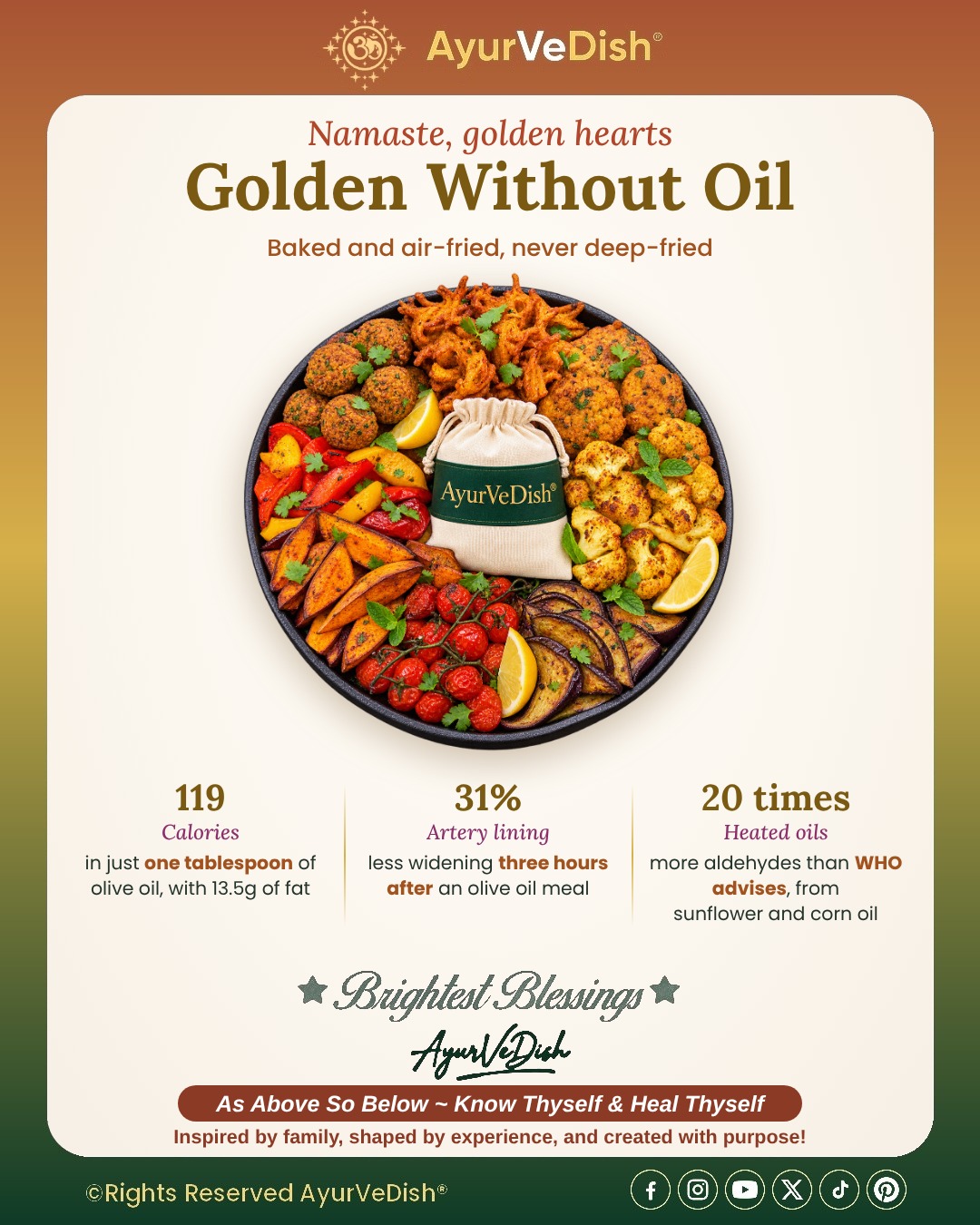
Oil has become such a familiar part of everyday cooking that many of us rarely stop to ask whether every meal needs it. At AyurVeDish, we believe it doesn’t. Every recipe is designed for air frying and oven baking. Oil is entirely optional.
Whole Foods, Not Extracted Oils
There is a real difference between eating a whole food and eating one part taken from it. Olives, seeds and avocados carry their natural fats alongside fibre and other nutrients. Pressing out the oil leaves the fat on its own, in a concentrated form. One tablespoon of olive oil carries about 119 calories and 13.5g of fat, and every gram of fat gives 9 calories, more than twice the 4 calories in a gram of carbohydrate or protein.
So we ask the ingredients to do the work. Blended beans bring creaminess, lentils bring comfort, seeds bring richness, and vegetables bring sweetness, colour and texture.
Why We Say No to Oil
Oil is often sold to us as heart healthy. We disagree. It is the most calorie-dense food in any kitchen, and it carries none of the fibre of the olive or seed it was pressed from. As the research further down this page shows, a single oily meal can impair the lining of our arteries within hours, oil breaks down into toxic compounds when it is heated, and the seed oils we were told to choose for our hearts failed the very trials meant to prove them.
What the Ancient Texts Say
The Bhagavad Gita (17.8) describes sattvic food, the food of clarity and goodness, as rasya, snigdha, sthira and hridya: juicy, unctuous, lasting and pleasing to the heart. Ayurveda values that natural richness. Our reading is that it is found in whole seeds, pulses and vegetables, just as nature made them, rather than in oil pressed out of them.
The very next verse (17.9) describes the food of rajas, passion, as too bitter, sour, salty, hot, pungent, dry and burning, and says it brings pain, grief and disease.
Ayurveda, Ghee, Oil and Today’s Kitchen
We honour Ayurveda, and we know its classic texts speak warmly of ghee. The Charaka Samhita, which took shape around 2,000 years ago, names ghee, ghrita, as the finest of all the fats it uses (Sutra Sthana 13.13), and some constitutions are traditionally given more of it than others.
But the cow of Charaka’s day is not the cow of today. She was not bred for the huge yields of modern dairy herds, nor kept pregnant and milked for most of the year. Today’s dairy cows are kept pregnant and lactating for around 300 days a year, so the milk, butter and ghee made from them carry the hormones of pregnancy. Ghee is also almost pure dairy fat, and around 60 per cent of that fat is saturated.
Ayurveda values oil too, above all sesame oil, for cooking and for massage. But the oil of its day was pressed fresh, in small amounts, in a wooden ghani turned by a bullock, from mustard, sesame or coconut. Most oil on our shelves today comes from industrial plants, where seeds are pressed and then washed with hexane, a solvent distilled from crude oil, to strip out the last of the oil. It is then refined, bleached at 90 to 110°C and steamed to take away its smell. Even cold-pressed oil, bottled and shipped, can sit on a shelf for months, and as the research below shows, any oil breaks down into toxic compounds in a hot pan.
Think about when these words were written, around 2,000 years ago. There were no fridges, no freezers and no shops full of fresh food all year round. Harvests could fail, winters were hard, and people lived on whatever the land and their animals could give them. Ghee keeps for months without a fridge, which made it precious in a hot climate with no way to keep food cold, and oil was pressed fresh, in small amounts, as it was needed. We believe that is why the texts prized them. Today we can cook with fresh whole foods every day, without relying on fats that keep.
That is why we leave out ghee and oil as firmly as we leave out dairy. We keep the wisdom of Ayurveda, and we apply it to the food in front of us today.
We love the planet we live on and every creature we share it with. We believe in the bigger order, in which every life matters, and we give 10% of our profit to Act Anukampa Jeevdaya Parivar in Ahmedabad, which cares for animals in shelters and hospitals and serves hot, fresh, sattvic meals to children in the slums.
What Researchers Have Found
Arteries after a meal. Dr Michael Greger of NutritionFacts.org, summarising the research on oil meals, describes a “significant and constant decrease in endothelial function three hours after each meal, independent of the type of oil”, whether fresh or deep fried. In 2000, Dr Robert Vogel and colleagues at the University of Maryland measured how well the main artery in the arm could widen, a sign of a healthy artery lining, in 10 healthy adults before and three hours after five different meals. Only the olive oil meal significantly reduced it, by about 31 per cent. The other four, including olive oil with a balsamic vinegar salad and olive oil with vitamins C and E, did not. The researchers credited antioxidant-rich vegetables, fruit and vinegar with the protection.
What Happens When Oil Is Heated
Cooking oils change when they meet heat and air. Here in Leicester, Professor Martin Grootveld and his team at De Montfort University have shown that heating cooking oils produces toxic compounds called aldehydes, and that the more unsaturated the oil, the more of them form. In tests for the BBC, sunflower and corn oil produced aldehydes at levels 20 times higher than the World Health Organization recommends. Even olive and rapeseed oil, the safer choices in the tests, still produced them, only in lower amounts. The International Agency for Research on Cancer has also classified the fumes from high-temperature frying as probably carcinogenic to humans.
When there is no oil in the pan, there is no heated oil to break down.
Seed Oils and the Heart
For decades we were told to swap butter for vegetable oils. Then Dr Christopher Ramsden and colleagues at the US National Institutes of Health recovered long-lost data from two major diet trials of the 1960s and 1970s, and the picture changed.
Sydney. In the Sydney Diet Heart Study, 458 men who had recently had a coronary event were told to replace saturated fat with safflower oil, rich in the omega-6 fat linoleic acid. Over about three years, their risk of dying from heart disease was 74 per cent higher than that of the men who carried on as before, and 17.6 per cent of them died, against 11.8 per cent.
Minnesota. In the Minnesota Coronary Experiment, 9,423 people were given a diet using corn oil in place of saturated fat. Their cholesterol fell by 13.8 per cent, yet deaths from heart disease did not fall. In the recovered data, every 30 mg/dL drop in cholesterol was linked to a 22 per cent higher risk of death. In the post-mortems that could be recovered, 41 per cent of those on the corn oil diet showed evidence of at least one heart attack, against 22 per cent of the others.
These trials compared seed oils with saturated fat rather than with a whole food diet, and neither showed any survival benefit from the oil.
Less reliance on added oil. More creativity with whole foods. More ways to enjoy the food you love.
Not a Drop
Dr Caldwell Esselstyn, whose patients with heart disease are followed on our Whole Food, Plant-Based Living page, writes in his programme rules: “You must not consume oil of any kind—not a drop.” In his view, the fats in oil injure the endothelium, the delicate inner lining of our arteries.
Cooking the AyurVeDish Way
Soften vegetables in a splash of water or vegetable stock. Let onion, garlic, ginger and spices release their aromas without frying. Steam, simmer, bake, roast or air fry for different flavours and textures, and lean on herbs and spices for warmth, fragrance and depth. Our grain free pakoda, dal vada and falafel premixes are made to be baked or air-fried, and our optional tadkas can be dry-toasted with a splash of water.
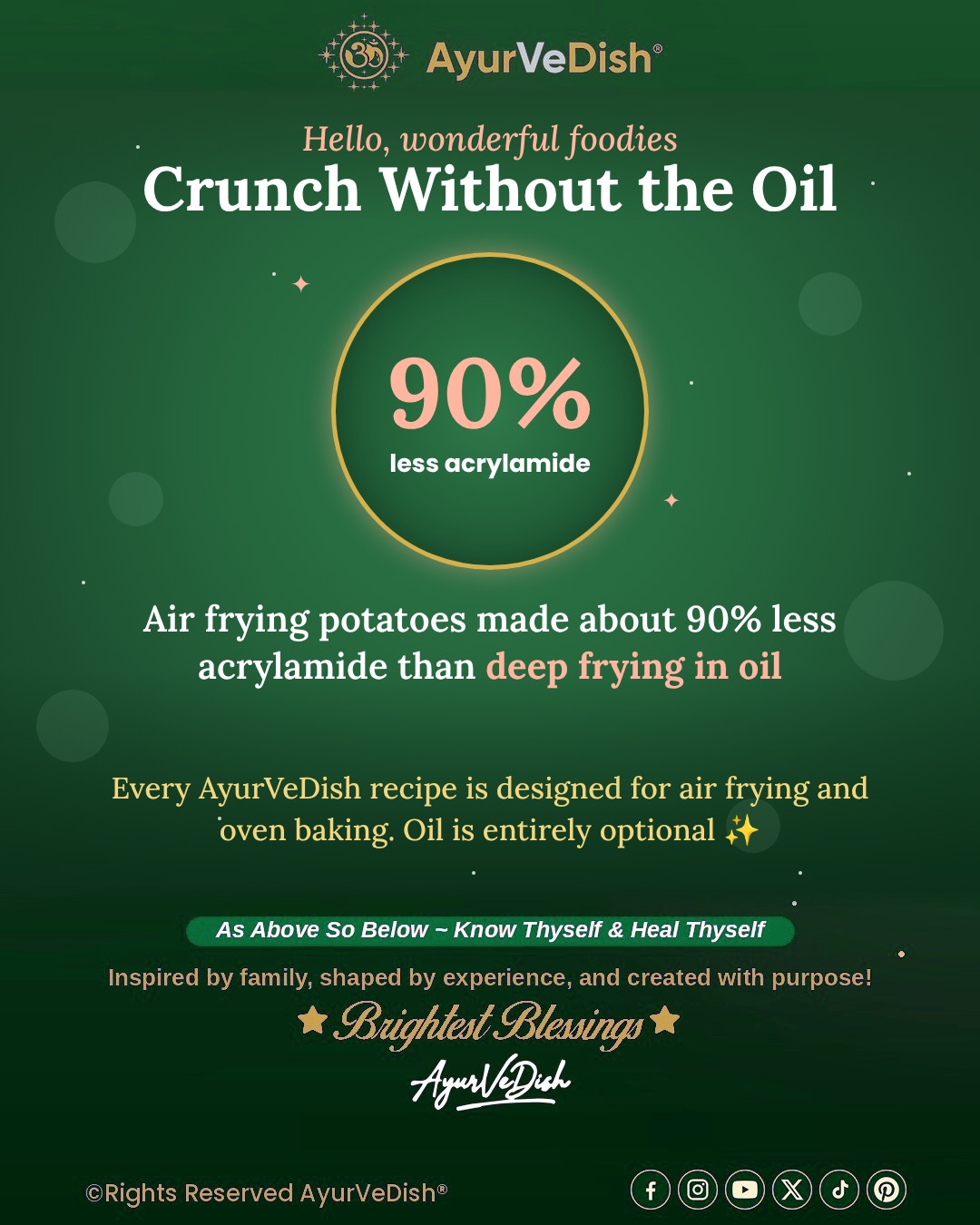
Air frying and oven baking give you the crunch without the oil. In one study at the Universitat Politècnica de València, Mariola Sansano and colleagues found that air frying potatoes produced about 90 per cent less acrylamide, a compound that forms in starchy foods at high heat, than deep frying in oil.
Let Food Be Thy Medicine Before Medicine Becomes Thy Food.
As Above, So Below, Know Thyself and Heal Thyself.
Inspired by family, shaped by experience, and created with purpose!
Brightest Blessings

This page is for information only. For medical advice, please speak to a qualified professional.
Evidence and Sources
- Bhagavad Gita, Chapter 17, verses 8 and 9. asitis.com/17/8-10.html vedabase.io/en/library/bg/17/9
- University Hospitals. Oil, olive, salad or cooking, 1 tablespoon. uhhospitals.org/health-information/health-and-wellness-library/article/nutritionfacts-v1/oil-olive-salad-or-cooking-1-tablespoon
- British Dietetic Association. Fat: food fact sheet. bda.uk.com/resource/fat.html
- Vogel RA, Corretti MC, Plotnick GD. The postprandial effect of components of the Mediterranean diet on endothelial function. Journal of the American College of Cardiology 2000;36(5):1455-1460. pubmed.ncbi.nlm.nih.gov/11079642
- Dr Caldwell Esselstyn, Prevent and Reverse Heart Disease, programme rules, via Dr Gourmet. drgourmet.com/askdrgourmet/health/heartattackproof.shtml
- Forks Over Knives. The great oil debate: experts weigh in on the health impact of plant oils. forksoverknives.com/wellness/the-great-oil-debate-experts-weigh-in-on-health-impact-of-plant-oils
- Ramsden CE et al. Use of dietary linoleic acid for secondary prevention of coronary heart disease and death: evaluation of recovered data from the Sydney Diet Heart Study and updated meta-analysis. BMJ 2013;346:e8707. doi.org/10.1136/bmj.e8707
- Ramsden CE et al. Re-evaluation of the traditional diet-heart hypothesis: analysis of recovered data from Minnesota Coronary Experiment (1968-73). BMJ 2016;353:i1246. pmc.ncbi.nlm.nih.gov/articles/PMC4836695
- Dr Michael Greger, NutritionFacts.org. Olive oil and artery function. nutritionfacts.org/video/olive-oil-and-artery-function
- De Montfort University Leicester. DMU research on healthiest cooking oils revealed on BBC’s Trust Me, I’m a Doctor. 2015. dmu.ac.uk/about-dmu/news/2015/july/dmu-research-on-healthiest-cooking-oils-revealed-on-bbcs-trust-me,-im-a-doctor.aspx
- Grootveld M et al. Potential adverse public health effects afforded by the ingestion of dietary lipid oxidation product toxins: significance of fried food sources. Nutrients 2020;12(4):974. doi.org/10.3390/nu12040974
- Grootveld M. Evidence-based challenges to the continued recommendation and use of peroxidatively-susceptible polyunsaturated fatty acid-rich culinary oils for high-temperature frying practises. Frontiers in Nutrition 2022;8:711640. doi.org/10.3389/fnut.2021.711640
- International Agency for Research on Cancer. IARC Monographs Volume 95: Household Use of Solid Fuels and High-temperature Frying. 2010. publications.iarc.who.int/113
- Sansano M, Juan-Borrás M, Escriche I, Andrés A, Heredia A. Effect of pretreatments and air-frying, a novel technology, on acrylamide generation in fried potatoes. Journal of Food Science 2015. doi.org/10.1111/1750-3841.12843
- Charaka Samhita, Sutra Sthana 13.13 (ghrita, ghee, as the best of the fats). siva.sh/caraka-samhita/sutra-sthana/13/11-15
- Harvard Magazine. Modern milk (Dr Ganmaa Davaasambuu). 2007. harvardmagazine.com/2007/05/modern-milk-html
- USDA FoodData Central. Butter oil, anhydrous (ghee). fdc.nal.usda.gov
- Penn State Extension. Processing edible oils (hexane extraction, refining, bleaching and deodorising). extension.psu.edu/processing-edible-oils
- Banglapedia. Ghani, the traditional wooden oil press. en.banglapedia.org/index.php/Ghani